
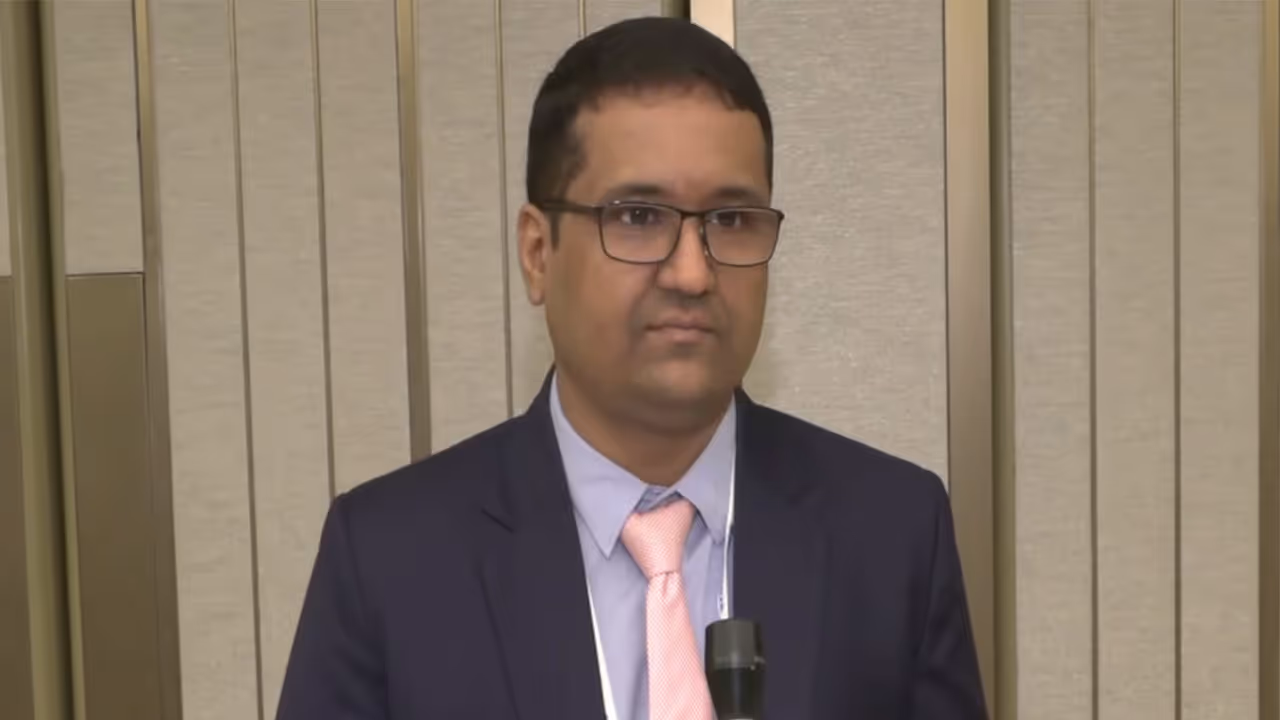
BCG's Hardik Shah said AI will reshape Indian banking but requires stronger governance and cybersecurity. He warned of massive cyber risks and called for industry-wide infrastructure and investment to ensure responsible and secure adoption of the technology.
Artificial intelligence is set to reshape India's banking sector over the next decade, but banks, regulators and the government will need to strengthen governance, cybersecurity capabilities and shared infrastructure to ensure responsible and secure adoption of the technology, said Hardik Shah, Managing Director and Partner at Boston Consulting Group (BCG).
Speaking to ANI on the sidelines of FIBAC 2026, Shah said the rapid adoption of AI would require the banking industry to fundamentally rethink processes rather than merely automate individual tasks, while maintaining strong controls and human accountability.
Strengthening Cybersecurity Posture
"Cyber risk is a massive potential hurdle" with the use of AI, Shah said, adding that the cost of creating cyberattacks has fallen 17-fold and the speed of attacks has increased significantly. "This is one area where banks, the regulator, the government together has to come together and completely overhaul the cyber security posture of the industry," he said.
Shah said cybersecurity cannot be treated as an issue that individual banks can address in isolation, calling for higher investments, stronger capabilities and shared utilities at the industry level. "I think this is not an area where one bank can individually safeguard themselves. It'll have to be a common utility, it'll have to be together as an industry level infrastructure and investment," he said.
AI Governance and Innovation
On AI governance and explainability, Shah said banks would need to build on the controls traditionally used for predictive models in underwriting and extend them to generative AI systems. Banks should embrace regulatory frameworks around responsible AI and establish adequate controls and governance mechanisms, while also upskilling risk, analytics and other professionals to manage AI-related risks, he said.
Advocating for an AI Sandbox
Shah also advocated creating an AI sandbox similar to the infrastructure developed around India's digital public infrastructure, including the Unified Lending Interface (ULI) and Account Aggregator framework. He said a third-party and fourth-party vendor registry, along with protocols and accreditation processes, could allow banks to experiment with AI in controlled environments while accelerating innovation.
Democratising Access to Credit
AI could also help democratise access to credit for small businesses and agriculture by lowering the high operating costs associated with servicing smaller loans, Shah said. While nearly 80 per cent of India's adult population now has access to credit, entry-level products can carry interest rates of 20-25 per cent, partly because operating costs are two to three times the credit cost.
Shah said banks must reshape entire processes around AI to unlock productivity gains, rather than simply automating individual steps. (ANI)
(Except for the headline, this story has not been edited by Asianetnews Editorial staff and is published from a syndicated feed.)