
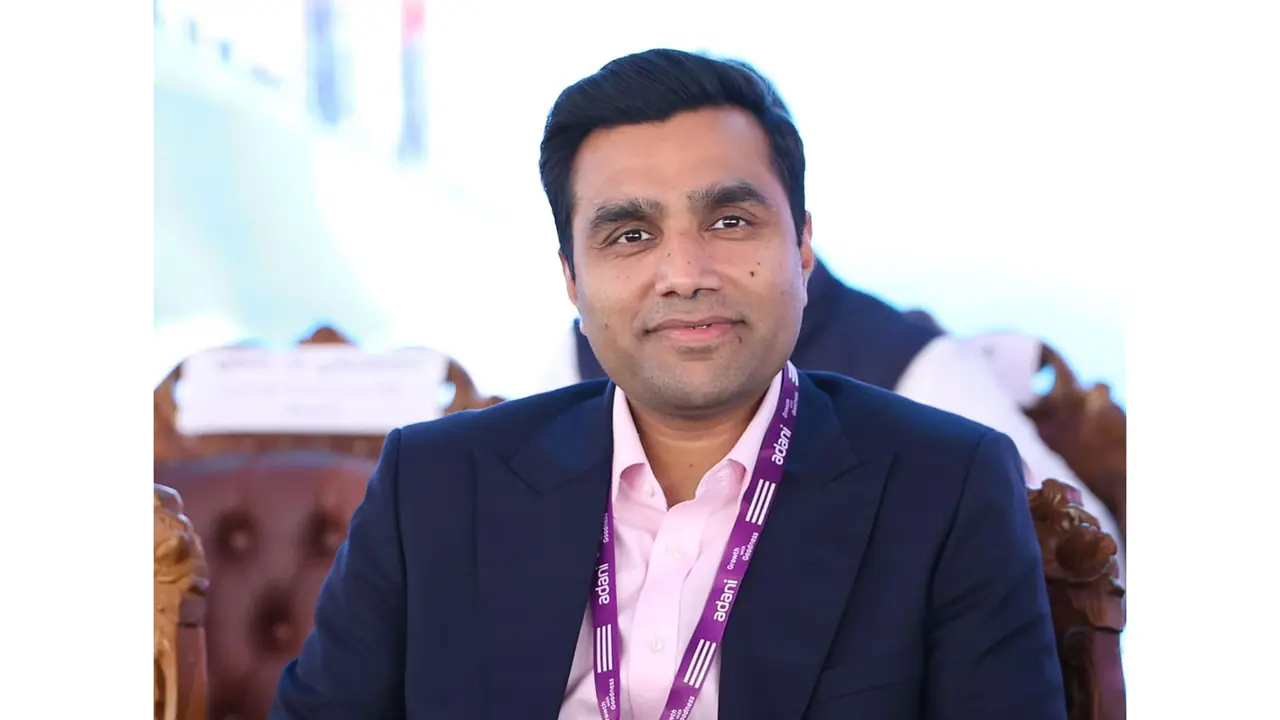
The Adani Group will invest Rs 2 lakh crore annually for the next five years in greenfield infra projects like renewable energy, airports, and logistics, Karan Adani announced, aiming to boost India's energy self-reliance and logistics networks.
The Adani Group plans to invest Rs 2 lakh crore in greenfield infrastructure projects annually over the next five years, spanning renewable energy, transmission, airports, logistics and data centres, Karan Adani, Managing Director (MD), Adani Ports and Special Economic Zone (APSEZ) has said.
Strategic Rationale Amid Global Disruptions
Speaking at the India Today conclave here, Karan Adani spoke of the need to make India self-reliant from an energy import perspective. He said resilient infrastructure and logistics networks will be critical to sustaining economic growth as global supply chains face recurring disruptions from geopolitical tensions and shifting trade routes.
Karan Adani, who is also Director, Adani Cement, noted that the ongoing crisis in West Asia has highlighted the vulnerability of global trade routes passing through key maritime choke points such as the Strait of Hormuz, the Suez Canal and the Strait of Malacca. Disruptions along these corridors can quickly ripple across global supply chains, reinforcing the need for stronger logistics infrastructure and diversified trade networks.
Karan Adani added that the infrastructure platforms built by the Adani Group are national assets that strengthen India's trade, logistics and energy security.
Speaking during a fireside conversation at the conclave that brings together leaders from politics, business, technology and culture, Adani said disruptions since 2020 -- from the Covid-19 pandemic to geopolitical conflicts -- have reshaped global trade and supply chain strategies. "Supply chains have faced continuous shocks over the past few years. In such an environment, countries must build strong logistics networks and resilient infrastructure," he said.
Karan Adani said the Adani Group's infrastructure strategy reflects this paradigm shift. By building platforms across ports, logistics, energy and airports, the Group aims to strengthen India's capacity to support trade, manufacturing and economic growth. "We strongly believe in the India story. We know the assets we are building and the role they can play in the country's future," he said.
According to Karan Adani, the Group's long-term aspiration is to become the country's most efficient logistics provider and among the cheapest generators of power while maintaining strong corporate governance. Reducing logistics costs remains a key priority. Stronger integration between ports, transport utilities, airports and logistics networks can significantly improve supply chain efficiency. "Once infrastructure is built, trade follows," he said.
Rs 2 Lakh Crore Annual Capex Plan
To support this vision, the Adani Group plans to invest Rs 2 lakh crore in greenfield infrastructure projects annually over the next five years, spanning renewable energy, transmission, airports, logistics and data centres.
Group Transformation to Manage Growth
Karan Adani also spoke about the need to cut management layers in the Group as it has grown in size. "Today we have a Capex plan of two lakh crores annually for the next five years....so when we look at this kind of growth that we are doing, we looked at ourselves first: What is the risk? Where are we going? Are we doing it in the right way? Are we doing it in the best excellence way? And one of the things that we realised is, it was okay when we were smaller, but now as the Group, the kind of growth that we are envisaging, it is going to be unsustainable for us to continue the way we are operating," he said.
"And when we look at ourselves in the mirror, we do feel that we've become quite slow. We've become quite heavy, we've become slow, decisions have become slower. So that's where we are going through this whole transition or, I would say, transformation as an organisation, where it's a unique transformation that we are going towards where we are looking at partnership models, where we are going to be partnering with multiple companies to help us in terms of Capex execution or O&M execution," he added.
Expansion Across Core Verticals
Renewables remain a core capability for the Adani Group, alongside emerging technologies such as battery storage. The Group is also expanding its presence in materials such as cement, aluminium, copper and defence manufacturing, sectors that support large-scale infrastructure development.
In aviation, the Group plans to increase passenger handling capacity across its airport network from 100 million to about 200 million by 2030. With APSEZ operating international assets, including Haifa Port in Israel, the company has had to adapt to shifting trade patterns while maintaining cargo operations. Karan Adani said many global companies are increasingly moving towards regional supply chains to improve resilience.
Portfolio Goals for 2030
Looking ahead, the Adani portfolio aims by 2030 to double port capacity from 600 million metric tonnes (MMT) to 1,200 MMT, expand renewable energy capacity from 18 gigawatts to 50 gigawatts (GW), and increase thermal power generation from 17 GW to 45 GW.
Guided by Values and Core Competencies
Karan Adani said growth must also be guided by values. "Speed and scale are important, but empathy and responsibility are equally essential," he said, echoing Chairman Gautam Adani's emphasis on purpose-driven leadership. He acknowledged the influence of both his parents, describing the Chairman's leadership as a constant inspiration and highlighting the stellar social work of Dr Priti Adani through the Adani Foundation in education, healthcare and sustainable livelihoods. "Our focus remains clear," he said. "We believe deeply in the India story and are committed to building assets that contribute to the country's long-term development."
Focus on Three Key Verticals
Answering a query, Karan Adani said the Adani Group is very focused and knows its strengths. "If you look at the group, we are in three big verticals, if I have to club it. The first is the whole energy piece, where as a group we believe that we have to generate energy which is cheapest for the consumer. To prioritize what the government is looking from a long-term perspective. So, that's where in the energy vertical, we are fully integrated--whether it's the transmission, distribution, generation. In generation, it is thermal, we started renewable, now we are starting battery storage. So basically, we keep developing and focus on the energy that is our core competence and obviously next is the data center that we've just announced," he said.
"The second big part of the group is the whole ports, logistics, transport utility...And the third big vertical for the group is the whole materials and science part...even the defence--that falls part of the materials business. That's how you should look at the Group. We are very focused, we know where our core competency is, and that's how we are structured," he added.
(Except for the headline, this story has not been edited by Asianet Newsable English staff and is published from a syndicated feed.)
