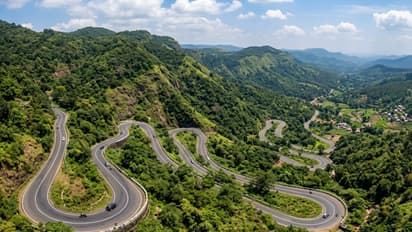
Why are many roads designed with curves instead of straight stretches? Discover how engineers account for terrain, slopes, vehicle speed, visibility and road safety when planning road layouts.
Drivers experience many twists and turns on regular road journeys. Mountain roads feature continuous snake-like curves for miles. We sometimes wonder why engineers avoid straight lines even for short stretches. A straight road seems like the fastest way to reach any place. Engineers actually follow strict scientific principles to design these curved paths. Road construction teams evaluate vehicle safety, land conditions, and environmental impact before laying the asphalt. These interesting reasons explain why straight roads are quite rare.
25
Is There So Much Science Behind Road Bends?
Engineers cannot construct completely straight roads, from massive highways to village cement streets. Planners sometimes add unnecessary curves to straight paths for a specific scientific reason. Drivers face very little work on a completely straight road for kilometers. They just drive in top gear while holding the steering wheel. This boring routine pushes drivers into a dangerous condition called Highway Hypnosis. They can easily fall asleep and cause major accidents.
What is Highway Hypnosis?
The driver's mind enters an autopilot mode due to the constant engine sound and straight white lines. Eyes remain open, and hands control the steering wheel perfectly. The brain, however, stops processing the surroundings completely. Drivers often say they do not remember how they drove the last 10 to 20 kilometers. Reaction time drops drastically during sudden braking needs in this state. Engineers introduce curves to break this trance and keep drivers alert. Drivers must also take a rest break every two hours during long journeys. You should park safely and sleep instead of just listening to music if you feel drowsy.
35
More Reasons Why Roads Are Built With Curves
Crossing hills and valleys
Terrain conditions force engineers to design curved roads in many areas. Construction teams can lay straight roads easily on flat plains. Hills, deep valleys, and massive boulders make straight roads impossible. A straight road up a mountain creates a very steep slope. Vehicles struggle to climb such steep paths safely. Heavy vehicles face massive brake pressure while coming down these straight slopes. Engineers design curved Ghat roads around the hills to solve this problem. The road length increases, but the slope becomes manageable for all vehicles.
Road design for reducing accidents
Planners give top priority to vehicle safety during road construction. Terrain is just one reason for avoiding straight roads. Vehicle speed and control at curves also matter heavily. Curves do not automatically make a road safe. Engineers calculate curve angles, turning radius, road slope, and sight distance carefully. Drivers must see the road ahead clearly at every turn to avoid accidents.
Would Vehicles Travel Faster If Roads Were Straight?
Drivers naturally increase their vehicle speed on long and straight highways. Clear visibility of the road ahead makes some people drive recklessly. Engineers do not use dangerous curves just to control this speeding habit. Vehicles will lose control if drivers do not slow down at sharp turns. Planners install speed limits, warning boards, rumble strips, and speed breakers for safety instead. Road design, maintenance, and driver behavior matter more than just straight or curved paths.
Reducing construction costs
A straight road requires clearing every single obstacle in its path. The route might cut through residential areas, commercial buildings, industries, farmlands, or forests. Land acquisition, compensation payments, and environmental clearances increase the project budget massively. Engineers also need to build expensive bridges and tunnels for straight paths. Planners choose curved alternative routes to reduce costs, minimize environmental damage, and avoid public inconvenience. They calculate route length, soil type, bridge requirements, and land prices before finalizing the map.
55
The Nature Of The Terrain Also Plays A Key Role
Construction teams must check soil strength before laying any road. Planners analyze water flow patterns and land sinking risks carefully. Wetlands, flood plains, and weak soils require special foundations and drainage systems. The road will sink or break without these proper engineering setups. Engineers conduct thorough soil tests to finalize the safest route. They change the path or add extra engineering support based on these test results.
Crossing rivers, lakes, and forests is not easy
A straight line on a map does not work in reality. Rivers, lakes, ponds, and flood zones block straight paths constantly. Rivers need expensive bridges, and mountains require long tunnels. Straight roads through forests also divide wildlife habitats dangerously. Planners evaluate travel distance, flood risks, environmental impact, and construction costs before finalizing the curved routes.