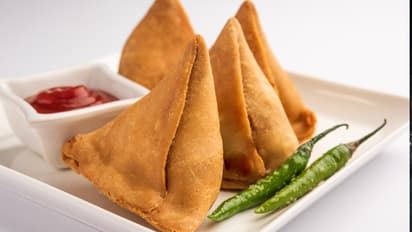
Today is September 5th, which is not just Teachers' Day in India, but also World Samosa Day! It's pretty shocking to learn that the humble street-side samosa was once a royal delicacy.
September 5th is World Samosa Day! The extraordinary history of an ordinary snack
For centuries, India has had trade and migration links with its neighbours. This cultural exchange with West and Central Asia heavily influenced our food. That's how the samosa became popular in India. Today, this snack has many local names and forms across the country, with the aloo samosa being the most popular and loved version.
210
The samosa is not from India; how did it arrive?
Food historians say the earliest forms of the samosa were found in West and Central Asia, centuries before it became popular in India. Traders, travellers, and cooks carried this snack to different regions, and that's how it became a part of South Asian food culture. Before it was called 'samosa', it had names like 'sanbosag', 'sanbusak', and 'sanbusaj', all linked to the Persian word 'sanbosag'.
310
The history of the samosa is very old!
Every year, September 5th is celebrated as World Samosa Day. While we love the potato and pea filling today, the original samosas were very different. Historical records show they were stuffed with minced meat, onions, dry fruits, and various spices. The filling changed depending on the region where it was made.
The famous poet and scholar Amir Khusru mentioned a samosa-like snack in his writings around 1300 AD. He wrote about a dish enjoyed by princes and nobles, which was filled with meat, ghee, and onions. This shows that a version of the samosa was already part of the royal food culture in the Indian subcontinent centuries ago.
510
The samosa, now a street food, was once a royal dish!
The famous Moroccan traveller Ibn Battuta visited the court of Delhi's Sultan Muhammad bin Tughlaq in the 14th century. He wrote about a snack called 'sambusak' served at the court. It was filled with minced meat, almonds, pistachios, walnuts, onions, and spices. It's amazing to think that today's cheap street food was once served on a king's dining table!
610
Not just the samosa, the potato is also not from India!
Here's another interesting fact: the potato is not native to India either! Its origin is in South America, from where it spread to the rest of the world. This means the popular aloo samosa we eat today could not have been the original version. Potatoes became a popular filling in India only later, thanks to their low cost and ability to absorb spices well.
710
India gave the samosa a new form
The most interesting part of the samosa's story isn't where it came from, but how India transformed it. Indian cooks adapted the snack to local tastes using ingredients like potatoes, peas, chillies, coriander, cumin, and ginger. This is how a foreign snack found a unique place in Indian food culture.
810
There are many types of samosas in India
The basic idea of a crispy pastry with a spicy filling has inspired many local snacks. For example, Bengal has the popular 'shingara'. In Hyderabad, 'lukhmi' is famous. Goa's 'chamuça' shows a mix of Portuguese and Indian influences. As the region changes, so do the ingredients, shape, and spices.
910
Why do Indians love samosas?
The samosa is popular for many reasons. It's affordable, easy to carry, and very filling. You can have it as a quick snack with tea, a starter at parties, or just as a street-side treat. The combination of a crispy outer layer and a soft, spicy filling is simply perfect. Plus, it can be easily adapted with vegetarian, non-vegetarian, spicy, or even sweet fillings.
1010
What is usually served with samosas?
In India, people commonly serve samosas with green chutney and green chillies. Depending on the region and taste, you might also get tamarind chutney, sweet and sour chutney, yogurt, chole (chickpea curry), chopped onions, or fresh coriander. But as most Indians will tell you, the combination is incomplete without a hot samosa and a cup of hot tea!