
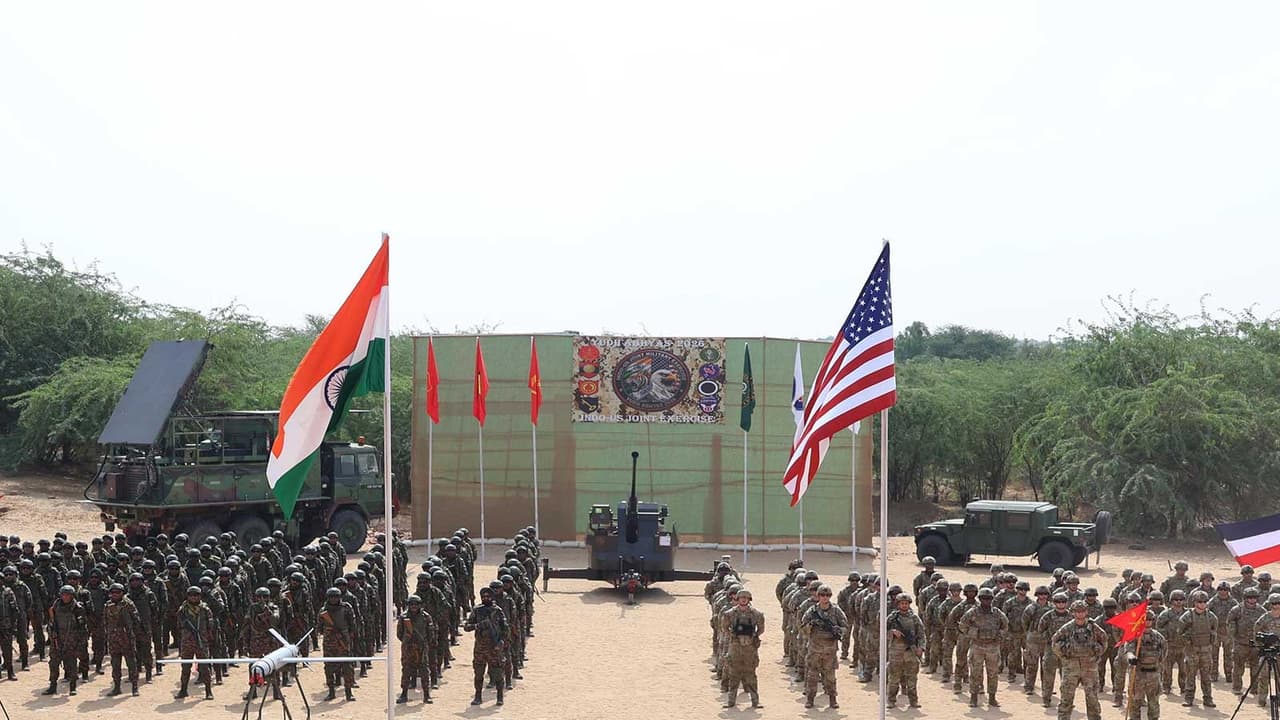
US Ambassador Sergio Gor lauded the ongoing India-US military exercise, Yudh Abhyas 2026, for strengthening interoperability and preparing the two forces for emerging future challenges, including high-altitude operations and unmanned threats.
Strengthening Interoperability for Future Challenges
US Ambassador to India Sergio Gor on Saturday highlighted the role of the ongoing India-US military exercise Yudh Abhyas 2026 in strengthening interoperability and preparing the two forces for emerging future challenges. In a post on X, Gor said, "Yudh Abhyas prepares US and Indian forces to meet present and future challenges!"
Gor made the remark as he reposted a post by the US Embassy in India which highlighted the training being undertaken by the two forces during the 22nd edition of the bilateral exercise. "US and Indian armed forces are training side by side to strengthen interoperability, share expertise, and enhance readiness. From high-altitude operations and disaster response to countering emerging unmanned threats, exercise Yudh Abhyas prepares both forces to meet present and future challenges," the post read.
Exercise Scope and Focus
The exercise commenced on September 15 and is being conducted simultaneously at the Auli Foreign Training Node in Uttarakhand and the Mahajan Field Firing Range in Rajasthan. The 22nd edition brings together around 600 personnel from each side and is focused on enhancing joint military capabilities, interoperability and coordination.
The exercise is centred on the employment of Integrated Battle Groups in mountainous and semi-mountainous terrain, with an emphasis on infantry-dominated operations. Technology infusion is also a key component, with the two armies training with drones and autonomous systems for surveillance and reconnaissance and exchanging expertise on emerging technologies and multi-domain warfare.
Consistent US Endorsement
Earlier on Tuesday, Gor had described the exercise as a "great partnership" while reposting a US Pacific Command post announcing the opening of Yudh Abhyas 2026. The US Pacific Command had said the two armies had officially opened the exercise at a ceremony on September 15, beginning two weeks of bilateral training focused on readiness, interoperability and cooperation.
The exercise includes personnel from the US Army's 11th Airborne Division and Indian Army contingents. On September 16, Gor had also highlighted the training objectives, saying in a post on X, "Over the next two weeks, U.S. and Indian soldiers will train together, sharing skills, building readiness, and improving collaboration between our forces."
Live-Fire Drills and Tactical Exchange
The remarks came after the US Embassy in India said that the 22nd edition of Yudh Abhyas was underway, with the two forces scheduled to undertake field training, live-fire exercises and exchanges of expertise and experience. The exercise subsequently moved into practical training activities at Mahajan.
On Wednesday, Indian and US Army personnel conducted a lecture-cum-demonstration on the deployment of the M777 Ultra-Light Howitzer at the Mahajan Field Firing Range. According to an official update, the session covered duties of key appointments, gun deployment, local defence coordination, movement to alternate positions during counter-bombardment and "shoot-and-scoot" drills. The activity also enabled personnel from the two armies to exchange field-level practices and coordinate artillery tactics.
The Ministry of Defence has said the exercise provides both armies an opportunity to share tactics, techniques and procedures and improve their ability to conduct coordinated operations across varied terrain and operational environments. The training programme also includes a brigade-level command-post exercise, field training, expert discussions, mountain and cold-weather operations and counter-unmanned aircraft system training at Auli.
At Mahajan, the US Army has said the exercise includes live-fire training involving systems such as HIMARS, Stinger and the Mobile Low, Slow, Small Unmanned Aircraft Integrated Defeat System. The exercise reflects the continued expansion of operational interaction between the Indian and US armies, with the current edition combining high-altitude and desert environments with training focused on conventional fires, unmanned systems and multi-domain operations. (ANI)
(Except for the headline, this story has not been edited by Asianetnews Editorial staff and is published from a syndicated feed.)