
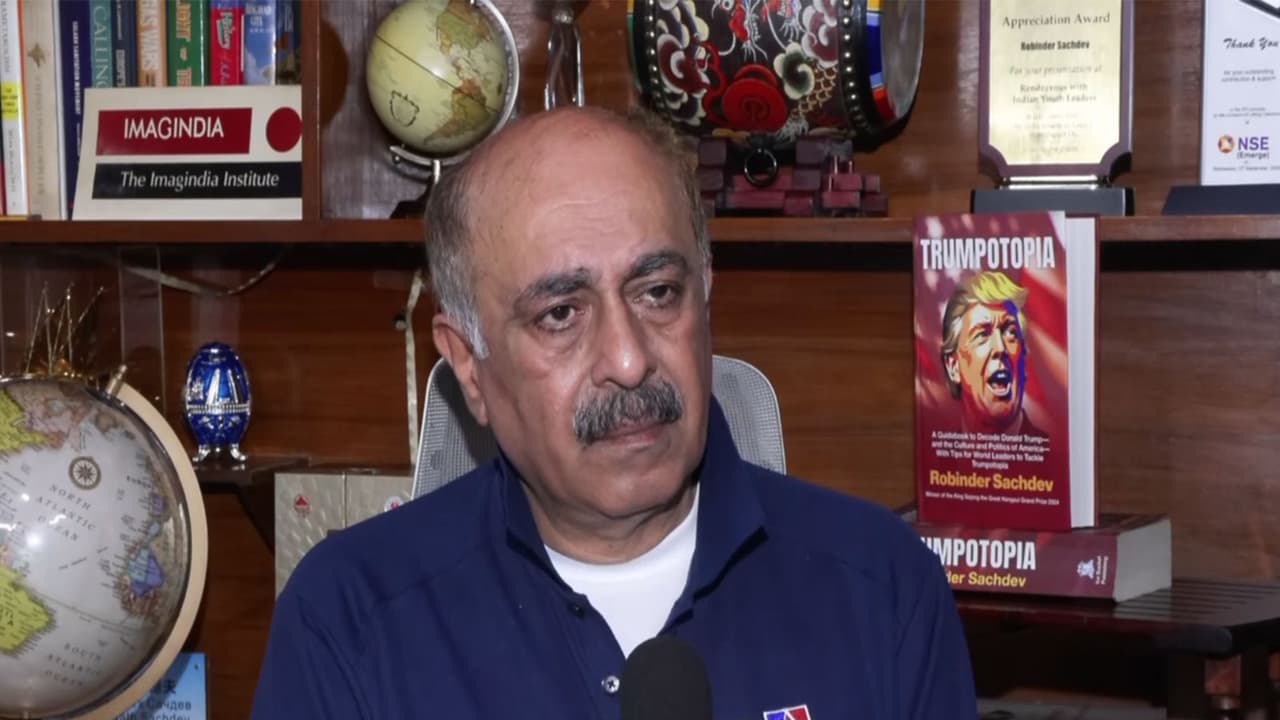
Failed US-Iran 'Islamabad Talks' have sparked fears of a global economic catastrophe. Expert Robinder Sachdev notes 'hard lines have been drawn', signaling continued conflict with major ripple effects on the world economy and a potential war.
The collapse of high-stakes "Islamabad Talks" between the United States and Iran has sent shockwaves through the international community, with experts warning that the world is now standing at the edge of a global economic catastrophe.
In a stark assessment, Foreign affairs expert Robinder Sachdev told ANI that the breakdown of negotiations is a "unfortunate" development for all parties, including India, signalling a dangerous escalation where "hard lines have been drawn." Sachdev added, "The fact that the talks did not yield positive results is unfortunate for all parties concerned--the United States, Iran, the region, and even India. This failure signals continued conflict with significant ripple effects on the world economy. Hard lines have been drawn, and while there is a hope that both parties might step back from the brink during the remaining days of the ceasefire, the alternative is that they may let loose the dogs of war," he said.
Strait of Hormuz: Iran's 'Super Weapon'
Despite the US delegation, led by Vice President JD Vance, praising Pakistan's mediation, no agreement was reached. Sachdev noted that the conflict has revealed a significant limitation of American military power: the inability to force open the Strait of Hormuz. "The main sticking points were the Strait of Hormuz, nuclear enrichment, and other fundamental disagreements. Despite being battered and damaged by American and Israeli forces, Iran has chosen not to yield to American demands. Their primary concerns remain sovereignty over their nuclear program and control over the Strait of Hormuz. In fact, the Strait of Hormuz has emerged as a new 'super weapon' in this conflict," he said.
Sachdev added, "It has been tested and bombarded, yet the Americans have not been able to force it open to commercial traffic despite their military might. This has shown Iran that they should never relinquish the control they have asserted over this vital waterway."
Despite being battered by American and Israeli forces, Iran has realised that using small submarines, torpedoes, and mines can stop commercial shipping entirely. "The strategic reality is that the Strait of Hormuz is now a battle-tested asset for Iran. The Strait has been proven as an effective chokehold. Iran has realised that by using small submarines, torpedoes, fast boats, and mines, it can stop commercial shipping entirely. Each ship and its cargo are worth hundreds of millions of dollars; no owner will risk a vessel if it isn't covered by insurance," he said.
The Insurance Impasse: A Strategic Leverage
Sachdev said that by demonstrating that they can disrupt the global oil supply despite facing the world's most powerful military, Iran has secured a new level of strategic leverage. "Ultimately, Iran's strategy is to assert sovereignty over these waters. They may even move toward a system where they require coordination or a "toll" for safe passage through the highway of the Strait. By demonstrating that they can disrupt the global oil supply despite facing the world's most powerful military, Iran has secured a new level of strategic leverage,' he said.
The expert highlighted a critical reality of modern maritime trade: regardless of how many warships the US sends as escorts, commercial vessels will not move without maritime insurance. Currently, insurance companies are refusing to cover ships entering what has become a battle-tested war zone, effectively handing Iran a "strategic leverage" that military intervention cannot resolve. "The bottom line is that the Strait of Hormuz cannot be opened solely through military intervention. Insurance companies are refusing to provide maritime insurance to tankers and ships in a war zone. Without insurance, no commercial ship will enter the area, regardless of how many warships the US sends to escort them," he said.
Tehran's 'Red Lines' Remain Non-Negotiable
According to Sachdev, the "red lines" for Tehran remain non-negotiable; Iran refuses to surrender its right to enrichment, control over the waterway is now seen as Iran's primary defence against Western economic pressure and Iran is demanding the release of frozen funds in Qatar and the U.S., as well as compensation for infrastructure damage. "Other issues included reparations and compensation for damages, as well as the release of Iranian funds blocked in Qatar and the US. There is also the issue of Lebanon, which many believe must be bundled into any peace deal. While the situation in Lebanon might have been solvable if the US pressured Prime Minister Netanyahu to restrict his "Greater Israel" project, the core red lines remain. Iran appears ready to declare an end to nuclear weapon aspirations, but it will not surrender their sovereignty over enrichment. This, combined with their control of the Strait, presents a massive problem for the world economy," he said.
Domestic Pressures Mount on Trump
Back in Washington, President Donald Trump is facing a tightening vice of domestic and geopolitical pressures; Petrol prices at American stations are soaring, causing a rift within his MAGA base regarding foreign wars, domestic pressure is mounting as the 2026 midterms approach. "While Trump believes the US has already won by pounding Iran's infrastructure--taking out steel mills, petrochemical plants, and senior IRGC leadership--he is facing significant domestic pressure. Petrol prices are rising at American gas stations, and a divide is growing within the MAGA base regarding foreign wars and blind support for Israel. With midterm elections approaching, Trump is under immense pressure regardless of his rhetoric," he said.
'Farcical' Threats Against China
While Trump has threatened 50% tariffs on nations supplying weapons to Iran, he is simultaneously preparing for a high-stakes trade visit to China, making his threats appear "farcical" and full of holes. "Trump's threats toward China also seem farcical. He has threatened 50% tariffs on nations that supply weapons to Iran. However, Trump is scheduled to visit China soon to strike a trade deal he badly wants. It is unlikely he will impose massive tariffs on China for supplying air defense weapons to Iran while simultaneously trying to negotiate a trade agreement. This appears to be a threat with many holes in it," he said.
Bracing for a Naval Blockade?
As the diplomatic window closes, President Trump has signalled his next move on Truth Social, hinting at a full naval blockade of the Strait. In a post on Truth Social, Trump shared an article which said, "The Trump card the president holds if Iran won't bend: a naval blockade." With the ceasefire period ticking away, the global economy remains held hostage by a 21-mile-wide waterway that military force has--so far--failed to tame. (ANI)
(Except for the headline, this story has not been edited by Asianet Newsable English staff and is published from a syndicated feed.)