
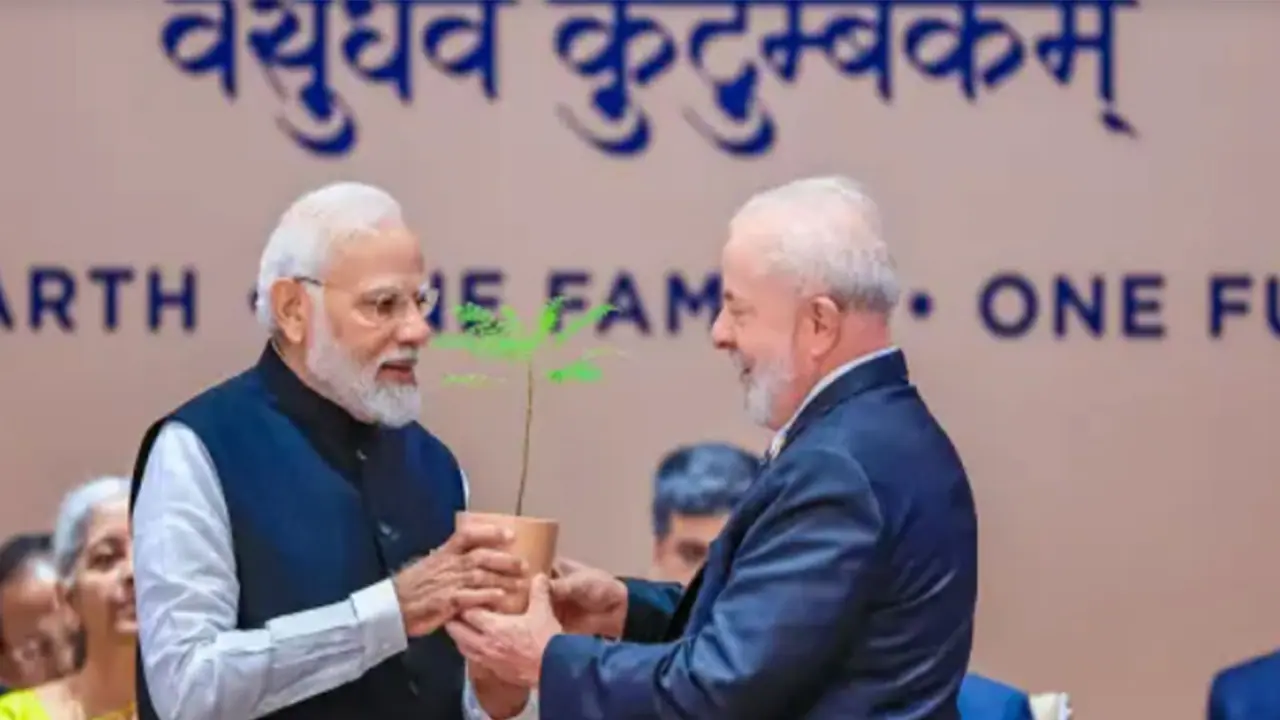
The upcoming BRICS summit in New Delhi is being hailed as one of the most significant in the group's history. It will focus on consolidation after a period of rapid expansion, with India's PM Modi expected to play a key bridging role.
The upcoming BRICS summit in New Delhi on September 12 and 13 could emerge as one of the most significant meetings in the grouping’s history, even as Brazilian President Luiz Inacio Lula da Silva will remain in Brazil for his election campaign. Brazil will instead be represented by Foreign Minister Mauro Vieira.
Shift from Expansion to Consolidation
According to Brasil 247, the summit comes at a crucial stage for BRICS as the grouping moves from rapid expansion towards consolidation. The bloc, originally comprising Brazil, Russia, India, China, and South Africa, has expanded considerably in recent years, adding countries and strengthening its presence across Asia, Africa, and West Asia. The expansion has increased BRICS’ share of the global population, production, trade, energy, and natural resources. However, the next challenge will be integrating its diverse members, building trust, and transforming its collective economic and political weight into practical cooperation. Areas such as development finance, trade, payments in national currencies, financial integration, artificial intelligence, science, technology, energy, food security and infrastructure could become central to the bloc’s future agenda.
India's Pivotal Role
Prime Minister Narendra Modi is expected to play a key role in this transition. India’s strategic autonomy, its ties with Russia, engagement with China and relations with the United States and Europe position New Delhi as an important bridge within the expanded grouping. Brasil 247 noted that India and Brazil share a broadly similar approach, supporting multipolarity while maintaining independent relations with multiple global powers. This approach could help BRICS avoid becoming an explicitly anti-Western alliance and instead focus on cooperation based on common interests.
Key Leaders and Geopolitical Dynamics
Chinese President Xi Jinping’s participation is also significant, particularly amid improving India-China ties following years of tensions. Differences between the two countries remain, but greater cooperation within BRICS could demonstrate that disagreements do not necessarily prevent collaboration on shared priorities. India is also expected to hand over the BRICS presidency to China, making coordination between Modi and Xi important for the bloc’s continuity in 2027.
Russian President Vladimir Putin’s presence further strengthens the summit’s geopolitical significance.
From Ambition to Practical Cooperation
The New Development Bank, led by Dilma Rousseff, represents one example of BRICS converting political ambitions into practical institutions. The New Delhi summit could therefore mark a shift from expansion to consolidation. Its success will depend on strengthening institutions, deepening economic and technological cooperation, managing internal differences and turning BRICS’ growing global influence into tangible results. (ANI)
(Except for the headline, this story has not been edited by Asianet Newsable English staff and is published from a syndicated feed.)