
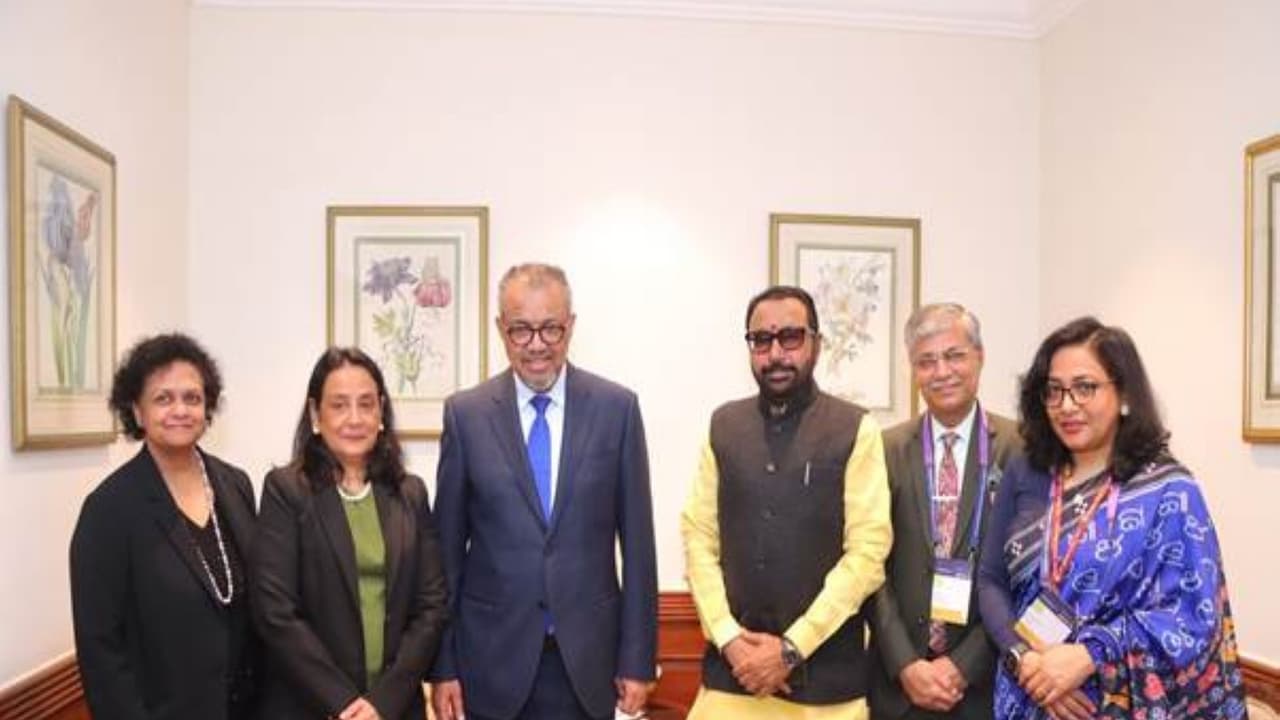
Union Minister Prataprao Jadhav met WHO DG Tedros Ghebreyesus at the Global Summit on Traditional Medicine, thanking WHO for its global leadership in advancing Traditional, Complementary and Integrative Medicine (TCIM). PM Modi will attend the closing.
Union Minister of State (I/C) for the Ministry of Ayush and Union Minister of State for Health & Family Welfare, Prataprao Jadhav, met with the Director-General of the World Health Organization, Tedros Adhanom Ghebreyesus, to express India's gratitude for WHO's leadership in advancing Traditional, Complementary and Integrative Medicine (TCIM) globally.
The meeting was held on the second day of the WHO Global Summit on Traditional Medicine. Prime Minister Narendra Modi will grace the closing ceremony of the Summit on December 19, 2025, at Bharat Mandapam in New Delhi.
Summit Enters Decisive Phase
According to the Ministry of Ayush release, the Summit entered a decisive phase with high-level deliberations on science, research investment, innovation, safety, regulation and health system integration, reaffirming the role of Traditional Medicine as a key contributor to an equitable, resilient and people-centred global health ecosystem. Guided by the theme "Restoring Balance: The Science and Practice of Health and Well-Being," the sessions are closely aligned with the newly adopted WHO Global Traditional Medicine Strategy 2025-2034, translating strategic vision into implementable pathways for countries and communities.
Bilateral Meetings to Strengthen Cooperation
Prataprao Jadhav held bilateral talks with delegations from Nepal, Sri Lanka, Micronesia, Mauritius and Fiji, while senior officials from the Ministry of Ayush engaged with other participating countries. In total, the Ministry of Ayush conducted sixteen bilateral meetings with delegations from Brazil, Malaysia, Nepal, Sri Lanka, Micronesia, Mauritius, Fiji, Kenya, the United Arab Emirates, Mexico, Vietnam, Bhutan, Suriname, Thailand, Ghana and Cuba, aimed at strengthening international cooperation in Traditional Medicine.
India-Cuba Collaboration Strengthened
On the sidelines of the Summit, the institute-level Memorandum of Understanding between India and Cuba, involving the All India Institute of Ayurveda, was extended. A Joint Working Group was also established to advance collaboration in curriculum development, public health integration, Panchakarma training and regulatory coherence in Ayurveda.
In-Depth Discussions on Science and Research
On the second day of the Summit, plenary sessions were held, with experts from Australia, Morocco, Iran, Uganda, Canada, Switzerland, the United States, the United Kingdom, Colombia, Brazil, India, New Zealand, Germany, Nepal, the Republic of Korea and Sri Lanka sharing insights and experiences on advancing Traditional Medicine globally.
Plenary Session 2: Investing in Science to Drive Progress
Plenary Session 2, themed "Investing in Science to Drive Traditional Medicine Progress," emphasised the role of scientific research in advancing Traditional Medicine. The session highlighted the importance of sustained investment, innovation, methodological harmonisation and international collaboration to establish Traditional Medicine as an evidence-based health domain.
Parallel Session 2A: Translating Research into Global Action
Parallel Session 2A, themed "Translating the WHO Traditional Medicine Research Roadmap into Global Action," focused on operationalising the WHO roadmap by addressing research complexity, codification of knowledge systems and global capacity building.
Parallel Session 2B: Research Methodologies and Applications
Parallel Session 2B, titled "Research Methodologies and Applications," examined innovative and methodologically appropriate research approaches aligned with Traditional Medicine epistemologies, including whole-systems and multimodal clinical trials, transdisciplinary designs and Indigenous methodologies.
Parallel Session 2C: Evidence from Traditional Medicine
Parallel Session 2C, themed "The Science of Well-Being - Evidence from Traditional Medicine," explored scientific evidence on Traditional Medicine's contributions to mental health, pain management, cancer care, self-care, antibiotic resistance and healthy longevity.
Parallel Session 2D: Building the Traditional Medicine Pipeline
Parallel Session 2D, titled "From Innovation to Investment - Building the Traditional Medicine Pipeline for Scale and Equity," examined governance frameworks, validation criteria and investment pathways required to scale Traditional Medicine innovations safely and equitably.
Parallel Session 2E: Impact of Meditation on Health
Parallel Session 2E, themed "Impact of Meditation on Health - Restoring Balance from Individual to Social and Ecological Well-Being," reviewed neuroscientific, clinical and public health evidence on meditation and explored opportunities for integration into health systems, education, workplaces and community programmes.
Re-Imagining Health Systems for Balance and Safety
Plenary Session 3, titled "Re-Imagining Health Systems for Balance, Safety and Resilience," focused on integrating Traditional Medicine safely and effectively into health systems. The session introduced the WHO Global Traditional Medicine Strategy 2025-2034 and highlighted regional experiences from South-East Asia and the Western Pacific.
Parallel Session 3A: Integration Models
Parallel Session 3A examined global frameworks and country-level implementation models for integrating Traditional Medicine into health systems.
Parallel Session 3B: Quality, Safety and Training
Parallel Session 3B focused on quality, efficiency and patient safety through education, training, ethical standards, accreditation and safety systems.
Parallel Session 3C: Regulatory Frameworks for Products
Parallel Session 3C advanced discussions on regulatory frameworks for Traditional Medicine products, covering quality, safety, efficacy, cross-border trade, digital health applications and protection of traditional knowledge.
Parallel Session 3D: Regulation of Practitioners
Parallel Session 3D addressed regulation of practitioners, minimum education standards, ethical conduct and evidence-based clinical practice guidelines, highlighting the role of Traditional Medicine in strengthening health system resilience.
Advancing Towards a Shared Global Commitment
Advancing towards safe, equitable and resilient health systems, the second day of the Summit reinforced a shared global commitment to science-based validation, robust governance, patient safety and equitable integration of Traditional Medicine, setting the foundation for the Summit's final day of policy dialogue and collective global commitments.
(Except for the headline, this story has not been edited by Asianet Newsable English staff and is published from a syndicated feed.)