
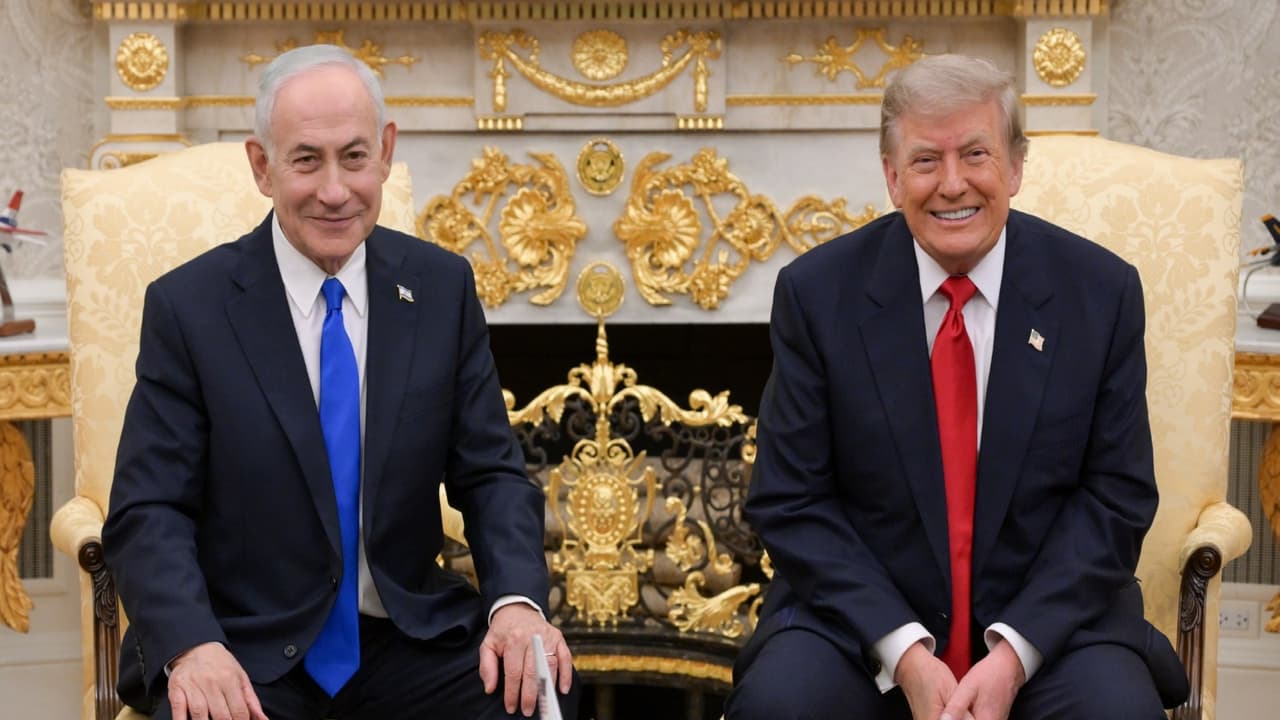
US President Donald Trump and Israeli PM Benjamin Netanyahu met to discuss Iran, exploring diplomatic, economic, and military options. Netanyahu expressed skepticism about a deal with Tehran and also discussed Syria and a new US-Israel defense MOU.
Trump, Netanyahu Discuss Iran Strategy
US President Donald Trump and Israeli Prime Minister Benjamin Netanyahu held a 90-minute meeting at the White House to discuss regional security issues and ongoing tensions over Iran, according to a report by Axios, citing a senior Israeli official.
The bilateral engagement marked their first face-to-face dialogue since the onset of the Iran conflict, following weeks of friction between Washington and Tel Aviv over military strategy. While the White House characterised the dialogue as "positive and productive", Netanyahu subsequently described the interaction as "one of the best conversations I've ever had" with Trump, reaffirming a joint commitment to prevent Tehran from obtaining nuclear weapons.
Three Approaches to Tehran
During the talks, which were heavily dominated by Iran, the senior Israeli official noted that Netanyahu expressed that he was "sceptical" regarding Tehran's willingness to sign a meaningful deal. The Israeli official stated that the two leaders discussed three distinct approaches currently under consideration by Washington: pursuing a diplomatic resolution, enforcing a naval blockade alongside heightened economic sanctions, or resuming full-scale military strikes.
"We discussed all of those options at length and very candidly. Not as an attempt to promote one option over another, but to examine what the best outcome would be from each. That's what the conversation was about," the Israeli official was quoted as saying.
Advocating for continued pressure on Tehran, Netanyahu pointed out that the Iranian economy remains under heavy strain and urged a combined approach using kinetic and non-kinetic measures. "We discussed increasing the economic pressure through both kinetic and non-kinetic means. We talked about the possibility of continuing the blockade in order to pressure Iran," the official told Axios.
The senior official further claimed that Iran is grappling with fuel shortages, long queues at filling stations, and rising public discontent over the economic situation. "The regime is very worried about that. It's concerned that people will rise up over the economic situation," he added.
Netanyahu told Trump that Tehran was seeking to exploit the Strait of Hormuz as "the only leverage it has left" to extract diplomatic concessions from the US, according to the official.
Addressing Security in Syria
Addressing the security landscape in Syria, the Israeli Prime Minister presented a comparative map contrasting Turkey's military presence with Israel's smaller buffer zone in the south, maintaining that Israeli forces would remain deployed there while jihadist threats persist. "Netanyahu wanted to show this to Trump because sometimes he forms certain opinions based on inaccurate information that some people give him," the official said.
US-Saudi Nuclear Agreement
On the subject of the proposed US-Saudi nuclear agreement, the official said Trump views the pact through the prism of normalising ties between Riyadh and Israel. "We'll have something to say on the nuclear issue if we see real progress," the official noted, adding that specific details remained undisclosed.
Future of US-Israel Defense Cooperation
Regarding bilateral defence cooperation, Netanyahu outlined a proposal to gradually taper off direct US military aid over the next decade to enhance Israeli self-reliance and shield defence capabilities from political shifts in Washington.
According to the official, the proposed memorandum of understanding (MOU) includes USD 16 billion in direct US military assistance, an additional USD 5-10 billion earmarked for missile defence support, and a joint USD 16 billion fund dedicated to research and development for next-generation weapons systems. (ANI)
(Except for the headline, this story has not been edited by Asianetnews Editorial staff and is published from a syndicated feed.)