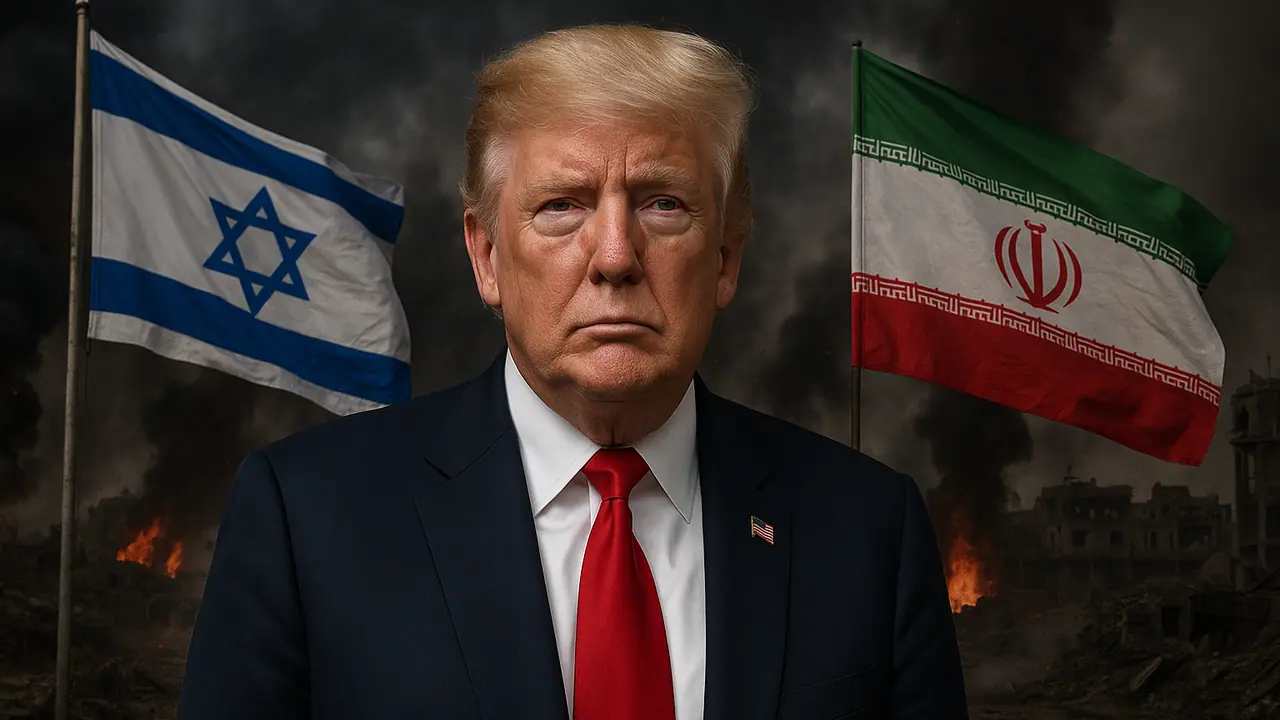
Donald Trump’s surprise brokering of a ceasefire between Iran and Israel draws mixed reactions as questions mount over the long-term impact of US strikes and Middle East diplomacy.
Israel-Iran War: In a dramatic turn of events that few saw coming, US President Donald Trump orchestrated a ceasefire between Iran and Israel on Tuesday after nearly two weeks of intense fighting, culminating in an American airstrike on key Iranian nuclear sites. What followed was a swift de-escalation and a flurry of declarations of “victory” from all three sides—Israel, Iran, and Trump himself.
But as the dust settles over the Middle East, questions loom large about what was truly achieved, whether the ceasefire will hold, and what this high-stakes diplomatic maneuver means for Trump's legacy at home and abroad.
The Social Media President Becomes the “Peacemaker”
As missiles rained down across the region and tensions teetered on the edge of a wider war, the ceasefire announcement came not from a press conference or diplomatic cable—but from Trump's preferred platform: social media.
Related Articles

The message was cryptic, bold, and immediate. Iran had just launched missiles at a US base in Qatar—rockets that were intercepted with minimal damage. Within hours, Trump declared the conflict over. No further retaliation. No prolonged campaign.
“I don't think the Israeli government was able to sustain a long-term war, but I think the main factor here was President Trump. He did not want to see a new war in the region break out under his watch,” Will Todman, a senior fellow at the Center for Strategic and International Studies, was quoted as saying in an AFP report.
His assessment speaks volumes. Despite criticism from across the political spectrum—including from some within his own MAGA base—for abandoning his promises of avoiding foreign entanglements, Trump managed to flip the narrative. By Tuesday, he was once again positioning himself as a peacemaker.
All Sides Claim Victory—But What Was Actually Achieved?
Iran, licking its wounds after its most intense military setback since the 1980-88 war with Iraq, found the ceasefire a much-needed off-ramp. In the immediate aftermath of the US airstrikes, Trump subtly dangled an economic incentive: a potential easing of US pressure on China to curb its purchase of Iranian oil—a lifeline for Iran’s sanctions-hit economy.
On the Israeli side, Prime Minister Benjamin Netanyahu publicly thanked Trump for stepping in. The Israeli Defense Forces had just endured the longest stretch of sustained aerial attacks in decades, managing simultaneous fronts in Gaza, Syria, and Lebanon, all while under heavy Iranian fire.
But despite Trump’s triumphant tone, critics note that the core components of Iran’s nuclear sites—though targeted—remain largely intact. A classified report, according to CNN and The New York Times, reveals that the bombing failed to destroy critical infrastructure.
“Trump vocally used his troll power to try to restrain the actions of Israel and Iran, but that matters less compared with the role that these countries continuously play,” Brian Katulis of the Middle East Institute told AFP.
Katulis credits Gulf powers like Qatar with doing the behind-the-scenes diplomatic lifting that helped broker the ceasefire. Still, he acknowledged that Trump’s mix of military action and online messaging “confused Americans and global actors alike about what it is we're actually trying to get done.”
Ceasefire or Pause Button? The Fragility of the Peace
The long-term stability of this truce remains uncertain.
Even as the ceasefire holds, the possibility of renewed violence lingers. Jonathan Panikoff of the Atlantic Council sheds light on how fragile the domestic political calculus was for Trump. Had the conflict continued, it could have cost him politically.
“A prolonged US military campaign had the potential to really fracture President Trump's own base of support,” he told AFP news agency. “My guess is the majority of his MAGA and other Republican base will stay relatively unified, even if they were unthrilled in some quarters.”
On the Democratic side, reaction was mixed. While some hawks supported the Iran strike, others denounced it. Critics on the left have long accused Trump—and his predecessors—of granting Israel carte blanche in its regional ambitions.
Annelle Sheline, a former State Department official who resigned in protest under President Biden, now at the Quincy Institute, said Trump must now enforce the ceasefire seriously and even-handedly.
“Trump demonstrated that he can rein in Israel when he chooses to do so. Now he must do the same to insist on a ceasefire in Gaza,” she said. “Netanyahu believed he enjoyed America's unconditional support.”
More Questions Than Answers
In the days ahead, attention will shift to whether Iran resumes covert nuclear activity, how Netanyahu’s coalition survives this latest test, and whether Trump uses this crisis as a political talking point or a genuine diplomatic blueprint.
For now, the ceasefire is real. The bombs have stopped falling. But the silence is laced with unease.