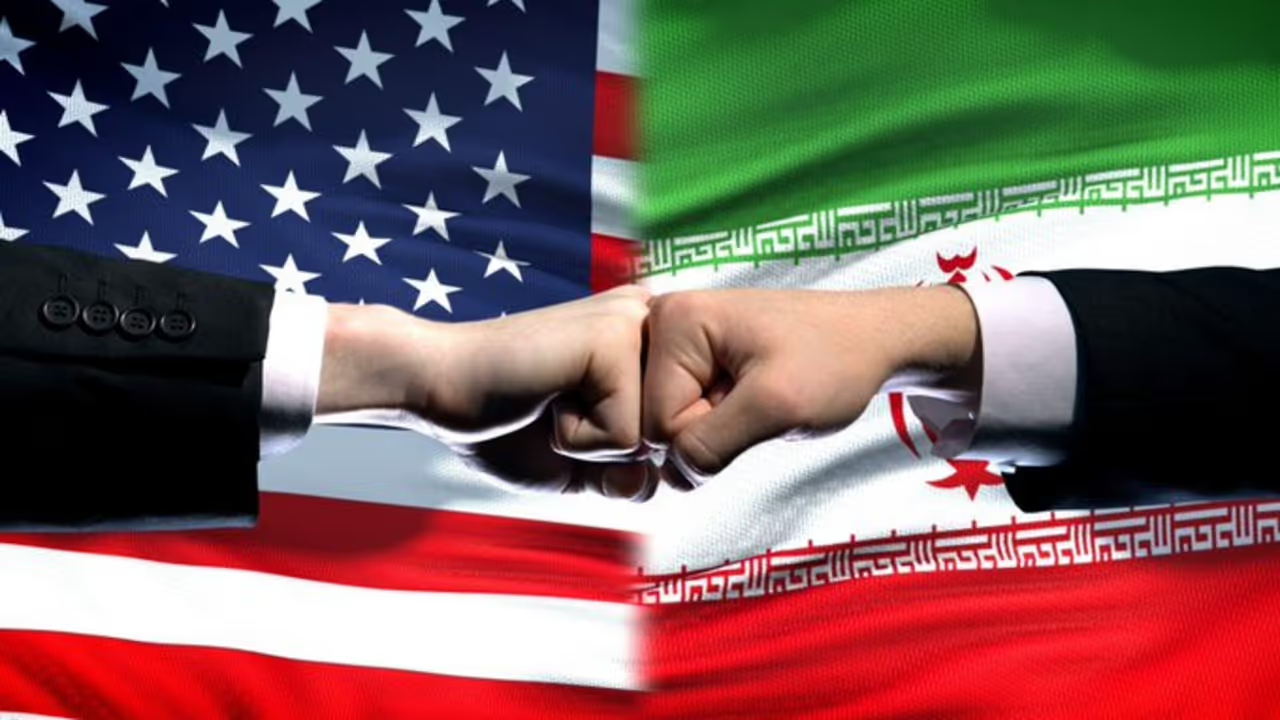
The declaration of a ceasefire understanding between the United States and Iran has been predictably received with caution, suspicion, and understandable scepticism from some and a complete disregard from a few as well.
The declaration of a ceasefire understanding between the United States and Iran has been predictably received with caution, suspicion, and understandable scepticism from some and a complete disregard from a few as well. As geopolitical activities go, the Iran – US conflict with a sprinkling of Israel and then the roping in of the entire middle- east, has been closely followed first by states, and then by lay people as fuel prices started to have an impact on individual pockets. Therefore, this news of a move towards de-escalation and resolving the impasse that the Strait of Hormuz has become for the rest of the world is welcome information.
However, this optimism requires caution.
The views discussing this ceasefire are quite varied in the western and the non – western perspectives. While the US based or generally western media is ready to celebrate the declaration; the non-western perspectives on it are cautious pointing out that the declaration lacks clarity and has a faint smell of instability. At the moment, this is not a lasting peace deal but an arrangement between US and Iran which bases itself on unclear conditions and ambiguous compliance.
Related Articles

It’s an understanding that is built on shaky terms which stand to come apart as the negotiations move on to resolving the issues from just deferring them.
What seems like a peace settlement in the conventional sense would be better understood as a tentative de-escalation agreement constructed on the foundation of immediate incentives.
The peace - framework includes reopening of the Strait of Hormuz, phased military de-escalation, relief mechanisms for sanctions, and a broader political understanding proposed to pause further escalation. Structurally, however, this echoes a tactical pause more than a durable political settlement. The distinction is imperative because markets, and media cycles often confuse the absence of escalation with the presence of stability. They are not the same thing.
The Strait of Hormuz is central to this agreement. The reopening of this strait is therefore the single most important short-term outcome of this arrangement. It is also one that was most sought after by the rest of the world, however there is deep governance ambiguity around the opening of Hormuz. There is a lack of clarity on maritime enforcement, on security guarantees, and practical governance of the shipping routes.
Another misconception is that this opening of the strait would lead to an immediate lowering of fuel process. However, energy markets tend to not move as fast. Shipping insurance premiums would only decline once there is complete faith that this peace deal will hold.
The lack of trust that exists between the US and Iran is mirrored by the markets. The drop in shipping insurances, and resuming of maritime traffic will not be instantaneous; and will only happen once the stake holders are sure of stability and profit.
This matters because geopolitical risk lingers in pricing mechanisms long after headlines move on. Once the much-awaited stability does arrive, crude benchmarks will stabilize faster that retail prices. Even then supply chain adjustments, refining margins, and speculative positioning will take even longer. Supply chains also tend to remember political instability much longer than diplomatic declarations.
The question that shipping insurances and supply chains much like most geopolitical enthusiasts and specialists are pondering is; will the peace last. Ironically, throughout history, US-Iran diplomacy has not failed at the hands of political fragility and not because of diplomatic failure to negotiate. The negotiations have been long and arduous but in the end US and Iran tend to work out a framework that equally irks both enough to work. It is only when implementation ends abruptly because of political motivations. The former US – Iran nuclear deal is one such example. Every time this happens the trust deficit grows event further.
One sees the continuation of this trust deficit pattern in this peace arrangement as well. In many ways, the arrangement works because the hardest questions have been postponed rather than resolved.US mentions that the peace deal is contingent on compliance by Iran. However, the terms of that compliance are unclear. There are questions that remain unanswered; Iran’s nuclear capabilities and US’ reservations around it have not been discussed. Nuclear sequencing, verification mechanisms, sanctions durability, and broader regional security concerns appear deferred into future talks. That may be politically pragmatic in the short term, but it also creates delayed fragility.
Sanctions is another crucial aspect that has not been clearly pondered. Iran is asking for guarantees that sanctions relief will be credible and durable. Washington wants measurable restraint and visible compliance before committing political capital. However, its unclear whether Iran has to reduce its enrichment before the sanctions are lifted or whether this negotiation will lead to reduction in political pressure from the US and lifting of sanctions before the nuclear question is resolved. There is no clear announcement regarding these expectations. Both sides continue to operate from deep institutional distrust. This situation is the proverbial old wine in the new bottle; each side wants proof before making irreversible concessions.
The arrangement, therefore, appears to be politically useful tool for both governments in the short term. For Washington, de-escalation reduces the likelihood of a prolonged regional military commitment and eases the pressure from energy volatility. For Tehran, it offers breathing room from economic pressure and lowers the risks associated with direct confrontation.
While these incentives are great for temporary cooperation, they don’t work if long-term working frameworks are not constructed. This is why describing the current moment as transformative would be premature. Ceasefires rarely fail because parties suddenly reject diplomacy. More often, they yield because incentives dry out faster than enforcement. A simple delay in sanctions commitment, disagreement over sequencing, regional military interaction, domestic political pressure, or competing interpretations of the agreement can gradually erode trust and subsequently this peace arrangement.
The West Asia region is aware of this cycle of erosion of peace. Lebanon is a great illustration of this conundrum. Lebanon remains one of the clearest tests of whether de-escalation is for the entire region or just US and Iran. Political understanding at the state level does not always necessarily translate neatly into regional behaviour and role of Local actors cannot be discounted. This means Lebanon has becomes the litmus test. If tensions rise there, confidence in the broader de-escalation architecture weakens quickly.
Regional actors such as Saudi Arabia and the United Arab Emirates benefit materially from de-escalation. Stable shipping routes, lower energy volatility, and reduced military uncertainty align directly with their economic priorities. Gulf states may welcome this peace deal however, they are simultaneously re-examining their long-term security dependence, particularly after exposure of vulnerabilities in their security infrastructures.
If one was to evaluate this peace deal with clinical objectivity, in the short term there are reasons for calculated optimism. The likelihood of a wider regional war has decreased. Energy panic may reduce. Shipping through Hormuz should gradually stabilize if implementation proceeds as promised. Diplomatic channels, once reopened, also reduce the risks of accidental escalation.
However, with passage of time these assurances become more fragile. The threat to this arrangement is probably not dramatic collapse however, its gradual erosion. Agreements of this kind often weaken through an accumulation of small failures and mistrust and an eventual change in political motives and incentives.
This attempt to regulate the situation between US an Iran is more of a conflict-management mechanism rather than a historic breakthrough. While cynicism around it can prevail, it does not take away from its geopolitical significance even if it is in the short term. The most practical outcome over the next six months would be a regulated conditional stability that allows business as usual and is categorised as neither peace nor war.
A gradual economic normalisation of the region and global trade flow that depends on the region as countries that are the most impacted scrounge for reasons and mechanisms to make this conditional normalisation last as long as it is possible.