
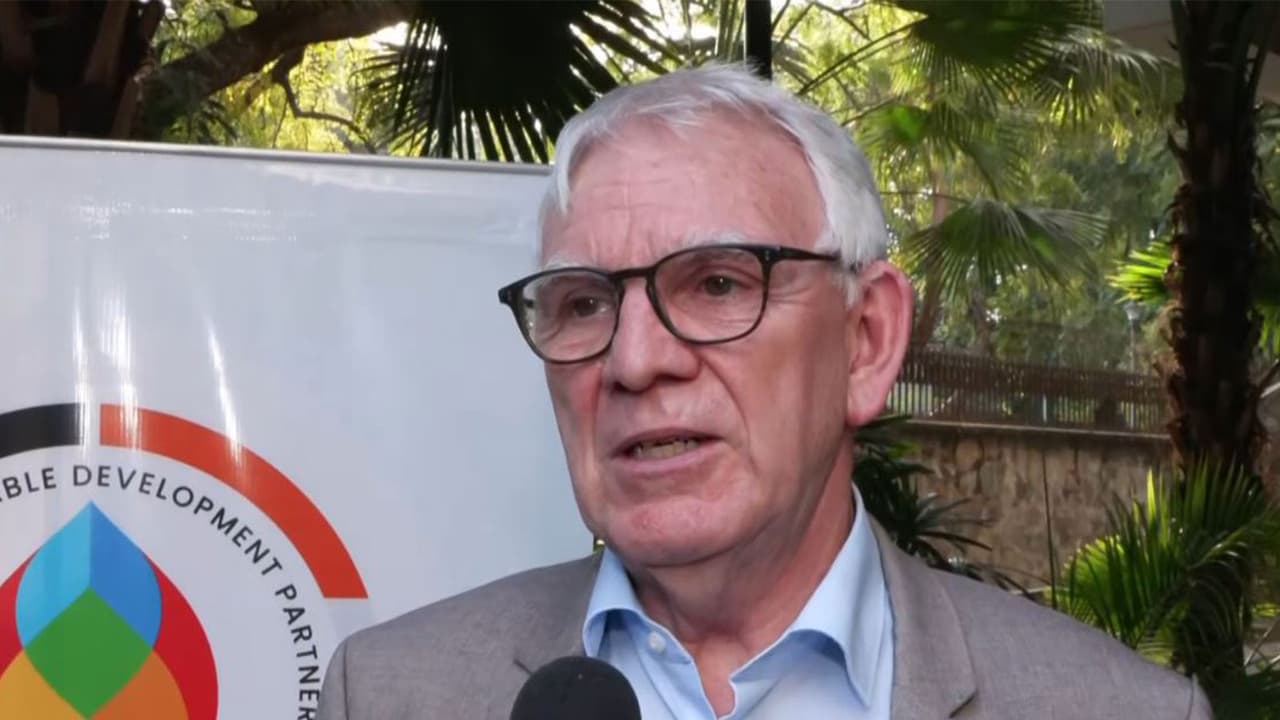
German State Secretary Jochen Flasbarth condemned global tariffs as 'poisoning the world economy' during a visit to India. He advocated for free trade and sustainable development as crucial solutions for advancing global climate action.
Amid escalating global tariff tensions, Germany's State Secretary for Environment Jochen Flasbarth on Wednesday said tariffs are poisoning the world economy, while asserting that free trade and sustainable economic development provide a key solution for climate action.
During an interaction with ANI as part of his visit to India, the State Secretary at Germany's Federal Ministry for the Environment, Climate Action, Nature Conservation and Nuclear Safety said that growing trade restrictions and geopolitical tensions are diverting global attention away from climate transformation. "All this is horrible. Wars are horrible. They are moving attention from global transformation, climate and biodiversity towards the military sector. And tariffs are poisoning our world economy," he said when asked how tariffs and trade policies by some countries, like the US, are impacting global climate cooperation and the green supply chain.
Tariffs and Geopolitical Tensions
Flasbarth said that the cooperation between countries such as India and Germany is crucial to keep climate ambition on track. "I believe sitting together peacefully as we do it, between India and Germany and looking at the opportunities cooperation can provide is a key and therefore tariff barriers are bad, and free trade and sustainable development together, economic development, is a key solution," he added.
Flasbarth's remarks come in the wake of a tougher stance taken by US President Donald Trump following a US Supreme Court ruling that struck down his sweeping tariffs. Days after the ruling, Trump raised global tariffs from 10 per cent to 15 per cent, even as businesses and governments worldwide sought repayment of an estimated USD 133 billion already collected by Washington.
Flasbarth said his current visit to India is aimed at strengthening bilateral and multilateral cooperation, particularly at a time when, according to him, "the US is disappearing from the multilateral scene". He underlined that while no specific agreement is expected during this visit, sustained engagement is critical. "This visit is not intended to lead to an agreement right now. But it is enormously important that we are constantly in contact," he said, pointing to the renewed momentum around the concluded India-EU Free Trade Agreement and its environmental relevance.
India-Germany Climate Cooperation
On climate cooperation, Flasbarth expressed satisfaction over the progress made under the India-Germany Green and Sustainable Development Partnership (GSDP), launched in 2022. He said the partnership consolidated various strands of cooperation -- sustainability, climate and environment -- under one umbrella. "A lot has happened in renewable energy, climate adaptation, biodiversity, nature-based solutions, agriculture and urban development," he said, adding that both sides view the partnership positively.
However, he admitted that more needs to be done, particularly in integrating climate mitigation, adaptation and biodiversity goals. Highlighting nature-based solutions as a key area, he cited cooperation in rewetting peatlands and forest-related initiatives but noted that "we are by far not where we should be."
Climate Finance and Private Sector Role
Responding to a question on climate finance--a subject of continued friction between developed and developing nations--Flasbarth said Germany has delivered on its commitments, identifying India as one of its three major partners in the Global South, alongside South Africa and Brazil. "We are very happy that we are able to support India. But it is not a one-way track. It is becoming more and more a real partnership," he said. He emphasised that private sector investment will be critical for scaling climate mitigation and adaptation efforts, noting that "the really big money is sitting there."
Environmental Cost and Opportunities of AI
On the environmental cost of artificial intelligence -- a subject debated during India's recent AI Impact Summit -- Flasbarth acknowledged concerns around energy consumption and radiation but said perspectives have evolved. "Looking back a couple of years, the environmental perspective on digitalisation and AI was more one of concern because it is highly energy-consuming. But this has changed a lot. There are so many opportunities in wisely using AI," he said, describing energy consumption as "manageable" compared to the broader benefits.
He also indicated scope for collaboration between India and Germany on green data infrastructure and energy-efficient AI systems, calling it a "starting point" with significant potential. (ANI)
(Except for the headline, this story has not been edited by Asianet Newsable English staff and is published from a syndicated feed.)