
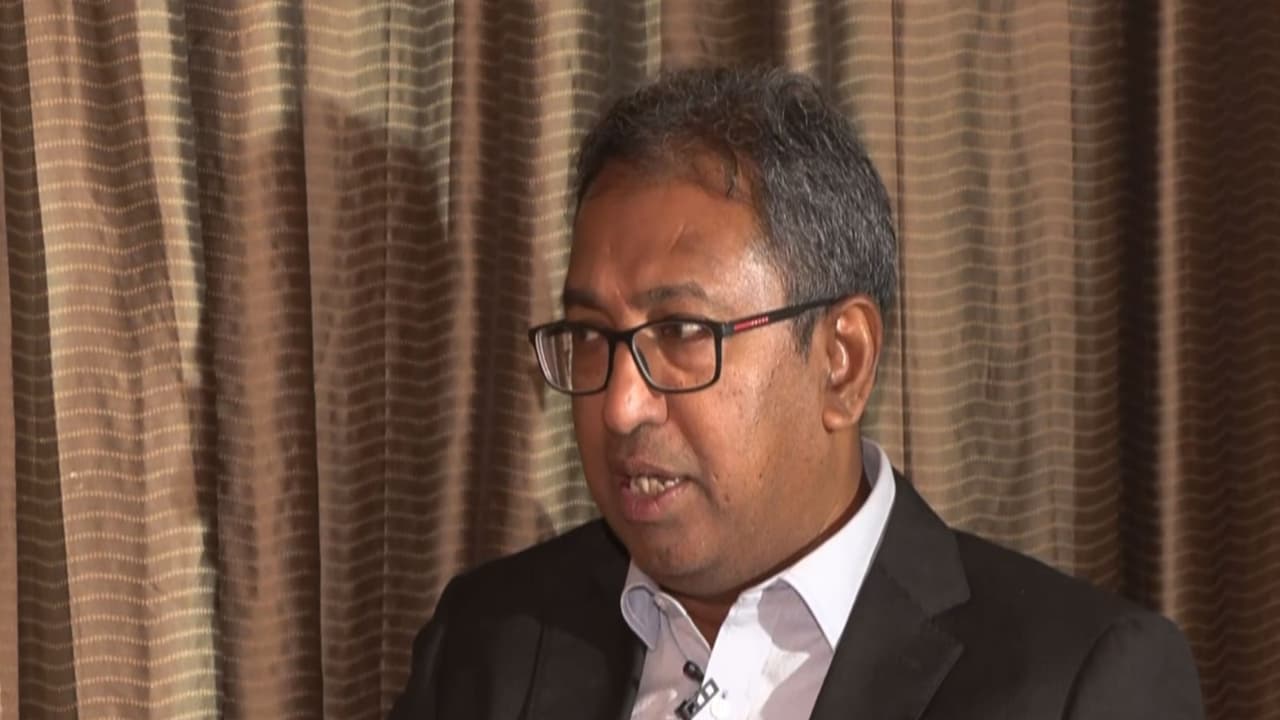
Sri Lankan MP Harsha de Silva expressed shock after a US submarine sank an Iranian frigate, calling it a dangerous escalation bringing the West Asian conflict into the Indian Ocean, a traditionally peaceful region.
Sri Lankan MP Harsha de Silva expressed shock following the sinking of the Iranian frigate IRIS Dena by a U.S. submarine on March 4, 2026. Harsha de Silva, MP, Chair of the Committee on Public Finance of the Parliament in Sri Lanka, while talking to ANI, said regional neighbours have traditionally viewed the Indian Ocean as a zone of peace and connectivity and torpedoing of a warship is seen as a dangerous escalation that brings the West Asian conflict directly into South Asian waters.
"Indian Ocean has always been a peaceful place, and we've always said, look, we need rules-based order and freedom of navigation in the Indo-Pacific was the thing that everyone wanted to achieve and was driven really by the United States and allies," he said.
Concerns Over Indian Ocean Security
Silva said that Sri Lanka has control over the ocean around it for a circumference of 12 nautical miles. "And for us, you see, we would like to call it the Sea of Sri Lanka. You know the ocean around us. We have sovereign control of 12 nautical miles and the contiguous area going up to 200 nautical miles, which is the exclusive economic zone. Now, what transpired obviously is not something we had planned to deal with. See? It was a surprise. Because the rules had to be observed," he said.
Silva said that the Indian Ocean is for everyone, noting that smaller nations like Sri Lanka--already navigating economic recovery--the prospect of an external military conflict spilling into their sovereign waters is a major security and economic nightmare. "In that context, you know, there is competition in the Indian Ocean, right? People want to rule the Indian Ocean. No, the Indian Ocean belongs to all of us. It is not the ocean of India. It is just called the Indian Ocean. And that's why I said the sea of Sri Lanka has to be within that. And all literal states have a role to play," he said.
Balancing Relations with India and China
When asked about Sri Lanka's relationships with China, Silva said that no government has dismissed India's concerns. "I mean, look, you know no government in Sri Lanka has dismissed India's security concerns in the Sri Lankan sovereign territory. No one has done that. Because you can have friends, you can have best friends, but India is our only neighbor right? I mean India has other neighbors but for us it is our only neighbour," he said.
Harsha de Silva emphasised Sri Lanka's balanced approach to relations with India and China, highlighting China's long-standing support for Sri Lanka's development. He defends the Hambantota port project, stating it was a mutually agreed deal and not a Chinese imposition, emphasising shared responsibility for the debt incurred "China is an important partner for Sri Lanka, and we have had very good relationships with China since the 1950s, when you know we had this rice rubber pact where we bartered rice for rubber, and they have been supportive of Sri Lanka's, you know, development. So, to us, it is how do we maintain good and healthy relations with both India and China, right, so the Chinese project in Hambantota has been written about, you know, the debt trap etc but I take a slightly different view, and you know it is not something that the Chinese imposed on Sri Lanka. It is something that the Sri Lankan government said let's do it. You can't force anything, so therefore the blame must be taken by those people who got into this debt, and not only blame one party, but the two parties to the contract and having said that, we have a positive commercial partnership with China," he said.
Fishermen Issue a 'Perennial' Challenge
Silva further said that the issue of Indian fishermen in Sri Lanka is a perennial issue and will not go away soon, because both sides depend on fishing for a living. "This is a perennial issue, you know it's not going away because I think on both sides of the straits, you know, folks are depending on fish for their living. These are not, you know, big corporates these are small fishermen, and when the Indian trawlers come, and you can see the satellite images, you know, they do not come in dozens but rather in hundreds, and they go back, so the issue, I think, is a complicated one. You can't just say this is the line so you stay here, and you know somehow stay on this," he said.
Silva then said that it is more of a legal issue than a political. "Yes, every foreign minister and deputy foreign minister worked on this. It is about bottom trawling and whether bottom trawling is a traditional fishing method, and you know, does it destroy the seabed? But as I said, I think the solution is economics-related, not legal," he said.
Sri Lanka's Economic Challenges
He further said that Sri Lanka is stable as an economy, but not growing. "So it is possible to take Sri Lanka from where it is to where it ought to be. So it is with a very optimistic outlook that I'm speaking. Now, what has not happened is growth. You know we are stable as an economy," he said.
Inflation and High Prices
Silva explained that the inflation has reduced, but the prices of products remain high. "But I said yes and no, that is because price levels have gone up. You know what used to be 100 is now 250. So the price level went up because it went up to 70%. And then you know inflation went up so much over several months, it went up proportionally. Inflation is the rate of increase in prices. Now the rate of increase of prices is low, but it is increasing. So if you had a negative, it would come down," he said.
Rising Poverty and the Need for Growth
Silva explained that they need to create jobs now to improve the economic situation there. "Yes. We had some months with negative numbers; it came down a bit, but it stays high. So what that means is poverty went up from 12% to 26%. Like we had never seen in Sri Lanka. So this is the untold truth. So we need to be able to create jobs, economic opportunity and for that we need growth and growth is the challenge for this Government," he said.
Details of the Sinking
The comments came as on March 4, the IRIS Dena, an Iranian Moudge-class frigate, was sunk by a US Navy submarine in international waters approximately 40 nautical miles off the coast of Galle, Sri Lanka. The vessel was carrying an estimated 180 crew members. Sri Lankan naval forces rescued 32 survivors and recovered 87 bodies. Many others remain missing. (ANI)
(Except for the headline, this story has not been edited by Asianet Newsable English staff and is published from a syndicated feed.)