SpaceX achieved a major milestone by successfully returning the Starship spacecraft from orbit and catching it with mechanical arms at the launch tower. During this fifteenth test flight, the spacecraft also deployed 26 Starlink satellites. However, the Super Heavy booster performed a simulated landing in the Gulf of Mexico due to a guidance issue.
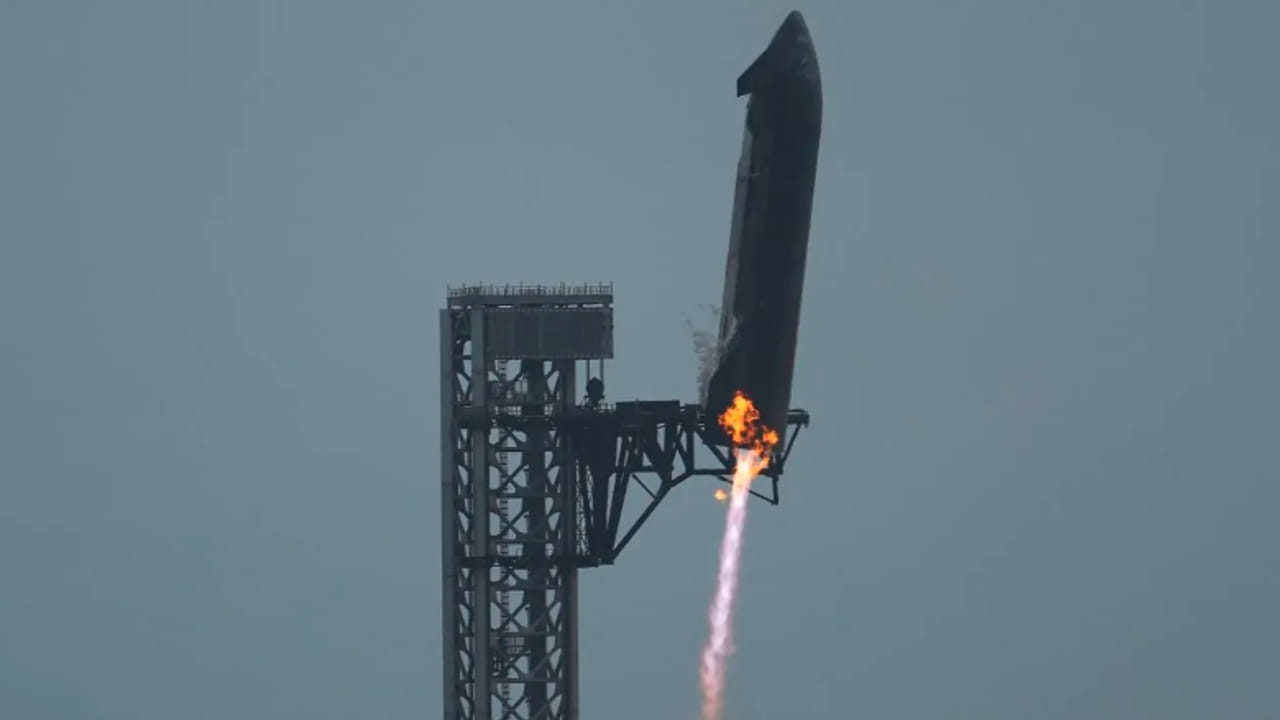
A significant milestone in SpaceX's quest to create a completely reusable rocket system has been reached with the successful return of the massive Starship spaceship from orbit and its capture by mechanical arms at its South Texas launch site. On Saturday afternoon, two mechanical arms known as "chopsticks" on the launch tower captured the spacecraft.
The accomplishment was made on Friday afternoon during Starship's fifteenth test flight. The spacecraft's top stage was successfully returned from orbit and captured at the launch site for the first time by SpaceX.
The roughly 170-foot-long Starship was traveling at over 17,000 miles per hour at an altitude of nearly 170 miles when one of its engines momentarily failed, forcing it out of orbit and starting its descent toward Earth.
Related Articles

Air pressure warmed the spacecraft's underbelly as it entered the atmosphere, slowing it down. It was then guided through the denser atmosphere by flaps at the front and back.
Starship rotated into a vertical posture and activated its engines during its last fall. After a brief moment of hovering, it moved between the mechanical arms, which encircled it and secured it.
Over the last ten years, SpaceX has developed technology to recover and use the boosters of its smaller Falcon 9 rockets. These rockets were successfully landed and utilized again in later launches.
After every launch, Falcon 9 rockets' top stages are still thrown away. Starship was intended to be completely reusable from the beginning and is far bigger than Falcon 9. After it has entered orbit, recovering its top stage is a major technological task.
SpaceX managed to achieve that feat on its first attempt. During the latest test flight, the spacecraft also deployed 26 of the company's next-generation Starlink satellites after reaching orbit.
By capturing both parts of the rocket, the business had planned for an even more ambitious outcome. The enormous launcher that launches Starship into orbit is located in the lower part, referred to as Super Heavy.
In three prior test flights, SpaceX has previously captured the booster. It would have been the company's first "double-catch" manoeuvre if the rocket and spacecraft had been successfully recovered. Nevertheless, the booster discovered an issue with its guidance and navigation control system after finishing its portion of the mission. Instead of going back to the launch tower, it performed a simulated landing over the Gulf of Mexico.