
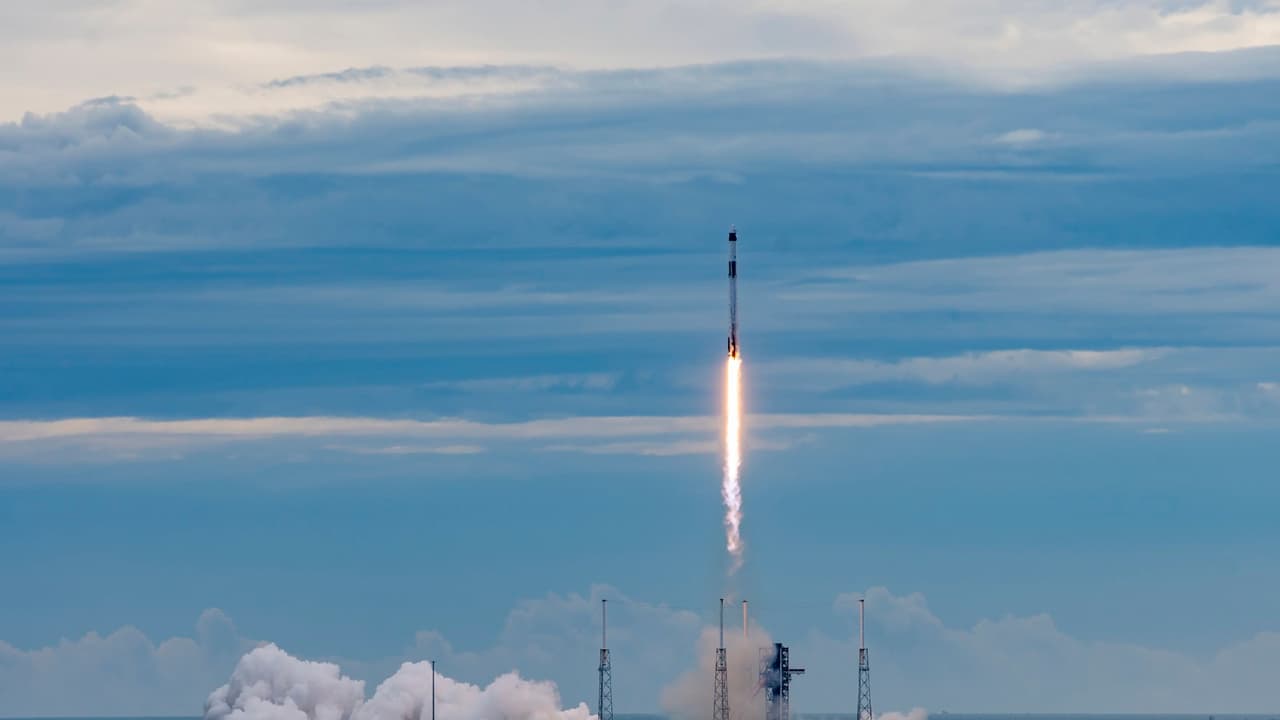
SpaceX successfully launched NASA’s Crew-13 mission to the ISS with a four-person international crew. The Falcon 9 booster also made a successful landing. The mission aims to set a record for the fastest docking with the space station.
SpaceX successfully landed its Falcon 9 first-stage booster at Landing Zone 40 at Cape Canaveral Space Force Station shortly after launching the Dragon spacecraft into orbit on Thursday, beginning NASA’s Crew-13 mission to the International Space Station (ISS). The milestone landing followed the launch of the SpaceX Dragon spacecraft carrying NASA astronauts Jessica Watkins and Luke Delaney, Canadian Space Agency (CSA) astronaut Joshua Kutryk, and Roscosmos cosmonaut Sergey Teteryatnikov. NASA confirmed that the spacecraft has safely reached orbit, separated from Falcon 9’s second stage, and opened its nosecone.
Post-Launch Briefing Announced
Building on the momentum, NASA has announced a post-launch media briefing scheduled for 1:10 p.m. EDT at the Kennedy Space Centre. The briefing will feature top leadership including NASA Administrator Jared Isaacman, Dr Lori Glaze of the Human Spaceflight Mission Directorate, Low Earth Orbit Program Manager Dana Weigel, CSA Director Mathieu Caron, and SpaceX Director Julianna Scheiman.
Record-Breaking Journey to the ISS
The mission blasted off at 11:10 a.m. EDT from Space Launch Complex 40 at Cape Canaveral, piercing clear Florida skies. At the moment of ignition, the ISS was slicing through low Earth orbit at 17,500 mph (28,200 km/h) roughly 263 miles above Earth. In a dramatic visual alignment, the station zoomed directly over the launch pad just 97 seconds after liftoff.
Now in orbit, Crew-13 is on track to rewrite the spaceflight record books. The astronauts will spend approximately 7 hours and 50 minutes phasing through orbit before targeting docking at the Harmony module's space-facing port at 7:00 p.m. EDT. If successful, the manoeuvre will mark the single fastest launch-to-docking transit in the history of the ISS.
Mission Research Objectives
During its mission, Crew-13 will support research aboard the International Space Station by using microgravity to develop human stem cell-derived tissues that could contribute to personalised medicine, disease modeling, and pharmaceutical testing for conditions including heart disease and Parkinson’s. The crew will also study crop production using a new, largely autonomous plant-growth system and examine how plants develop outside dedicated growth facilities.
Additionally, the astronauts will continue health studies focused on factors associated with blood-flow abnormalities in microgravity and test a new in-flight diagnostic device designed to monitor astronaut health, according to NASA.
NASA's Low Earth Orbit Program
Crew-13 is part of NASA’s Low Earth Orbit Program, which works with private companies to provide dependable access to space, advance research and development aboard the space station, and support future missions beyond low Earth orbit. (ANI)
(Except for the headline, this story has not been edited by Asianet Newsable English staff and is published from a syndicated feed.)