
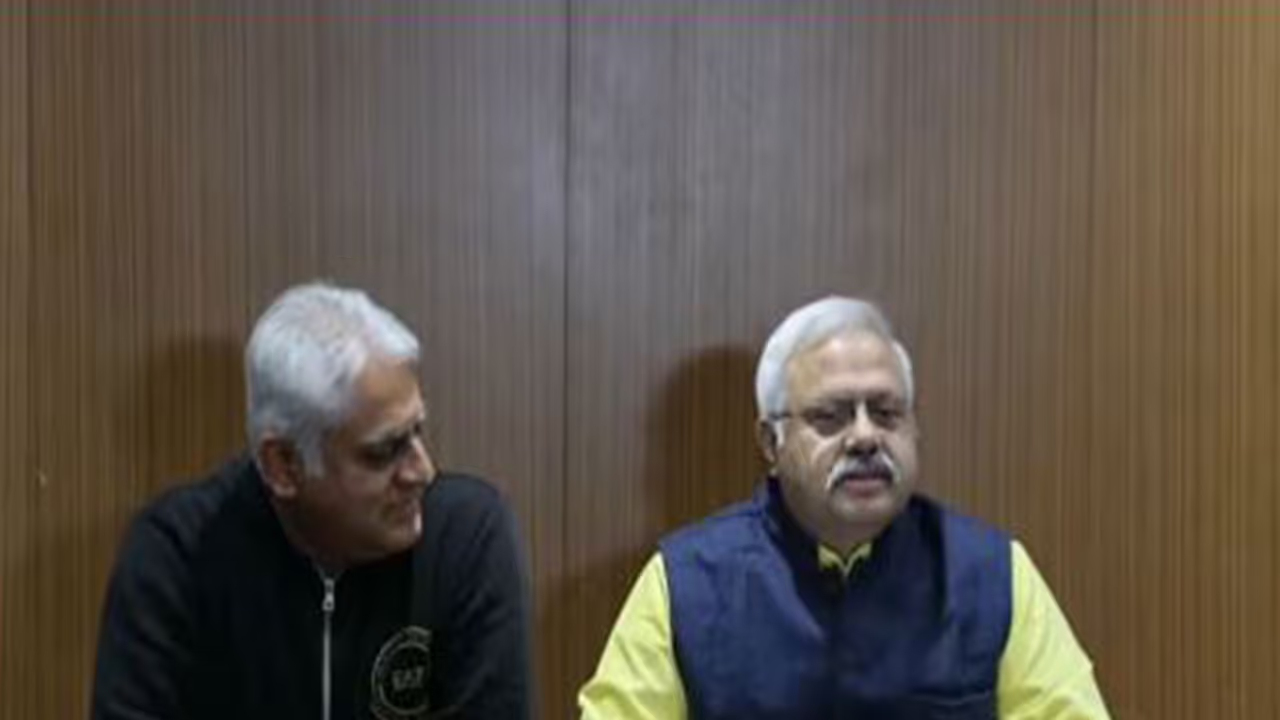
RSS Chief Mohan Bhagwat's UK visit, part of centenary celebrations, aims to clarify global misconceptions about Hindutva. RSS Prachar Pramukh Sunil Ambekar said the goal is to foster a deeper civilisational dialogue with Western academia.
Clarifying the core ethos of Hindutva to address global misconceptions, Rashtriya Swayamsevak Sangh Prachar Pramukh Sunil Ambekar said that RSS Chief Mohan Bhagwat’s visit to the United Kingdom aims to engage Western academia and public figures in a deeper civilisational dialogue about India.
Speaking on the ongoing six-day tour as part of the RSS centenary celebrations, Ambekar emphasised that Bharat is a "cultural concept" rather than a rigid political nation-state, and that Hindutva inherently respects and accepts all religious traditions. "There are a lot of misconceptions. Bharat is not like a nation-state political concept; it is a cultural concept. Hindutva is not like any religion; it is not a fixed concept. It is a concept where there will be respect and belief in the truth of any type of religion or all religious practices. That is Hindutva; that is Bharat. And so, I think the visit will help to clear the ideas," Ambekar noted, asserting that the organisation is open to transparent dialogue to foster broader mutual understanding.
Centenary Tour and International Engagement
Rashtriya Swayamsevak Sangh Chief Mohan Bhagwat arrived in the United Kingdom on a visit spanning September 2 to 7, a visit being undertaken on the occasion of the centenary year of the RSS.
Addressing the significance of the tour, Ambekar stated, "This tour is on the occasion of the centenary year of the RSS." He further noted, "From the UK, he will return to India, to Delhi. This tour is being undertaken on the occasion of the centenary year of the RSS, which is the largest voluntary organisation based in India."
During the week-long engagement, the RSS Sarsanghchalak will be interacting with prominent public figures, prominent organisations, and members of the diaspora. "This week, he will be meeting with the people, important people from public life. He will be engaging with different organisations. He already visited Shri Swami Narayan temple in Willesden... all visits will strengthen the dialogue, collaboration and long-term relationship with the UK and the relationship between the UK and India," Ambekar noted, adding that "this tour is on the invitation of the organisation Integral," he said.
Emphasising the broader civilisational necessity of international engagement, Ambekar added, "We believe that apart from the diplomatic dialogues at the government level, there is a need for people-to-people dialogue; there is a need for civilisational and cultural relations at large, and as the largest voluntary organisation based on culture and civilisation, RSS definitely can play an important role at the world level."
Addressing Hindutva Misconceptions
Addressing misconceptions surrounding the Hindutva narrative, particularly within Western academic circles, Ambekar clarified the cultural foundations of the ideology. "There are a lot of misconceptions. Bharat is not like a nation-state political concept; it is a cultural concept. Hindutva is not like any religion; it is not a fixed concept. It is a concept where there will be respect and belief in the truth of any type of religion or all religious practices. That is Hindutva; that is Bharat. And so, I think the visit will help to clear the ideas," Ambekar asserted.
North American Outreach
Earlier in New York on August 29, at the invitation of American Hindus for Engagement and Dialogue (AHEAD), he addressed a multi-faith leaders’ meeting attended by 175 participants from different denominations and religions, the release stated. He also addressed the 'Universal Oneness' conference at Madison Square Garden, where over 6,000 delegates from 853 cities and 39 US states, representing 250 organisations, took part. Around 250 students from universities across the United States also participated in the dialogue. The interfaith leaders’ meeting adopted a five-point “Call for Action” resolution.
Bhagwat then travelled to Toronto at the invitation of Canadian Hindus for Outreach, Relations and Dialogue (CHORD), where he addressed the 'Hindu Vishwa Bandhu' conference. More than 2,000 delegates representing 175 organisations from all ten Canadian provinces participated in the gathering, the release noted.
Historical Context of RSS
The RSS was established during India's freedom struggle by Dr Keshav Baliram Hedgewar, who believed that a strong and cohesive society was essential to sustaining political and economic independence once it was won. Over the past century, the organisation has grown into what it describes as a civilisational movement, run by volunteers engaged in social service across India, the release emphasised. (ANI)
(Except for the headline, this story has not been edited by Asianet Newsable English staff and is published from a syndicated feed.)