
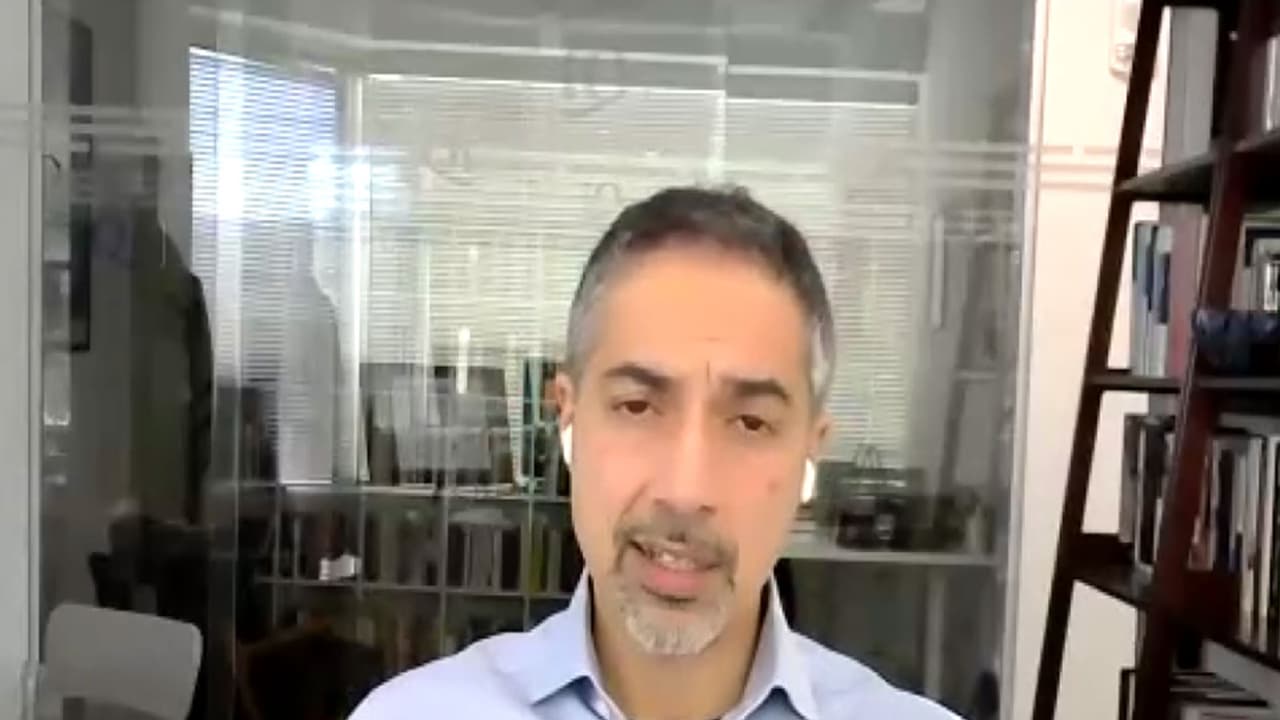
Middle East expert Trita Parsi claims there's no credible evidence for Reza Pahlavi's popularity in Iran, citing social media manipulation and nostalgia as factors for his limited support, which he says is not deep or widespread.
Middle East expert Trita Parsi on Wednesday said there was no credible evidence that the exiled crown prince of Iran, Reza Pahlavi, was popular among ordinary Iranians. Parsi, in an exclusive interview with ANI, said that some local media outlets have made him popular, but there was also dissent, especially among the diaspora.
Pahlavi's Popularity Questioned
"I haven't seen any reports or credible reports or polls that would be able to put the number at any place. I can tell you anecdotally that on the one hand, in the diaspora, there has been a massive social media manipulation conducted by the Israelis. This is reported by Haaretz in order to make him popular," Parsi said.
He further stated that public support for Pahalvi stems from nostalgia and that the Shah's son would be preferable to the current regime. "Some of that artificial manipulation has translated into organic support. And you do see organic support, undoubtedly, in the diaspora. You also see a tremendous amount of opposition to him in the diaspora. Inside the country, you also see some elements of support. Exactly how large it is unclear. A lot of people I've spoken to say that they don't see any deep support for Reza Pahlavi, but rather this is the most insulting thing they can chant at the regime to go as far as, you know, even support the son of the Shah," he said.
Nostalgia and Failed Protests
Parsi noted a sense of desperation among the public, as previous protests had failed to topple the regime. "There is definitely nostalgia inside of Iran, particularly in certain segments (that) don't even have any memory of the time of the Shah. They just hear stories that it was better. And I think it's more than anything else, a cry of desperation because nothing else has worked in their view. The Mahsa Amini protests and that revolution didn't overthrow the government. Reform didn't bring about the changes that they wanted," he said.
He then stated that although Pahalvi's initial call to action was heeded, subsequent calls were not. "So, out of the elimination of all of those other options, he has emerged as someone who has at least a modicum of support. How deep it is and how wide it is are unknown. As I mentioned earlier, although many people heeded his first call to protest on January 8th, they did not heed his subsequent calls for continued protests from their balconies or for strikes in the oil industry. None of that was heeded," he said.
Strategy Aimed at US Support
Pahalvi's strategy is to show deflection from the regime and to pretend that he has been chosen as the successor. "So it seems to me a phenomenon that cannot be dismissed, should not be dismissed, but also not one that is as big as he and his supporters are trying to make it to make it sound as if he has already been chosen by the people as a successor. But more importantly, I would have to say, his conduct and his strategy do not seem to even be based on trying to win the support of the population, and more importantly, to generate defections from the regime," he said.
He added that Pahalvi's strategy is primarily to secure support from US President Donald Trump. "That would be critical if you're actually trying to take over. Rather, his strategy seems to be aimed solely at winning Trump's support in order to have Trump install him from the top rather than him getting to power from the bottom," he said.
Iran's Future and Potential IRGC Rule
Parsi said that the regime must already have chosen its successor, and that's how things might play out. "Well, it depends on how things play out. If the plan of the regime, as it was at least until a couple of weeks ago, is that nothing changes. It's just that the supreme leader will be replaced by another supreme leader chosen already at this stage, probably someone who has been chosen or two or three names that have been our candidates," he said.
Parsi further said that Iran might go under an IRGC dictatorship. IRGC stands for the Islamic Revolutionary Guard Corps, Iran's powerful ideological and military force, established after the 1979 revolution to protect the Islamic Republic's system. It operates alongside the regular army, exerts significant economic and political influence, and is often involved in regional conflicts. "But, you know, it's pretty hush-hush about it. There's a lot of public speculation, but nothing confirmed. But if you have essentially a regime change from within, then everything can change. And then I think the likeliest scenario is that Iran will go in a much more clear and military dictatorship direction under the control of the IRGC and perhaps either not have a supreme leader or go back to what the constitution originally envisioned, which was a supreme leader council of three different ayatollahs rather than just one," she said.
Earlier on January 20, Pahlavi issued a sharp statement addressed to Iran's Supreme Leader Ayatollah Ali Khamenei, accusing him of crimes against the Iranian people. Posting on X, Pahlavi wrote, "Today I am speaking to Ali Khamenei, the leader of the regime occupying Iran. You are an anti-Iranian criminal. You have neither honour nor humanity." (ANI)
(Except for the headline, this story has not been edited by Asianet Newsable English staff and is published from a syndicated feed.)