
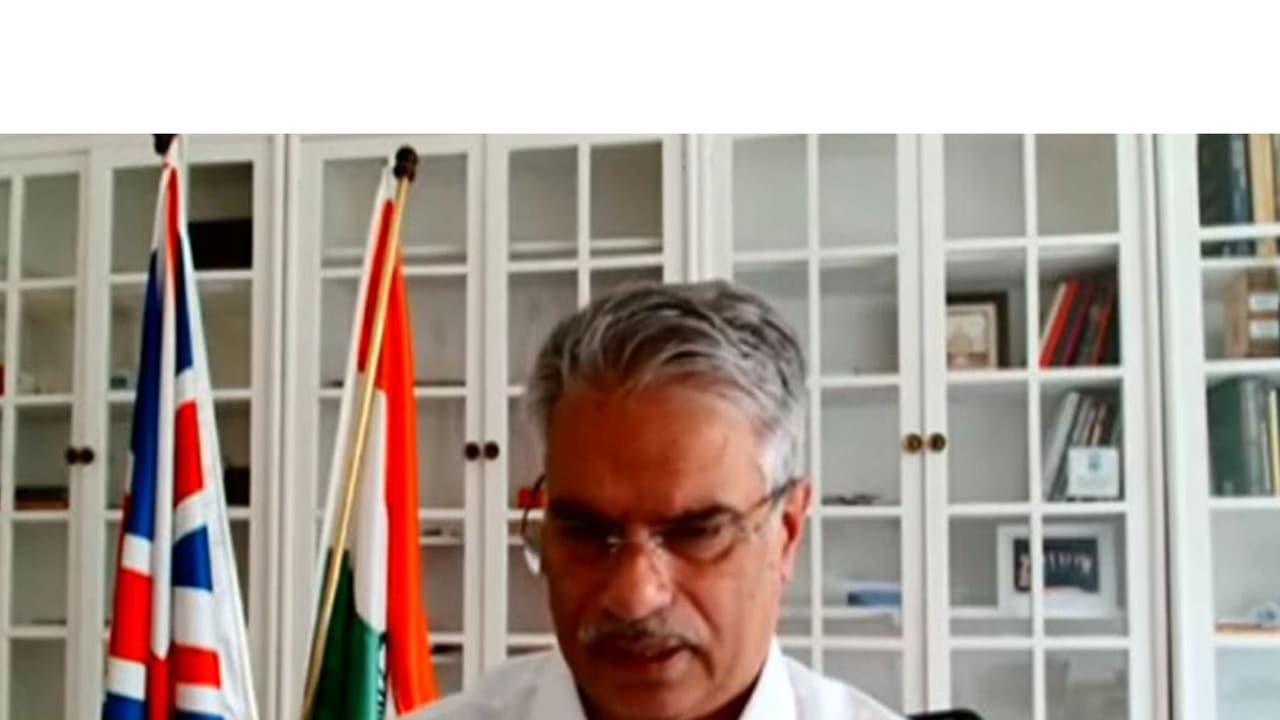
UK's Trade Commissioner Harjinder Kang has called 'political will' the key to the India-UK FTA. He highlighted the cross-party support in the UK and continuity in India that made the deal possible. The agreement comes into effect today, July 15.
London [UK], July 15 (ANI): United Kingdom's Trade Commissioner for South Asia, Harjinder Kang, on Wednesday described "political will" as the key behind the India-UK Free Trade Agreement, highlighting the significance of political and administrative continuity. The two nations signed the FTA last year in July 2025, during Prime Minister Narendra Modi's visit to the UK. The agreement will come into effect on July 15, starting today.
In an interview with ANI, Kang, who served as the UK's Chief Negotiator for the UK-India FTA, said that the final decisions on agreements are in the hands of political leadership.
Harjinder Kang said, "Unless there is political will there, these things (FTA) are very difficult to negotiate at the bureaucratic, administrative level. You need the political will. A lot of the final decisions are very much political. I need the will of the government of the day to be definitely keen on."
Cross-Party Support in the UK
Describing the UK's case, he said that the negotiations on the FTA began under a Conservative Party government; however, the Labour Party, sitting in the Opposition, was also keen on the deal. He said that the Labour Party manifesto mentioned building relationships with India, and their government took forward the negotiation work on the deal.
For India, he noted that the nation did not face any "turbulence" as the political and administrative team remained the same throughout the negotiation period.
Kang said, "This whole exercise was kicked off under the conservative government at the time. And then halfway through, there was an election in the UK where we were expecting a change of government. And the Labour government at the time were very supportive of the deal in opposition. They actually told me that they were very supportive of what you're doing in India. We want to do more of it, and we won't reverse it. We'll carry on."
"The shadow trade secretary at the time, Jonathan Reynolds, and the shadow foreign secretary at the time, David Lamy, came to India before the elections to understand in more detail what this was all about and went back with much positive views and reaffirmation of what they thought was happening. And if you look at the Labour Party manifesto, there's a paragraph in there which it says that the Labour government wants to continue to build relationships with a country called India. And no other country is mentioned in that manifesto, which is great. At the end of the day, it's just a cross-party, cross-government ambition," he added.
Continuity Key to Successful Negotiations
Further, he said that continuity in thought and the process are required to reach a deal such as the India-UK FTA.
Kang told ANI, "We didn't get a huge change in process and direction. It was a continuation in that respect. Continuation is key to these things. I was the chief negotiator for the first two years. And my deputy then took over from me. She did it for the next year and a half. Then her deputy took over from her for the last year or so. You need continuity of thought and continuity of process. And I think that sort of political and administrative continuity on the UK side really helped."
"On the Indian side, you didn't have to contend with that turbulence. It was the same team at the political level, same team at the administrative level, which is a real bonus on both sides," he added.
Economic Dividends of the Pact
Speaking on the economic dividends of the pact, Harjinder Kang emphasised the reciprocal nature of the agreement.
"It has to be a win-win. If it wasn't a win-win, no system was going to sign it off," Kang stated, pointing to the remarkably balanced trade dynamics currently shared by the two nations. "If you look at our current trade, it's almost 50-50. It's not slightly in favour of India, and it's not heavily skewed either; it is almost evenly balanced," he explained.
Looking ahead, the trade deal is set to unlock substantial growth on both sides. "The GDP addition to both markets is about $5 billion, slightly in India's favour. So, roughly $5 billion each, which again makes it quite balanced. The additional bilateral trade is expected to be around $25.5 billion between the two countries..."
Bilateral Investment Treaty: A Work in Progress
Despite the breakthrough on the trade front, securing a comprehensive investment framework remains an unfinished priority. Industry consultations in the UK before launching the trade rounds revealed that securing robust investment terms was a paramount concern for businesses.
"When we conducted consultations in the UK before entering FTA negotiations, we received a wish list of priorities from everyone; right at the top of that list was investment," Kang noted. "What we were hoping to do alongside the FTA was to negotiate a Bilateral Investment Treaty. We previously had one, which was terminated in 2017, and that would have provided some degree of protection for future investments. That agreement has not been completed in time, so it remains a work in progress," he explained.
While a finalised investment treaty is pending, Kang stressed that establishing these legal safeguards would ultimately bolster corporate confidence on both sides, particularly given India's formidable investment footprint in the UK market.
"We will continue trying to achieve progress in that area because it would make a significant difference. Companies that currently have some reservations may feel more secure, and it would probably benefit both sides," Kang said.
Pointing to the strength of Indian industry abroad, he added, "India has a significant investment presence in the UK as well. More than a thousand Indian companies have invested in the UK, representing substantial investment. In fact, India has been the second-largest investor by number of projects for the last four or five years, after the US. There is strong Indian interest in ensuring there is some degree of investment protection as well. The Bilateral Investment Treaty is still something we are keen to progress, but right now, we are where we are."
Key Features of the Agreement
The UK-India Free Trade Agreement (FTA), officially known as the Comprehensive Economic and Trade Agreement (CETA), is a landmark deal that aims to boost bilateral trade between the two nations by £25.5 billion annually. The deal includes substantial tariff reductions on goods such as textiles, whisky, and cars, making Indian exports more competitive in the UK market and vice versa. According to the Ministry of Commerce and Industry, this agreement with the United Kingdom is expected to significantly improve market access for Indian exports, with 90.2 per cent of India's exports to the UK becoming duty-free. (ANI)
(Except for the headline, this story has not been edited by Asianet Newsable English staff and is published from a syndicated feed.)