
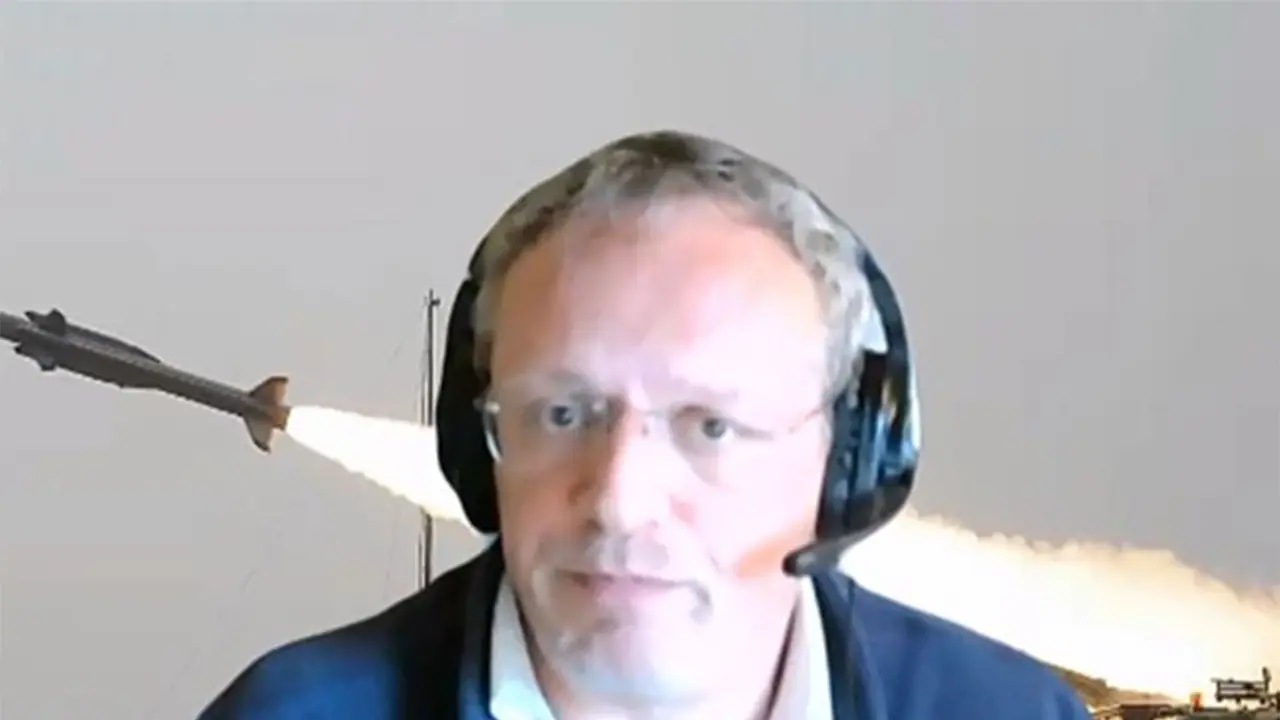
Austrian analyst Tom Cooper dismisses Pakistan's diplomatic efforts in West Asia as 'unimportant,' saying it's appeasing Trump for favours and is a hostage of its own incompetent armed forces, playing no significant role in the crisis.
In a blunt assessment of the escalating crisis in West Asia, renowned Austrian aerial warfare analyst and historian Tom Cooper has dismissed Pakistan's diplomatic efforts as "unimportant," characterising the nation as a minor player hamstrung by internal incompetence and short-term manoeuvring. Speaking to ANI, Cooper dismantled Islamabad's projection of itself as a high-level mediator between Washington and Tehran, suggesting the reality is far less prestigious.
Pakistan's Role 'Unimportant', Hamstrung by Incompetence
Cooper argued that there is a stark divide between Pakistan's international posturing and its actual strategic weight. He claimed the Pakistani government is currently focused on "appeasing" the Trump administration to secure immediate favours rather than building long-term influence. "Pakistan, let's say this, there are two worlds," he said. "Pakistan, on one side, is portraying itself as a big negotiator and so on. In reality, the Pakistani government is appeasing Trump in exchange for favours." ooper alleged that Islamabad is exploiting the US lobbying system to push agendas like the Kashmir issue, though he noted these efforts have seen "no success."
"They are exploiting political corruption in the United States. The entire system is based on political corruption... it is absolutely legal to bribe through so-called lobbyists," he said. "So the Pakistanis are exploiting this situation nominally intending to push the Kashmir issue, but actually without any success."
The analyst pointed to Pakistan's internal power dynamics as a primary inhibitor. "The country is de facto hostage of its own armed forces," Cooper stated, adding that "political and administrative incompetence" prevents the nation from playing any meaningful role on the world stage. "The actual Pakistan's role in all of this is unimportant because of political and administrative incompetence," he said, adding that the country is de facto hostage to its own armed forces and has to do whatever they want to do, regardless of consequences.
Israel, UAE Driving Agenda; US 'Entangled'
Moving beyond Pakistan, Cooper offered a provocative take on the broader West Asian conflict, suggesting that Israel and the United Arab Emirates (UAE) are driving an agenda to dominate the Middle East. "Essentially, Israel and the United Arab Emirates are attempting to impose themselves upon everybody else in the Middle East," he said, adding that this includes key regional players such as Saudi Arabia, Egypt, and Turkey. "They are doing this for the purpose of reshaping the Middle East into a collection of dysfunctional parastates, which would be impossible to govern but easier for them to control," he claimed.
Cooper further noted that the United States has become "entangled" in the conflict by backing Israel, leaving the current administration without an "honourable" exit strategy. He suggested the US is now pivoting to frame the situation as a regional clash between Iran and its neighbours to avoid direct military confrontation. "Israel was successful in getting the USA involved on its side, and the current US administration simply has no idea how to get out of this trouble in an honourable fashion," he said. "It cannot simply admit that it cannot achieve its aims and withdraw."
He added that the US is now attempting to reframe the conflict. "The Americans are trying to convert this into some sort of a conflict between Iran and its neighbours, especially the United Arab Emirates, while staying as far as possible out of direct military confrontation."
Europe Criticised for Incompetence and Energy Policies
Cooper did not spare European leadership from criticism, citing a lack of vision and a dangerous reliance on unstable energy markets. "In Europe, we have very deep fundamental problems," he said. "The first is political incompetence at the top. The second is disruption of energy supply."
He criticised European leadership for prioritising short-term stability over long-term solutions. "Our politics is obsessed with maintaining the status quo instead of developing new solutions or having any kind of vision," he said.
According to Cooper, Europe's reliance on external energy sources has compounded its vulnerabilities. "This has led to strategic mistakes, such as tying major economies to unreliable energy suppliers through long-term contracts without objective analysis of long-term effects and security," he noted.
He argued that Europe should diversify its energy sourcing and invest more in sustainable alternatives. "There is enough oil and gas globally, including in Africa and parts of Asia, but producers and intermediaries are keeping prices artificially high," he said. At the same time, he stressed the importance of renewable energy. "We should not only focus on renewable energy because it is imperative for the survival of humanity, but also ensure reliable fossil energy sources during the transition phase," he added.
Cooper's analysis paints Pakistan as a peripheral figure in a high-stakes game dominated by regional powers and a struggling West. Despite Islamabad's attempts to project influence, Cooper maintains that their actual role in the evolving West Asia crisis remains marginal at best.
"Essentially, Pakistan is playing no big role in these developments," he said. His assessment underscored the broader dynamics of the crisis, where major regional and global powers continue to shape outcomes, while countries like Pakistan struggle to convert diplomatic positioning into tangible influence. (ANI)
(Except for the headline, this story has not been edited by Asianet Newsable English staff and is published from a syndicated feed.)
