
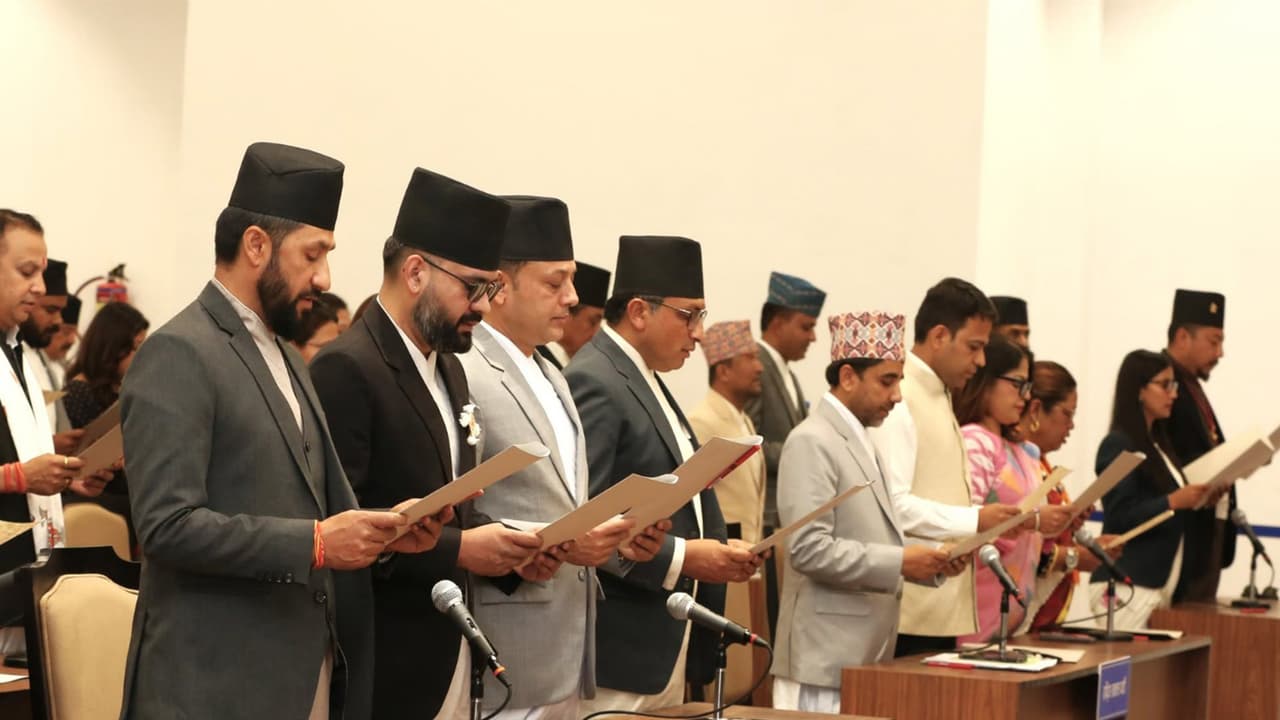
Nepal's new Parliament convened with newly elected members taking their oath of office. The session follows the March 5 elections after the previous Parliament was dissolved. The Rastriya Swatantra Party emerged as the largest party in the polls.
New Parliament Convenes for Oath-Taking Ceremony
The first meeting of Nepal's new Parliament after the elections early this month convened on Thursday, with newly elected members taking the oath of office and secrecy.
The previous Parliament was dissolved in September 2025 after the Gen-Z protest. The new lawmakers, elected through the election held on March 5, arrived at the under-construction Parliament building inside Singhadurbar, the administrative capital of the Himalayan nation, in traditional attire.
The Parliament Secretariat had requested the newly elected members of the House of Representatives to wear traditional attire while taking the oath. Nepali Congress parliamentarian Arjun Narsingh KC, the senior-most member of the House of Representatives, administered the oath to the MPs.
The ceremony was held at the under-construction multipurpose hall of the Federal Parliament at Singha Durbar. Necessary arrangements, including seating, rostrum, Speaker's chair, and designated spaces for the General Secretary, Secretaries, and other Secretariat officials, had been completed at the venue.
As per constitutional provisions, the oath-taking is mandated under Article 99 and Article 91(5) of the Constitution of Nepal, along with Section 75 of the House of Representatives Election Act, 2017.
Election Results and Party Standings
In the House of Representatives elections held on March 5, the Rastriya Swatantra Party emerged as the largest party with 182 seats, followed by the Nepali Congress with 38 seats, CPN-UML with 25, Nepali Communist Party with 17, Shram Sanskriti Party with seven, and the Rastriya Prajatantra Party with five seats.
Proportional Representation Results
Under the Proportional Representation system, 57 lawmakers were elected from the Rastriya Swatantra Party (RSP), 20 from the Nepali Congress (NC), 16 from the CPN (UML), nine from the Nepali Communist Party (NCP), and four each from the Shram Sanskriti Party and the Rastriya Prajatantra Party (RPP). The Election Commission had announced the PR election results on March 16.
First-Past-the-Post Results
Under the First-Past-the-Post (FPTP) system, the RSP secured 125 seats, followed by the NC with 19, UML with 9, NCP with 8, Shram Sanskriti Party with 3, RPP with 1, and one independent candidate. As per constitutional provisions, the House of Representatives, the lower house of the Federal Parliament, consists of a total of 275 members, including 165 elected through the FPTP system and 110 through the PR system.
(Except for the headline, this story has not been edited by Asianet Newsable English staff and is published from a syndicated feed.)