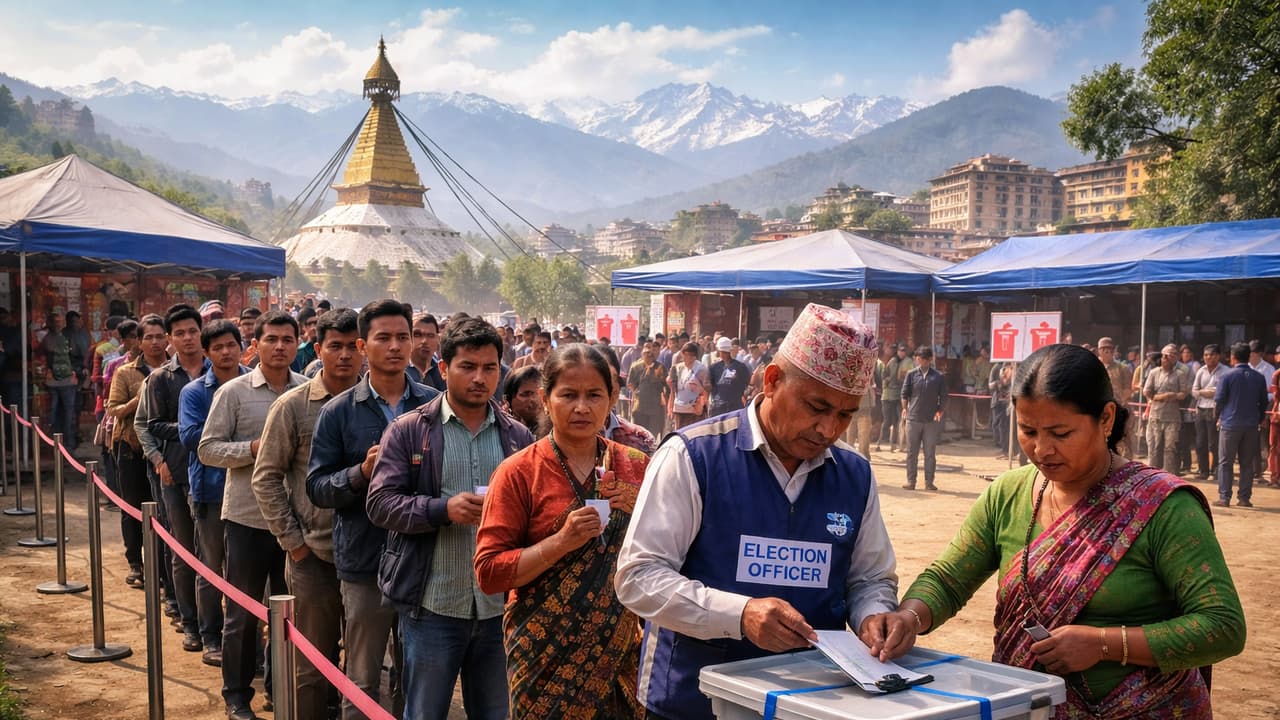
Nepal is holding a parliamentary election on March 5, 2026, following major youth-led protests in 2025 against corruption and political stagnation. Nearly 19 million people, including one million new young voters, will elect 275 representatives.
Nepal is holding a high stakes parliamentary election on March 5, 2026, the first since massive youth led demonstrations in 2025 that shook the country’s political establishment and ultimately forced the resignation of then Prime Minister K.P. Sharma Oli.
The 2026 election comes after a period of intense political activism, sparked by large Gen Z protests that began over a crackdown on social media and quickly broadened into nationwide outrage against corruption, economic stagnation and political stagnation. These protests, which tragically resulted in the deaths of dozens of demonstrators, signalled deep seated dissatisfaction with Nepal’s long standing cycle of political turbulence and shifting governments.
19 million voters, 275 seats
Nearly 19 million of Nepal’s roughly 30 million citizens are now eligible to vote for 275 seats in the House of Representatives, with 165 seats decided through direct constituency votes and 110 through proportional representation. Notably, about one million new voters — many of them young Nepalis motivated by the protest movement — were added to the rolls, amplifying the role of Gen Z in shaping the country’s political future.
Related Articles

Also Read: Nepal General Elections: EC confirms full preparation at 23,112 centres
This election marks a symbolic and generational shift, with younger voters calling for reforms that go beyond routine leadership changes. Key issues dominating the campaign include corruption eradication, job creation, economic reform, and improved governance. Many first time voters are expressing frustration with the traditional political elite’s inability to stem persistent unemployment and economic hardships, especially in rural areas. Analysts say this election will be a test of whether youth inspired momentum can translate into sustained political influence.
At the centre of this political drama is the emergence of new voices challenging Kathmandu’s older power structures. One such figure is Balendra “Balen” Shah — a 35 year old rapper turned politician and former mayor of Kathmandu — who has rapidly gained a reputation as a reform oriented candidate with strong youth appeal. Shah, running under the banner of the centrist Rastriya Swatantra Party (RSP), has pledged to address issues like healthcare, education, and job creation while tapping into disillusionment with Nepalese establishment politics.
Opposing Shah are well known veteran politicians, including K.P. Sharma Oli himself, whose decades long career represents the old guard and traditional communist establishment. As Nepalese voters go to the polls, former prime ministers and established parties such as the Nepali Congress and Communist Party of Nepal (Unified Marxist–Leninist) are closely watching their survival and relevance in this rapidly reshaping political landscape.
Also Read: Nepal Politics: How Rapper Balen Shah's Rise Challenges The Old Guard
Experts describe the election as a potential turning point for Nepal’s democracy — one that could either solidify new political forces born from protest movements or re affirm the dominance of entrenched elites. As ballots are cast nationwide under tight security, the outcome will determine whether the reform driven momentum of Nepal’s youth can redefine governance in a nation long plagued by political fragmentation and instability.