
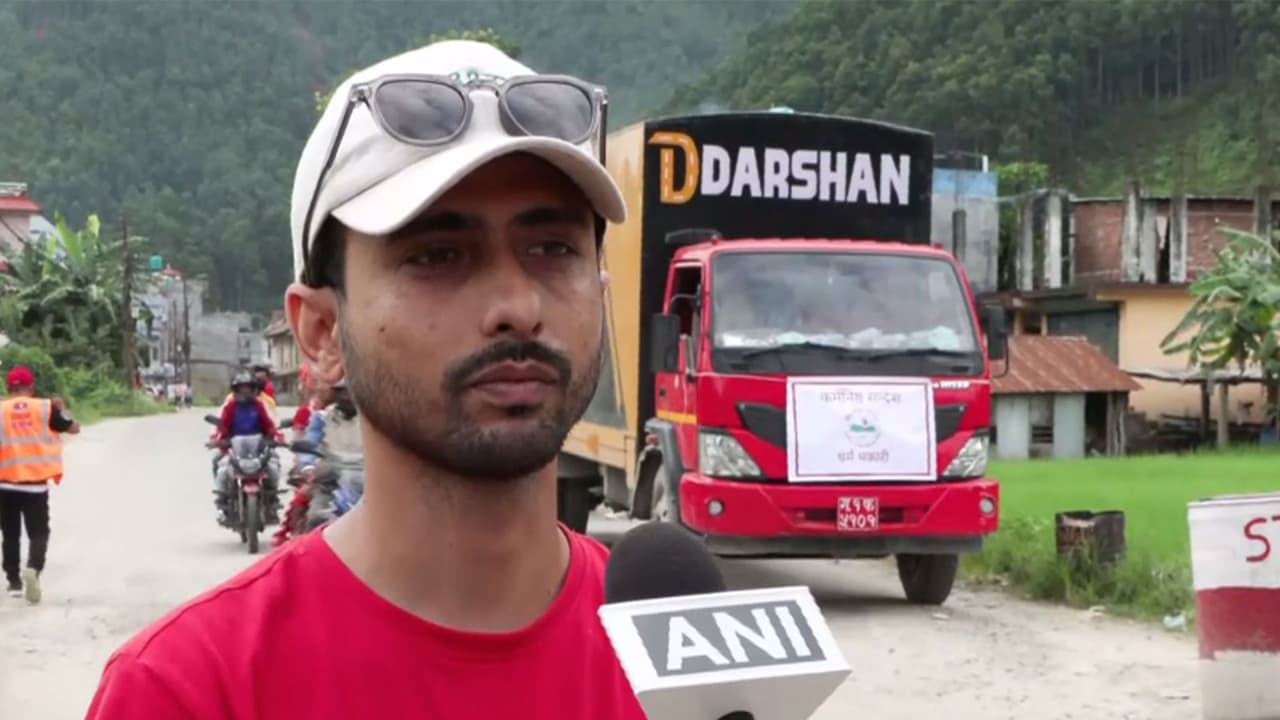
Amid devastating flash floods in Nepal's Nuwakot district, local organisations like Rastriya Sarokar Mancha Nepal are providing relief materials and essential supplies to survivors, focusing on food, medicine, and basic amenities.
As devastating flash floods continue to affect parts of Nepal, local organisations and NGOs have also stepped up efforts to provide relief material and essential supplies to survivors in Nuwakot district. Small trucks were seen transporting relief material to flood-affected areas, with volunteers engaged in distributing supplies among people in need.
The Rastriya Sarokar Mancha Nepal, Kathmandu, under its 'Karmanishtha Abhiyaan' (Mission of Duty) campaign, has sent its third batch of relief material, focusing on food supplies, basic amenities and essential items for affected families.
NGOs Step Up Relief Efforts
Speaking to ANI, Rastriya Sarokar Manch national spokesperson Pratik Joshi said, "This is part of our 'Karmanishtha Abhiyaan' (Mission of Duty) campaign. This is our third batch--the third vehicle. Our friends had also taken supplies from here previously; so, this is the third time we are bringing aid here. We have focused primarily on daily essentials--specifically food--and the most critical arrangements regarding food and accommodation."
On the requirements of flood-affected people, Joshi said the government's attention was currently focused on rescue operations, and citizens needed to come forward to support those affected. "The primary issue is that the government's attention is currently divided due to the ongoing rescue operations. We believe that as Nepalis, we should step up to help fellow human beings. Since the government is unable to fully focus its attention there right now, we decided to make our own efforts to provide assistance," he said.
"Based on what our friends shared with us--specifically regarding the need for food supplies, decent sleeping arrangements, and addressing gaps in basic amenities--we decided to focus on these areas," he added.
Focus on Essentials and Medical Aid
Joshi said the organisation provided food grains and high-protein items such as chickpeas and puffed rice (furandana) along with foam mats for survivors. "We are providing food grains and high-protein items like chickpeas and puffed rice to ensure people can have an extra meal during the day. We also brought foam mats so that children don't have to sleep on the cold ground; we've focused on these kinds of essentials. Previously, we had also provided medicines and similar supplies," he said.
Highlighting the need for medicines in flood-hit areas, Joshi said many survivors were vulnerable to health issues due to the disaster. "Given the nature of the incident, many people are traumatised. Consequently, a variety of medicines might be required. With the continuous water exposure, issues like fever and viral infections could arise. It is a highly vulnerable population, which is why we tried to make some advance arrangements," he said.
Reviving 'Dharma Bhakari' Tradition
He said the initiative was also aimed at reviving the traditional concept of 'Dharma Bhakari', a community-based system of collecting essential resources for emergencies. "Through this effort, we wanted to revive the concept of 'Dharma Bhakari'. This is rooted in our traditional philosophy--a concept of a community-based collection centre known as 'Dharma Bhakari'. In the past, the community would contribute according to their means to build up a stock, which could then be opened and utilised for crisis management during disasters," Joshi said.
He added that the organisation collected goods directly instead of accepting monetary donations. "We didn't accept cash from our supporters; instead, we sourced the actual goods and materials directly. We organised everything by coordinating with various people to get specific tasks done. Ultimately, the gap is not as wide as we imagine. We feel that the entire community should come together and move forward in this spirit," he said.
Meanwhile, a two-storey mint-green house in Nepal's Trishuli region has drawn attention after it remained almost untouched amid widespread destruction caused by flash floods. The house, which has gone viral on social media, stands surrounded by a landscape where buildings have been washed away, bridges have disappeared, and families have been displaced.
Scale of the Disaster and Rescue Operations
Nepal continues to deal with one of its worst recent flood disasters. According to the National Disaster Risk Reduction and Management Authority (NDRRMA), the death toll rose to 903 on Monday, while around 4,247 people remained missing. A total of 10,451 people have been rescued so far.
Chitwan has reported the highest number of casualties at 272, followed by Nawalparasi East with 207, Nawalparasi West with 151, Nuwakot with 95, Gorkha with 62, Dhading with 55, Tanahun with 37 and Rasuwa with 24.
The missing include security personnel, government employees, hydropower workers and foreign nationals. Nuwakot has reported 1,548 missing persons and Rasuwa 865, according to District Emergency Operations Centre data.
Rescue operations are continuing on the ground and by air. The Nepal Army has conducted aerial rescues of 252 foreigners and 3,344 Nepali nationals, while 411 flights have been conducted as part of rescue and relief operations.
On August 30, 15 people from a hydropower site, including five Chinese and seven Indian nationals, were rescued.
Nearly 20,000 security personnel have been deployed for rescue operations. Ground teams have carried out 8,730 rescues, while helicopter operations have airlifted thousands of people from affected areas. (ANI)
(Except for the headline, this story has not been edited by Asianet Newsable English staff and is published from a syndicated feed.)