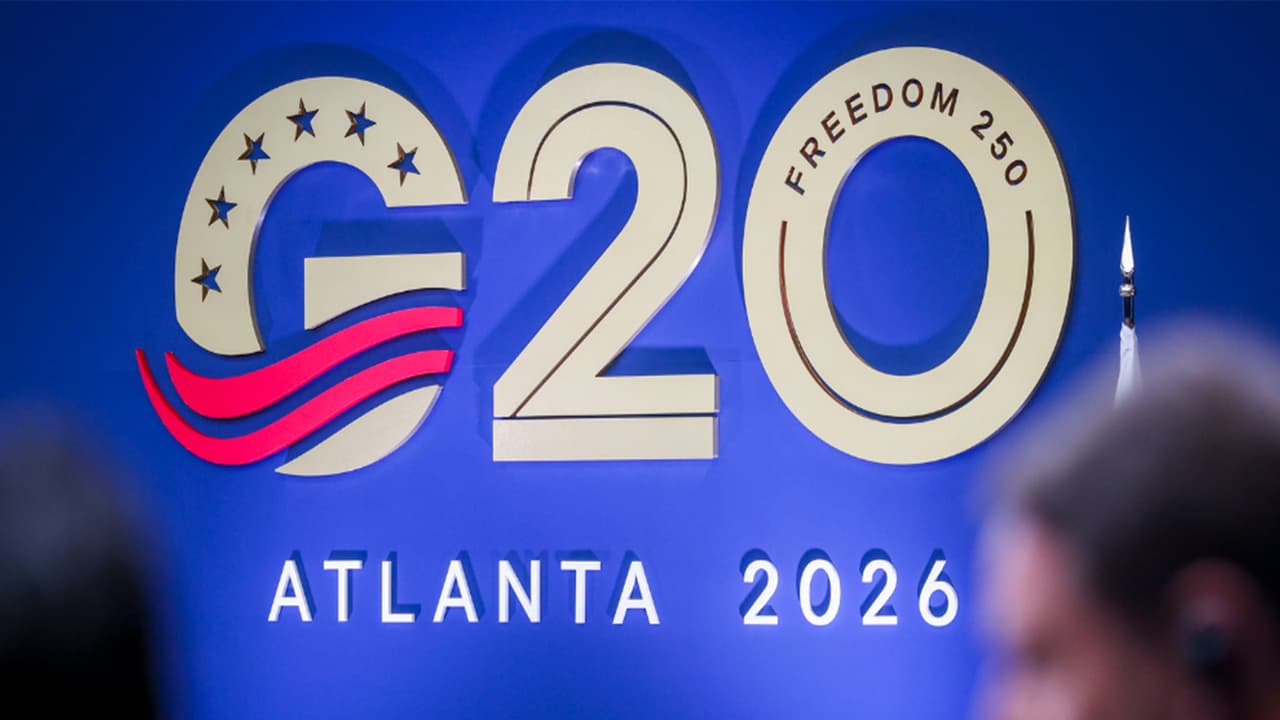
External Affairs Minister S Jaishankar joins G20 talks in Atlanta focused on energy security and supply chains, following the cancellation of the traditional group photograph due to a diplomatic dispute over Russian participation.
G20 Foreign Ministers Gather in Atlanta
External Affairs Minister S Jaishankar has joined G20 foreign ministers in the US city of Atlanta for talks on energy security and supply chains, as a row over Russia’s attendance led to the cancellation of the traditional group photograph. Jaishankar, who arrived on Friday, will also attend a meeting of the Quad, the grouping of India, the US, Japan and Australia, on the sidelines of the two-day gathering.
Several European ministers had threatened to boycott the photograph or walk out of it rather than stand alongside Russian Foreign Minister Sergei Lavrov, according to US officials. US Secretary of State Marco Rubio, who is hosting the meeting, scrapped the picture because he believed the dispute would be a distraction, two of those officials said, speaking on condition of anonymity. The talks otherwise went ahead as planned.
Diplomatic Tensions and Policy Stances
Unease over Russia’s invitation had been building. Some members questioned why Moscow was invited while its attacks on Ukraine were intensifying. Those concerns grew after President Donald Trump waived fresh sanctions on Russia and temporarily limited logistical and intelligence support to Ukraine, a move that pushed ties between Washington and Kyiv to a new low.
German Foreign Minister Johann Wadephul told reporters in Atlanta that European ministers would not pose with Lavrov. He said he expected there would be no group photograph at all and that there could be “no normality” with Russia. The UK said it had long avoided direct bilateral contact with Russian ministers since the invasion of Ukraine and that this would not change. Poland’s Radosław Sikorski called the cancellation “the right decision” and said he was not alone in refusing to be photographed with Lavrov.
Focus on Economic and Geopolitical Stability
The US says the agenda includes energy, supply chains and keeping sea lanes open. These issues directly affect India, which relies heavily on imports of oil, liquefied natural gas and fertiliser. In his opening remarks, Rubio urged ministers to work together, calling it a “moment of choosing” for the US and the world. He pointed to linked economic and geopolitical crises, including disruption to energy and food supplies, trade tensions and threats to freedom of navigation.
Setting the gravity of the talks, Rubio warned that the meeting came at a pivotal turning point for international stability. "I hope this will be a productive meeting, as we are in a critical moment. I would call it a moment of choosing, and I would say not just for my country, the United States of America, but frankly, for the world," Rubio said while addressing the meeting, which was also attended by External Affairs Minister S Jaishankar.
Elaborating on the nature of the crisis, Rubio stressed that nations were confronting compounding instability that directly impacts international commerce and security. "We are facing a series of interconnected economic and geopolitical crises, many of which pose severe threats, severe threats to essential foundations of the global economic order. New disruptions and strains to global energy and food supplies, and food markets, to the global supply chain, to trade, to freedom of navigation itself," he noted.
Against this backdrop, Rubio called for unified action among the world’s leading economies to safeguard global markets. He insisted that "the G20 must work together to confront these threats, to strengthen our economic resilience, to safeguard our markets and the economies that they sustain."
Strategic Objectives and Future Cooperation
Addressing the broader policy environment, Rubio pointed to the ongoing initiatives under President Donald Trump’s administration, noting that "the challenges we have addressed during the presidency of President Trump are multifaceted and interconnected, and the solutions must be too." Rubio explained that the ministerial gathering served as an essential foundation for long-term diplomatic objectives.
"Here, we can help set the context for expanded geopolitical stability and the broader economic prosperity agenda that our leaders will tackle," he said, highlighting the vital responsibility placed on diplomats and political leaders to act on behalf of their respective nations. "As diplomats, as political leaders, uh, we have a vital role to play," Rubio told the attendees. "We are tasked, on behalf of the nations that we serve, to work together with one another to coordinate responses to emerging crises and to protect our shared interests."
Furthermore, Rubio urged delegates to convert strategic dialogue into tangible political outcomes. "By translating our shared interests into practical cooperation and real action," Rubio emphasised, "we can reinforce global stability, and more importantly, we can deliver meaningful results for our citizens."
Highlighting key aspects of his address at the meeting, Rubio wrote in a post on X, "At today’s G20 Foreign Ministers’ Meeting, I made clear that maritime and food security drive economic security. Through our America First agenda, the United States is encouraging partners to protect shipping routes, strengthen food security, and reduce the economic consequences of geopolitical crises."
Quad and Bilateral Engagements
At the Quad meeting, ministers are expected to discuss Indo-Pacific strategy, technology, artificial intelligence and critical minerals. India’s Foreign Ministry says Jaishankar will also hold one-on-one talks with other G20 counterparts. Rubio’s own schedule includes meetings with Turkey’s Hakan Fidan and Saudi Arabia’s Prince Faisal bin Farhan. He will also meet Japan’s Motegi Toshimitsu and South Korea’s Cho Hyun, and the three will sign a trilateral Arctic Pacific partnership agreement.
The Group of 20 is a forum of major advanced and emerging economies that coordinates global economic policy. It was founded in 1999 after the Asian financial crisis. Its members are 19 countries, the European Union and the African Union, which joined in 2023. South Africa does not appear on the list of participants for the 2026 G20 leaders’ summit published by the US, while Poland, which is not a regular G20 member, does. President Donald Trump will host the summit in Miami in December. (ANI)
(Except for the headline, this story has not been edited by Asianetnews Editorial staff and is published from a syndicated feed.)