
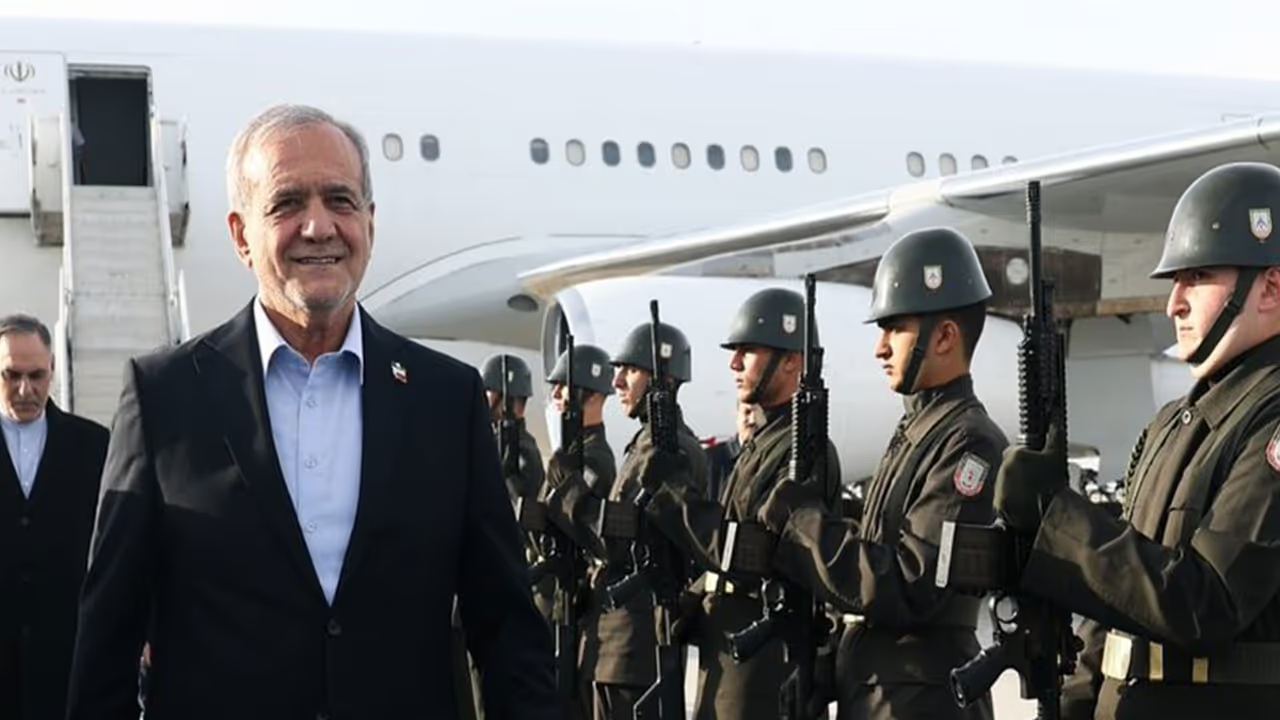
Iranian President Masoud Pezeshkian arrived in Turkiye for COP31, condemning the US as a threat to global peace and security while promising to address regional environmental damage caused by Western actions during the international summit.
Iranian President Addresses Geopolitical Tensions at COP31
Iranian President Masoud Pezeshkian arrived in Turkiye on Wednesday to attend the 31st UN Climate Change Conference (COP31). On his arrival the Iranian President described the US as a power that threatens Global peace and security. "They waged war, claiming to stop Iran acquiring nuclear weapons. Then they used the PrSM missile in Lamerd for the first time. Now they invoke the "Mother of All Bombs" to pursue diplomacy through threats. No contradiction, but a disgrace. Who threatens global peace and security?," he said in a post on X.
Prior to his departure for the international environmental summit, he had asserted that the United States and Israel are confronting political fallout stemming from military conflicts, as reported by Iran's semi-official Mehr News Agency. Describing the summit as an important opportunity to discuss regional issues and the environmental damage caused by aggressors, Pezeshkian noted that 196 nations are participating in the gathering, with 71 delegations headed by presidents or prime ministers. He indicated that he would utilise the event to address the ecological devastation inflicted upon Tehran and neighbouring territories by Washington and Tel Aviv.
Criticism of Western Policy and Diplomatic Stance
Furthermore, the Iranian President maintained that during his scheduled meetings, he would discuss the crimes perpetrated by the United States and Israel throughout the region, arguing that recent electoral verdicts reflect widespread public rejection of warmongering figures. He added that political outcomes observed across Western states and Palestine contradict the stated values of administrations professing a commitment to democratic principles and human rights, expressing optimism that the official mission would effectively communicate the aspirations of the Iranian public.
Military Warnings and Diplomatic Friction
Earlier, General Ali Abdollahi, Chief of Staff of Iran’s Armed Forces further emphasised Iran's hardened position saying anyone threatening Iran will be considered a direct target for asymmetric operations, warning the US and Israel of more devastating strikes if they make further miscalculations. "Every threat hub targeting Iran will become a direct target of asymmetric operations. We warn the enemy that the previous slaps were only the beginning. The uninterrupted production of weapons has been made possible even under enemy fire and heavy bombardment. Production lines deep underground are increasing the country’s assets," he said.
Meanwhile, the diplomatic engagement in Ankara unfolds against a backdrop of escalating geopolitical friction between Tehran and Washington. Iranian Foreign Minister Abbas Araghchi recently criticised Washington's approach towards Tehran, arguing that unrealistic expectations and American "delusions" have contributed to the failure of US policies. In a post on X, Araghchi revisited remarks made eight years ago by former US Secretary of State Mike Pompeo, who had suggested that Iranians would need to comply with the White House's demands if they wanted access to basic necessities such as food. Drawing a comparison with the current administration, the Iranian foreign minister accused US Secretary of State Marco Rubio of repeating similar rhetoric, despite the experiences of Cuban Americans affected by comparable policies.
"Eight years ago, a cartoon character like Pompeo said Iranians must follow White House diktat 'if they want to eat'. Today, Rubio, whose fellow Cubans are victims of the same policy, repeats that drivel. Forget about the inhumanity. It's the delusions that are producing failed US policy," Araghchi wrote, arguing that Washington's stance was not only inhumane but also based on mistaken assumptions that have undermined the effectiveness of American strategy.
In Washington DC, according to an Axios report, US President Donald Trump is said to have settled on a third option in the Iran conflict, choosing to intensify economic pressure on Tehran rather than resume military strikes or agree to a peace deal under terms deemed unacceptable by the US. With status quo continuing in West Asia, the situation is still on the edge. While conflict is likely to give way to hectic diplomatic parley its success remains a question.
(Except for the headline, this story has not been edited by Asianetnews Editorial staff and is published from a syndicated feed.)








