
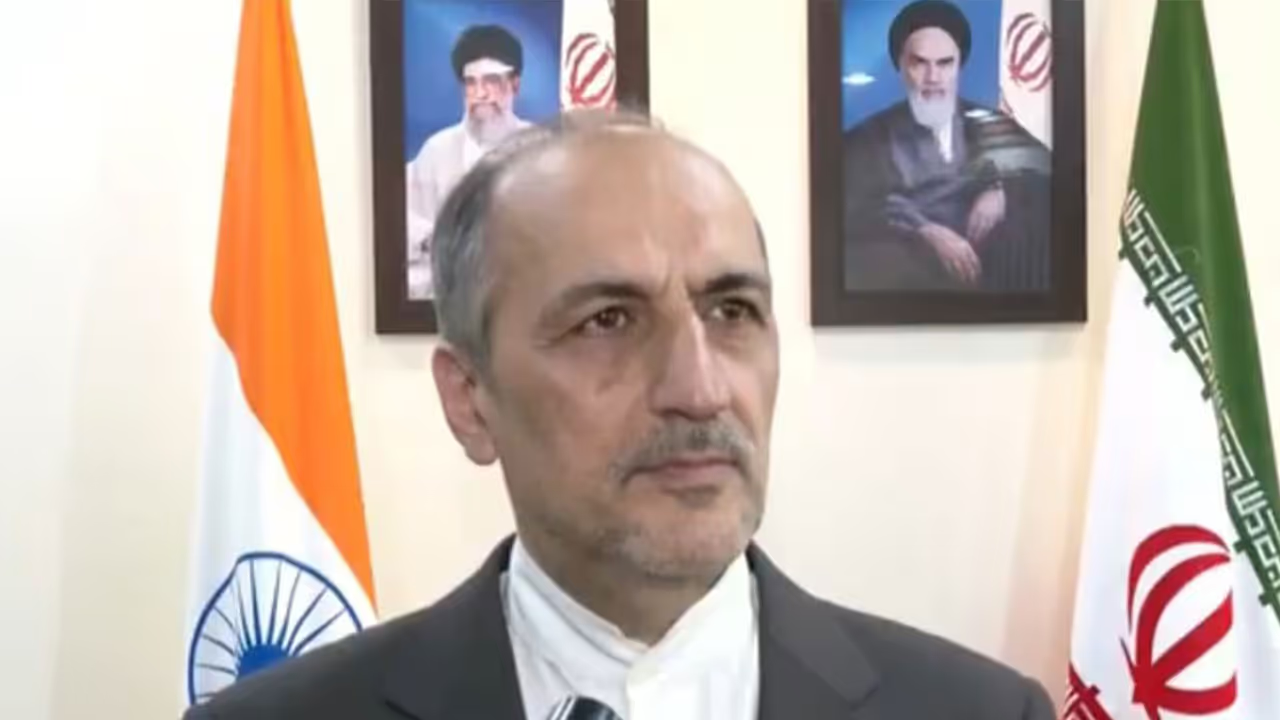
Iran's Consul General in Mumbai refuted US President Donald Trump's claims of controlling the Strait of Hormuz, asserting the waterway is 'completely under Iran's control' and will reopen only after Tehran's conditions under a 14-point MoU are met.
Iran Slams Trump's 'False' Claims
Iran's Consul General in Mumbai, Saeid Reza Mosayeb Motlagh, on Thursday slammed US President Donald Trump's claims that Washington has control over the Strait of Hormuz, calling the assertion "false" and maintaining that the strategically vital waterway is "completely under Iran's control." Speaking to ANI on whether the United States or Iran controls the Strait of Hormuz and whether Tehran would fully reopen it to international shipping, Motlagh said Iran could reopen the waterway once Washington fulfils its commitments and accepts Tehran's conditions.
"The Strait of Hormuz is completely under Iran's control. Mr Trump has made a false claim that the strait is under our control and that the United States has destroyed Iran's naval forces and missile forces," Motlagh said. "Unfortunately, judging from his statements, he seems to believe that this is the case," he added.
Safety of Neighbours a Priority
The Iranian diplomat stressed that any future arrangements concerning the waterway must ensure the safety of Iran as well as neighbouring countries along the Persian Gulf and Gulf of Oman. "One important point is that there must be no damage to the territory of the Islamic Republic of Iran. At the same time, we believe that no harm should come to the countries on the southern shores of the Persian Gulf and the Gulf of Oman either," he said.
Conditions for Reopening
Motlagh said Tehran was prepared to reopen the Strait of Hormuz once its conditions, under the 14-point Memorandum of Understanding (MoU), were met. "Iran can reopen the Strait of Hormuz once the United States fulfils its commitments and Iran's conditions are fully accepted," he said.
Trump Asserts 'Total Control'
His remarks came as Trump repeatedly claimed that the United States had control over the strategic waterway, through which a significant share of global energy supplies passes. Trump made similar remarks on Tuesday, saying that the US had "total control" over the Strait of Hormuz and expressing support for the idea of declaring the strategic waterway US territory.
"I think it's a great idea. I mean, we control it with the blockade. I like the idea of declaring it a territory. We have total control over the Strait," Trump told reporters. Trump also said the Strait remained open and that oil prices were falling, while warning that Iran was under severe economic and military pressure. He acknowledged that Iran could still "be a nuisance" by placing mines in the water but maintained that the US blockade had been effective.
Iranian Parliament Reinforces Stance
Iran has rejected Washington's assertions over the waterway. Iranian Parliament Speaker Mohammad Bagher Ghalibaf has also said that Tehran would not reopen the Strait of Hormuz until the United States fulfils commitments under a 14-point Memorandum of Understanding, including lifting the blockade, releasing frozen Iranian assets and lifting oil sanctions.
Addressing the 180th open session of Iran's 12th Parliament, Ghalibaf said Iran's military and diplomatic tracks would work together in responding to what he described as a US "breach of covenant". "Until America's commitments in the memorandum of understanding -- including lifting the blockade, releasing frozen assets, lifting oil sanctions, ending threats and military operations on all fronts, and other conditions to which America committed -- are implemented, the 'Strait' will not be opened," Ghalibaf said.
Ghalibaf also warned that Iran was prepared to mount a renewed military response to what Tehran described as violations of the ceasefire understanding, saying its military and diplomatic efforts would be coordinated in response to any breach.
Heightened Tensions and Global Significance
The conflicting statements from Washington and Tehran underscore the continuing uncertainty surrounding the status of the Strait of Hormuz amid heightened tensions between the two countries. The Strait is a critical global energy transit route, making the dispute over its control and access particularly significant for international shipping and energy markets. (ANI)
(Except for the headline, this story has not been edited by Asianet Newsable English staff and is published from a syndicated feed.)