
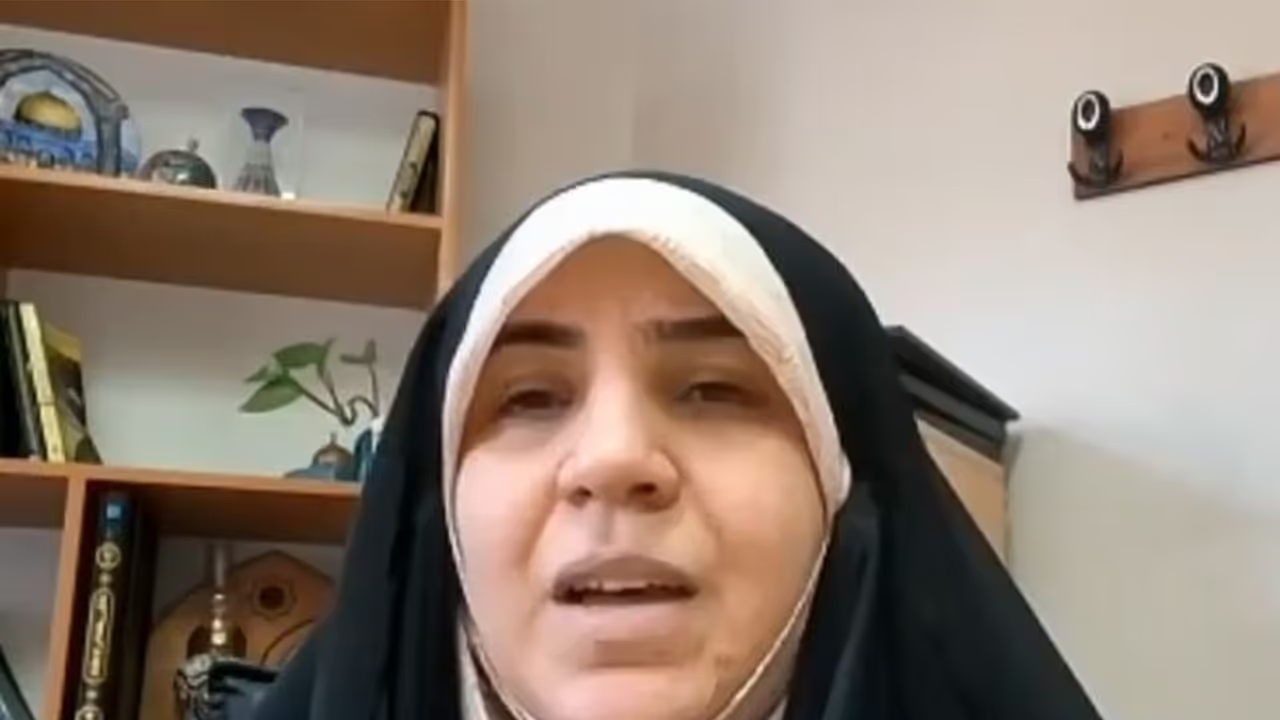
Iran views the Strait of Hormuz as a key strategic deterrent against potential attacks by the US and Israel, according to an Iranian academic. Tehran aims to bolster this leverage amid escalating regional hostilities and diplomatic uncertainty.
Assistant Professor of West Asian Studies at the University of Tehran, Elham Kadkhodaee, has said that Iran views the Strait of Hormuz as a strategic lever of deterrence aimed at ensuring that the United States and Israel 'think twice' before launching any attack on the country. She said Tehran is seeking to strengthen this deterrence mechanism amid escalating tensions in West Asia, particularly in the backdrop of ongoing hostilities between Iran and Israel.
'Escalation was Predictable': Iranian Academic
Speaking to ANI on Monday following a recent escalation involving intense rounds of attacks and counterattacks, Kadkhodaee described the situation as "predictable," citing developments in the region, particularly Israel's actions in Lebanon and broader regional tensions. She claimed that violations of ceasefire understandings and strikes in sensitive areas, particularly in Lebanon, had pushed the situation towards further escalation.
"This round of escalation between Iran and Israel was very much predictable, given the way that Israel is acting and behaving inside Lebanon, because from the very beginning, Iran had stated that a kind of ceasefire on all fronts was what Iran was after. It was a kind of a prerequisite for entering negotiations with the United States," the assistant professor said.
"Israel has been continuously violating the ceasefire; it's actually been occupying big parts of southern Lebanon, but for it to just attack outright the Lebanese capital, Beirut, it's something else; it's like a real red line that Israel has crossed, and Iran is determined to demonstrate that when it stands by its words," she added.
Deterrence Central to Iran's Strategy
Kadkhodaee described Tehran's core objective as ensuring security for its people as well as stability for allied regional actors, adding that maintaining deterrence remains central to Iran's strategy, particularly in preventing what she described as unchecked military actions by Israel and the United States.
"Iran wants to achieve security, guarantee security for its own people and also for the other civilians in the region, especially the countries that are allied with Iran and are resisting Israeli occupation and Israeli aggression. So, a big issue for Iran is maintaining deterrence, meaning that the Israelis and the Americans do not feel free to attack our country anytime they please," she said.
Strait of Hormuz as a Key Lever
"A big part of why Iran is holding strong onto the Strait of Hormuz is that it's the only, it's one of the most important options that it has in terms of maintaining this kind of deterrence which Iran is trying to build and to make it grow stronger and stronger so whenever Israelis and Americans again think about attacking our country, they will think about it twice and they may make wiser decisions, hopefully," she added.
Domestic Support and Scepticism Towards US
On public sentiment in Iran, Kadkhodaee claimed there is significant domestic support for the government's response to recent developments, stating that sections of the population view retaliatory actions as necessary for national and regional security.
Commenting on future developments, she said the trajectory of the conflict remains uncertain, alleging a lack of trust in US and Israeli commitments and further suggested that Israel's military actions are closely linked with American support and coordination.
Kadkhodaee also referred to ongoing diplomatic efforts, including statements from US President Donald Trump suggesting a possible deal, but said Iran remains sceptical about the durability of any agreement.
"Our adversaries, the Americans and the Israelis, are not honest at all, so it's very difficult to be able to predict what's going to happen. Trump, up to now, has been trying to frame an image in which the Americans are trying to restrain the Israelis, the Israelis are not buying into that; they're not proving to be very much restrainable. So we'll have to wait and see how serious this issue is for the Americans because everyone in Iran knows that the Israelis will not be able to carry on attacks on Iran without the support of the American military," she said.
Kadkhodaee concluded that effective deterrence can only be achieved through military capability, along with the clear willingness and resolve to use that strength against an adversary.
Direct Hostilities Erupt Amid Ceasefire Talks
This comes after Israel and Iran on Monday, marking the conflict's 100th day, officially traded direct fire, putting the region's already fragile truce in serious jeopardy and threatening to reignite an all-out regional war. This latest round of multi-front kinetic actions included a strike on an Iranian petrochemical complex and what Iran's Revolutionary Guard confirmed was the targeting of two Israeli bases.
These severe hostilities erupted just hours after US President Donald Trump reportedly called on Israel to refrain from retaliating against Tehran's missiles. The foundational breakdown of the cross-border truce infrastructure originally escalated after Israel launched airstrikes at Beirut's southern suburbs on Sunday. This initial action led to Iran retaliating with its own strike on Israel, ultimately triggering Monday's intense round of attacks and counterattacks.
This sudden re-eruption of hostilities has cast a foreboding shadow over diplomatic efforts to permanently end the war, which originally commenced on February 28.
Following this, Trump stated that both Iran and Israel are looking to implement an "immediate ceasefire," adding that the final negotiations on a peace deal aimed at achieving a complete solution to the West Asia conflict are currently underway. However, he cautioned that "ignorance or stupidity" could derail efforts to reach a final agreement.
"Both sides, Israel and Iran, are looking to do an immediate CEASEFIRE! Final negotiations on "Peace" are proceeding, subject to ignorance or stupidity getting in its way," Trump stated in a post on Truth Social.
The US President also noted that Washington's blockage of Iran will continue until a deal is reached, noting that the deal is moving "quickly."
"The Blockade will remain in place, and in full force and effect, until a 'Final Deal' is reached. Things should move quickly," the post added. (ANI)
(Except for the headline, this story has not been edited by Asianet Newsable English staff and is published from a syndicated feed.)