Fresh protests erupted across Iran as demonstrations entered a fourteenth day despite a nationwide internet blackout and deadly crackdowns. Rights groups warn of rising deaths, while protesters demand an end to clerical rule.
Fresh anti-government protests broke out across Iran on Saturday night as demonstrators continued to challenge the Islamic republic for the fourteenth consecutive day. Protesters took to the streets despite a nationwide internet blackout and an increasingly violent security crackdown. The unrest has become the most serious challenge to Iran’s clerical leadership in more than three years, with rights groups warning of rising deaths and global leaders expressing concern.
Protests continue despite internet blackout
Chants against Iran's leadership echoed through parts of Tehran late on Saturday as crowds gathered again, even though the government has shut down internet access across the country.
According to internet monitoring group Netblocks, the blackout has now lasted more than 48 hours. The shutdown has made it difficult for people to communicate, share information, or confirm the scale of protests and casualties. Despite this, videos have continued to emerge through limited connections and satellite links.
Related Articles

The demonstrations first began two weeks ago, triggered by worsening economic conditions, rising prices, unemployment, and public anger over corruption and repression. Over time, the protests have grown larger and more political, with many protesters now openly calling for the removal of Iran’s clerical rulers.
Tehran sees renewed street demonstrations
On Saturday night, crowds gathered in northern areas of Tehran, setting off fireworks, banging pots, and shouting anti-government slogans. Some protesters voiced support for Iran’s former monarchy, which was overthrown during the 1979 Islamic revolution.
Videos verified by AFP showed demonstrators chanting in the streets while cars honked in support. Other footage, which AFP could not independently verify, suggested protests also took place in different neighbourhoods of the capital.
On Friday, similar scenes were reported in Tehran’s Saadatabad district, where protesters chanted slogans including “death to Khamenei” as passing cars sounded their horns in approval.
An AFP journalist in Tehran earlier reported deserted streets and darkness ahead of planned protests, with many businesses closing early due to safety fears.
Protests spread to multiple cities
Demonstrations have not been limited to Tehran. Images and videos shared by activists and Persian-language television channels outside Iran showed protests in several major cities, including Mashhad in the east, Tabriz in the north, Hamedan in the west, and the holy city of Qom.
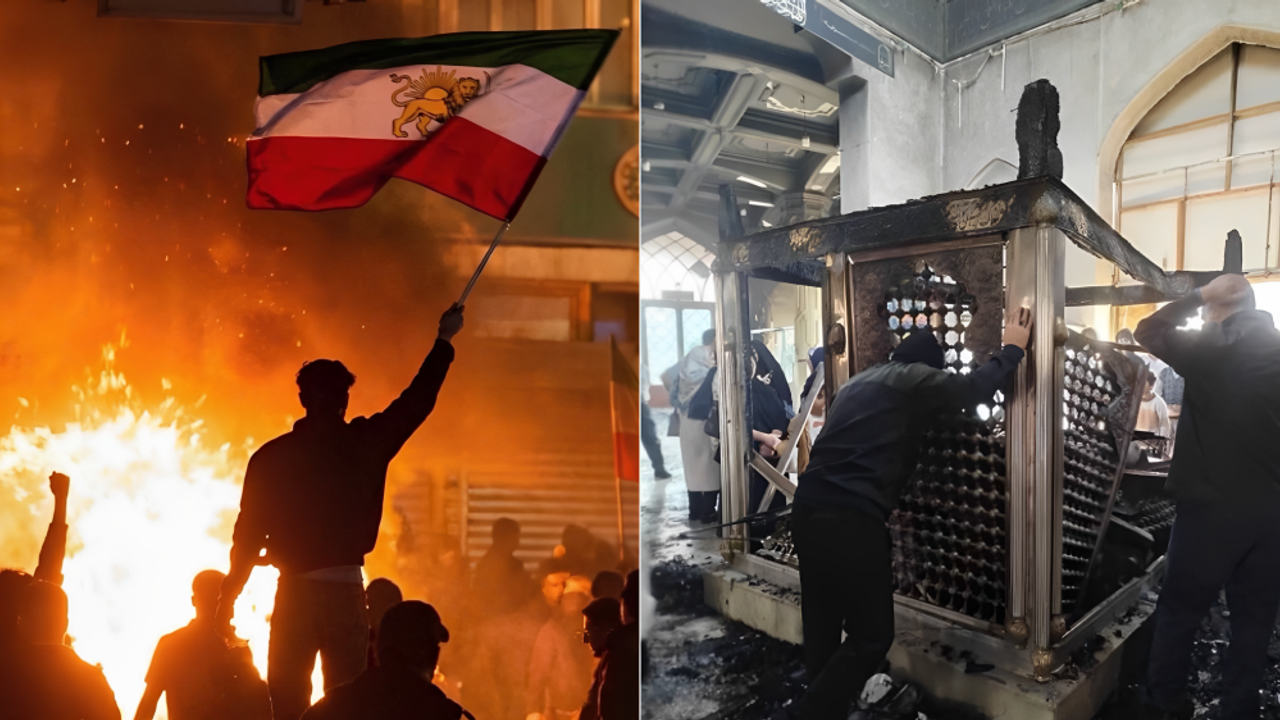
In Hamedan, footage showed a man waving a pre-revolution Iranian flag featuring the lion and sun symbol, while people danced near burning debris. The same flag briefly replaced Iran’s current flag at the country’s embassy in London after protesters managed to reach the balcony, according to witnesses.
Even US President Donald Trump liked the footage of an Iranian in London, UK raising the Lion and the Sun flag above Iran's regime's embassy.
The Institute for the Study of War, a US-based think tank, said protest activity continued across Iran despite the internet shutdown. Its Critical Threats Project recorded 60 protests across 15 provinces since midnight local time on January 10. Of these, 25 were medium-sized and eight were described as large.
Calls for organised resistance
Reza Pahlavi, the US-based son of Iran’s last shah, has become a prominent voice during the unrest. In a video message shared on social media, he urged Iranians to move beyond spontaneous protests.
“Our goal is no longer just to take to the streets,” Pahlavi said. “The goal is to prepare to seize and hold city centres.”
He praised the large demonstrations seen on Friday and called for more targeted action over the weekend. His comments were welcomed by some protesters but criticised by Iranian authorities, who accuse foreign-backed figures of fuelling unrest.
Internet blackout raises concern
The ongoing internet shutdown has raised serious concerns among human rights groups. Amnesty International said it was analysing “distressing reports” that security forces had intensified their use of lethal force under the cover of the blackout.
The lack of internet access has left many Iranians unable to contact family members, check work emails, or access basic services. One man in Tehran said on Saturday that he could not even check his email.
“This is the price to pay before the victory of the people,” he said.
Rights groups fear the blackout is being used to hide the true scale of arrests and killings.
Death toll and rights groups’ warnings
Norway-based Iran Human Rights said at least 51 people have been killed so far during the crackdown, though it warned the real number could be much higher.
The group shared images it said showed bodies of protesters who had been shot dead lying on the floor of Alghadir hospital in eastern Tehran.
“These images provide further evidence of the excessive and lethal use of force against protesters,” the group said.
Journalist and activist Masih Alinejad claimed in a post on X that hundreds of protesters had been killed. She called on the international community to take stronger action.
“This is not a protest. It is a revolution,” she wrote. “This is a war against unarmed people and they need the world’s support.”
Security forces and state response
Iranian authorities say several members of the security forces have also been killed. State television broadcast images on Saturday of funerals for security personnel, including a large gathering in the southern city of Shiraz.
State media also aired footage of buildings, including a mosque, on fire, blaming protesters for violence and destruction.
Iran’s army issued a statement saying it would “vigorously protect and safeguard national interests” against what it called an enemy seeking to disrupt order and peace.
The government has shifted its language in recent days. According to the Institute for the Study of War, officials have moved from calling protesters “rioters” to describing them as “terrorists”, signalling a far tougher stance and likely justification for further crackdowns.
Khamenei accuses United States
Supreme leader Ayatollah Ali Khamenei struck a defiant tone in a speech on Friday. He accused the United States of fuelling unrest and described protesters as “vandals”.
Iran’s leadership claims that what began as peaceful demonstrations were deliberately turned violent through foreign interference, which it says violates international law.
Iran’s ambassador to the United Nations, Amir Saeid Iravani, wrote a letter accusing Washington of bearing direct responsibility for “riots and violent acts” in Iran.
He condemned what he described as illegal behaviour by the US and its coordination with Israel to interfere in Iran’s internal affairs through threats, incitement, and encouragement of violence.
Trump offers support to protesters
US President Donald Trump responded to the unrest with strong public statements. On Saturday, he said the United States was ready to help the Iranian people.
“Iran is looking at FREEDOM, perhaps like never before,” Trump wrote on Truth Social. “The USA stands ready to help!!!”
A day earlier, he warned that Iran was in “big trouble” and repeated that he could order new military action. His comments came months after Washington backed and joined Israel during a 12-day war with Iran in June.
Iranian officials have repeatedly cited Trump’s statements as evidence of foreign involvement in the protests.
European Union voices concern
European Commission President Ursula von der Leyen also expressed strong support for Iranian protesters. In a post on X, she said Europe stood firmly with Iranians demanding freedom.
“Tehran’s streets, and cities around the world, echo with the footsteps of Iranian women and men demanding freedom,” she wrote. She condemned the “violent repression” of what she described as legitimate demonstrations and called on Iranian authorities to show restraint.
Daily life disrupted and fear on the streets
Life in many Iranian cities has been badly disrupted. An AFP journalist in Tehran reported broken shop windows, heavy security deployment, and early closures. A café manager in the capital said he was shutting early because “the area is not safe”.
The internet blackout has deepened fear and uncertainty, leaving families unsure of the fate of loved ones and workers cut off from jobs and pay.
As Iran enters its third week of unrest, the situation remains tense and unpredictable. Despite internet shutdowns, arrests, and deadly force, protesters continue to take to the streets, demanding change. With mounting casualties, global attention, and rising international pressure, Iran’s leadership faces one of its most serious crises in years, and there are no clear signs that the protests will end soon.
(With inputs from agencies)