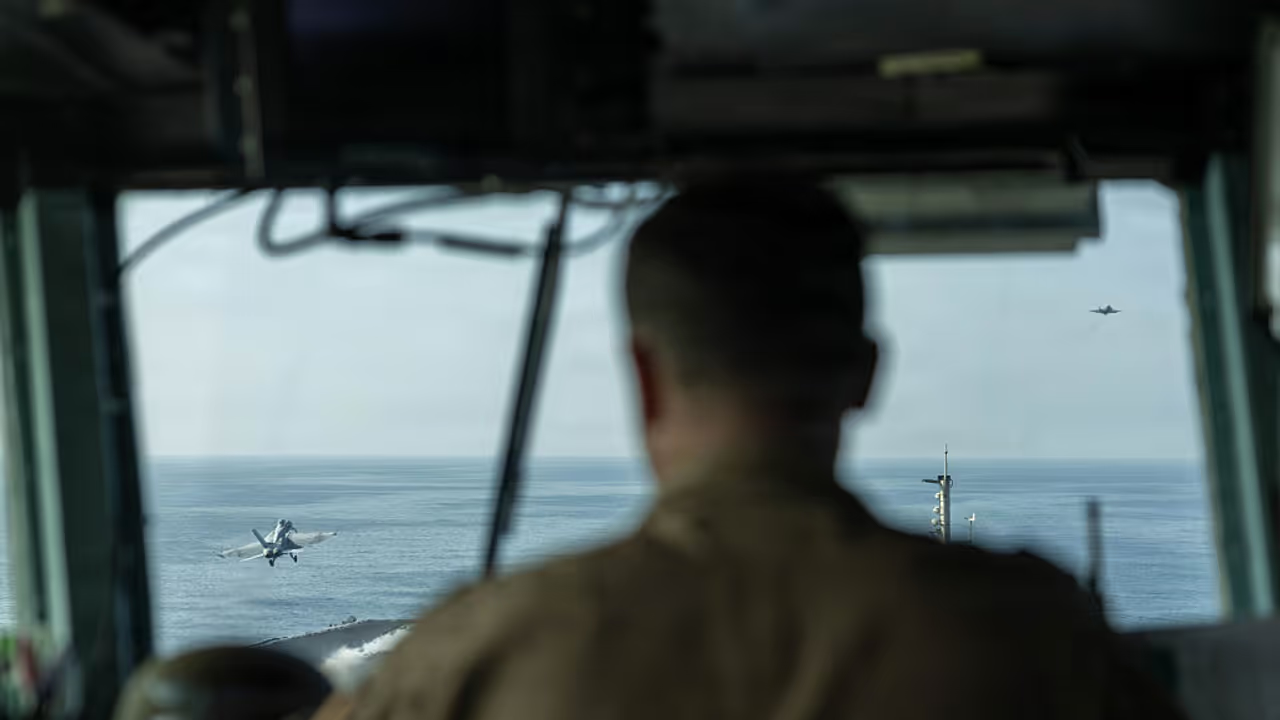
Iran’s Islamic Revolutionary Guard Corps claims it struck a US warship 650 km off its coast in the Indian Ocean, causing fires onboard. The United States Navy has not confirmed the attack yet.
Tensions in the Middle East escalated sharply on Wednesday after Iran’s military wing, the Islamic Revolutionary Guard Corps, claimed it struck a US warship deep in the Indian Ocean and asserted it now has “complete control” over the vital Strait of Hormuz. The claims come as fighting between Iran, Israel and allied forces entered its fifth day, with missile strikes, air raids and diplomatic fallout spreading across the region.
Iran claims strike on US warship
In a dramatic development, Iranian state television reported that the Revolutionary Guards fired missiles at a US Navy warship roughly 650 kilometres from Iran’s coastline in the Indian Ocean.
According to the Guards, the attack set fires onboard the vessel. However, the US Navy has not confirmed the claim so far, leaving uncertainty about what exactly happened at sea.
Related Articles

Meanwhile, Mohammad Mokhber, a senior aide to the late supreme leader Ayatollah Ali Khamenei told state TV that Iran has no intention of negotiating with the United States and can continue the Middle East war for as long as needed.
He told the broadcaster that Iran had "no trust in the Americans and we have no basis for any negotiations with them", adding that: "We can continue the war as long as we want."
Iran says it has ‘complete control’ of Hormuz
The Revolutionary Guards earlier declared that Iranian forces now have “complete control” of the Strait of Hormuz, one of the world’s most critical oil transit chokepoints.
The Guards warned that any vessel attempting to pass through the waterway risks damage from missiles or stray drones. The statement has raised alarm globally, as a large share of the world’s oil and gas shipments passes through the narrow corridor.
In response to rising risks, US President Donald Trump said Tuesday the US Navy was prepared to escort oil tankers moving through the Gulf shipping route.
Fresh Israeli strikes hit Tehran
Meanwhile, Israel expanded its air campaign, launching a new wave of attacks on targets in Tehran. The Israeli military said it struck “dozens” of sites, including security command centres in the Iranian capital.
An AFP journalist reported hearing a fresh explosion in the northeastern part of the city as the strikes unfolded.
Iranian frigate sinks near Sri Lanka
Another major incident occurred near Sri Lanka, where authorities said an Iranian navy frigate sank just outside the island’s territorial waters following an explosion.
The vessel, identified as the IRIS Dena, had 180 crew members onboard. Sri Lankan officials said 32 sailors who were critically wounded were rescued after the ship issued a distress call at dawn. A search operation for the remaining crew was still underway, and the cause of the blast remains unclear.
Global reactions grow sharper
International reactions to the escalating war are beginning to surface. Canada’s Prime Minister Mark Carney said the US-Israeli strikes on Iran “would appear, prima facie... to be inconsistent with international law”.
Financial markets also reflected the growing anxiety. Gulf stock exchanges in Dubai and Abu Dhabi reopened sharply lower after a two-day suspension, while Asian markets saw steep losses amid fears of a wider conflict and disruption to energy supplies.
Missiles, drones and regional strikes
Iran said it had launched more than 40 missiles at US and Israeli targets in a new wave of attacks. Sirens rang across large parts of Israel, including Jerusalem and Tel Aviv, after Iranian missiles were detected early Wednesday. There were no immediate reports of casualties, though Israeli media reported a fire caused by shrapnel near Jerusalem.
At the same time, Israel carried out strikes in Lebanon targeting positions linked to the Iran-backed militant group Hezbollah. Explosions were reported in Beirut’s southern suburbs and other areas. Lebanese authorities said strikes south of the capital killed six people and wounded eight.
Funeral preparations after Khamenei’s death
Iran also announced a three-day state funeral beginning Wednesday evening for Supreme Leader Ali Khamenei, whose death in US-Israeli strikes triggered the current conflict.
Following the announcement, Israel’s defence minister warned that any successor chosen by Tehran could also become a target.
Wider security concerns across the region
Security concerns are spreading beyond the immediate war zone. Qatar said it had dismantled two spy cells linked to the Revolutionary Guards and arrested 10 suspects.
In the Gulf, a drone attack caused a fire near the US consulate in Dubai, highlighting how diplomatic missions are increasingly being targeted as tensions mount.
The United States has also taken precautionary measures, ordering non-emergency staff at its consulates in Karachi and Lahore to leave Pakistan and allowing personnel at missions in Saudi Arabia, Cyprus and Oman to depart due to safety concerns.
US military claims large-scale strikes inside Iran
Admiral Brad Cooper, who leads US military forces in the Middle East, said in a video message that nearly 2,000 targets inside Iran had been struck since the conflict began.
With missile exchanges intensifying, global markets rattled and key shipping routes under threat, the crisis now appears to be entering a more dangerous phase — one that could have far-reaching consequences well beyond the region.