
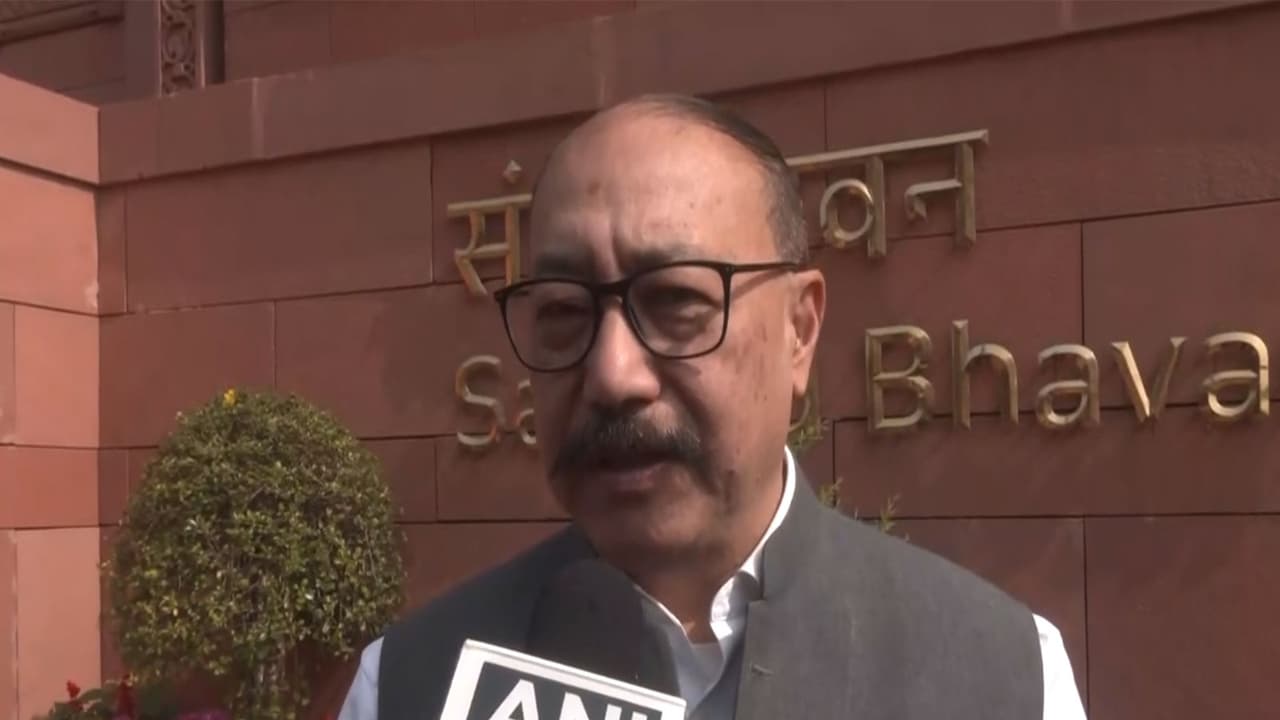
Former Foreign Secretary Harsh V Shringla praised the India-US trade agreement, crediting PM Modi's patience and personal friendship with President Trump. The deal reduces US tariffs on Indian goods from 25% to 18%, a move hailed by both leaders.
Former Foreign Secretary and Rajya Sabha MP Harsh V Shringla on Tuesday lauded the trade agreement reached between India and the United States, stating that the credit goes to Prime Minister Narendra Modi for being patient enough to create a conducive environment for the deal.
In a social media post today, US President Donald Trump said that both countries agreed to a trade deal under which the US will charge a reduced Reciprocal Tariff, lowering it from 25 per cent to 18 per cent. Prime Minister Narendra Modi also in a social media post announced that Made in India products will now have a reduced US tariff of 18% and extended "big thanks to President Trump on behalf of the 1.4 billion people of India for this wonderful announcement."
Shringla, in a conversation with ANI, said that PM Modi's personal friendship with US President Donald Trump helped clinch the deal. "I think it's a historic deal and the full credit for that has to go to our Prime Minister who has waited patiently to ensure that the best conditions were available before we finalize the deal. It is also attributable to the very strong personal chemistry he enjoys with President Trump and you saw President Trump said he's one of my greatest friends," Shringla said.
Benefits for India and Global Stature
The Rajya Sabha MP said that the friendship between the two leaders is beneficial for Indian exporters and Medium and small enterprises. "He's a very powerful leader and I think he was full of praise for Prime Minister Modi. So it also not only gives us a very competitive market advantage in the US straight away. It's very beneficial for our exporters, for our small and medium enterprises, for our workers, our farmers. But at the same time, I think it uplifts India's stature on the global stage," he said.
Major Trade Deals and Global Alignment
Shringla further said that it was extraordinary for India to conclude trade deals with the US and the European Union. "And I think this is something quite extraordinary that in a matter of few days, we have concluded two of the largest deals possible, one with the European Union and one with the United States. And I think this opens up huge opportunities for us in terms of our aligning with global supply chains, in terms of investments that would come into India as a result, technology, and opportunities that are linked to the confidence that such a trade deal provides," Shringla said.
On Russian Oil Purchases
He also said that the purchase of Russian oil is left largely with private enterprises. Hence, they will act as per their profitability. "Well, mean, know, purchase of oil is really largely left to the companies that are doing that. You know, many of them are in the private sector and they will purchase oil which is the most cost-competitive or reasonable if the price differential between Russian discounted oil and international oil is, you know, becoming less," he said.
Shringla said that oil matters are decided upon based on national interests. "And if there are better options, you'll go for the better option. So essentially, I think we will have to decide based on our national interests. And that's what is happening, I think," he said.
Impact on Indian Agriculture and Industry
He said that agriculture will not be affected in India as India opened its markets for the agricultural products that are not grown in India. "Yeah, I mean, obviously, it is not a one-way street. If you have so much access into their market, you have a 45-billion-dollar trade surplus with the US and that is only going to increase because the way I see it today, we have a 212-billion-dollar trade with the US. But by the end of the year, this trade might become 300 billion dollars. You will have far more access. You have to give some access also. Some items will come, but they will not threaten our agriculture. These are items that we don't produce in India. Those are the items like cherries, like blueberries," he told ANI.
He then said that today India is ready to compete in global markets. "We don't have this in India so I don't see any problem in a contradiction or any problem that our farmers could face as a result. And I think as far as industry is concerned of course some competition is good because after 75 years I think our industry would have that much confidence that we can compete with 40-50 % rates of duties with other competitors globally," he said.
Shringla Slams Opposition's Stance
Futher Shringla criticised the opposition's stance on the trade agreement. "Opposition has the wind knocked out of their sails. They have nothing to say now. Earlier, they complained that there is no deal. Now they're cribbing even after the deal is finalized. So now they are completely agitated by the fact that, you know, Prime Minister Modi has gone and concluded the father of all deals. The EU is the mother of all deals, is the father of all deals. And as a result, they have nothing to say. Yesterday night, Prime Minister Modi and President Trump concluded that deal," he said.
'Reciprocal Structure' of the Deal
He explained that such deals need time to be sketched out, and India will also tariff the US accordingly. "It takes time for this deal to be put on paper, for the elements to be available. So you cannot immediately say this is the thing, but the contours are there. 18% duty will be given for Indian products to the US. We will also provide reciprocal duties. The whole idea is a reciprocal structure, and that is what it is," he said.
The deal gave India lower tariff rates than Pakistan. Under the Executive Order issued by US President Donald Trump on July 31, 2025, new reciprocal tariff rates were announced for Pakistan at 19%. (ANI)
(Except for the headline, this story has not been edited by Asianet Newsable English staff and is published from a syndicated feed.)