
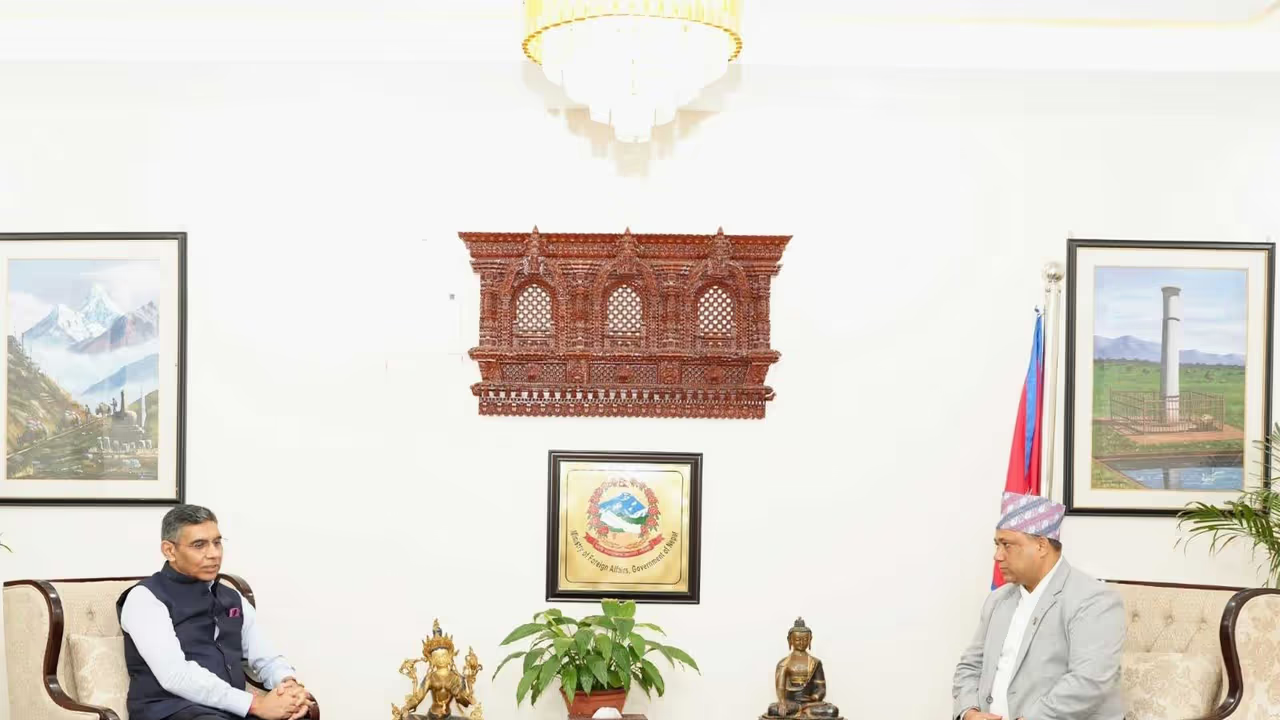
MEA's Additional Secretary Munu Mahawar visited Nepal and met with Foreign Minister Shisir Khanal and Foreign Secretary Amrit Bahadur Rai. They held productive discussions on strengthening India-Nepal cooperation across various sectors.
The Ministry of External Affairs' Additional Secretary (North) Munu Mahawar, during his visit to Nepal, held wide-ranging discussions on deepening the partnership between India and Nepal. During his visit, he paid courtesy calls on Hon. Foreign Minister of Nepal, Shisir Khanal and Foreign Secretary, Amrit Bahadur Rai, today. "Both sides engaged in productive discussions on India-Nepal cooperation across sectors, and discussed ways to further strengthen the unique partnership," the Embassy of India in Nepal said on Thursday. Additional Secretary (North) @MEAIndia Shri Munu Mahawar @AmbMunu paid courtesy calls on Hon. Foreign Minister of Nepal, Mr Shisir Khanal @shisir , and Foreign Secretary, Mr Amrit Bahadur Rai, today. Both sides engaged in productive discussions on 🇮🇳-🇳🇵 cooperation across… pic.twitter.com/QiSzfSpm2i — IndiaInNepal (@IndiaInNepal) July 16, 2026
Diplomatic Discussions on Bilateral Ties
Nepal's Foreign Ministry said that India and Nepal discussed strengthening the close and enduring ties between Nepal and India in areas of mutual interest during the meeting with Foreign Minister Khanal. Additional Secretary of the Ministry of External Affairs of India, H. E. Mr Munu Mahawar, paid a courtesy call on Hon. Foreign Minister Mr Shisir Khanal, at the Ministry today. During the meeting, discussions were held on further strengthening the close and enduring ties between… pic.twitter.com/gxor0s8T3W — MOFA of Nepal 🇳🇵 (@MofaNepal) July 16, 2026
India and Nepal held discussions on further deepening the longstanding ties and advancing the shared agenda in priority areas during a meeting between the Ministry of External Affairs' Additional Secretary Munu Mahawar and Nepal's Foreign Secretary Amrit Bahadur Rai.
Sharing the details of the meeting in a post on X, Nepal's Ministry of Foreign Affairs said that the leaders reviewed the progress of ongoing bilateral cooperation and exchanged views on advancing the shared agenda in priority sectors. "Reaffirming the longstanding friendship and multifaceted partnership between Nepal and India, they also discussed ways to further deepen institutional collaboration and maintain the momentum of high-level engagement," the post further noted.
Power Sector Cooperation Reviewed
As New Delhi and Kathmandu continue to expand their longstanding cooperation across all avenues, on Wednesday, the two partner countries held the 13th meeting of the Joint Steering Committee on Power Sector Cooperation (JSC) in Pokhra which focused on reviewing the bilateral power sector cooperation.
The meetings comprehensively reviewed the bilateral power sector cooperation between India and Nepal, including the development of hydropower projects, power trade and transmission infrastructure. Both sides appreciated progress on the development of new transmission lines, including the 400 kV Gorakhpur-New Butwal line.
Both sides discussed ways to expedite and facilitate the implementation of ongoing and envisaged power generation and transmission projects. Coordinated operation of Indian and Nepali grids, development of solar projects, cooperation in green hydrogen and capacity building of Nepali experts were also discussed.
Wide-Ranging Development Partnership
Meanwhile, on Tuesday, a foundation stone was laid for the construction of a monastery in Solukhumbu District of Nepal, which is also known as the gateway of Everest, to be built with Indian assistance. As close neighbours, India and Nepal are engaged in wide-ranging and multi-sectoral cooperation.
The implementation of HICDPs reflects the continued support of the Government of India in strengthening the efforts of the Government of Nepal in promoting growth and development, apart from augmenting infrastructure in priority sectors. Over the past seven decades, the India-Nepal development cooperation has not only expanded but also diversified to cover a wide range of sectors that include health, education, power, archives, archaeology, connectivity, trade, agriculture, cultural heritage preservation, capacity building and many more. (ANI)
(Except for the headline, this story has not been edited by Asianetnews Editorial staff and is published from a syndicated feed.)