
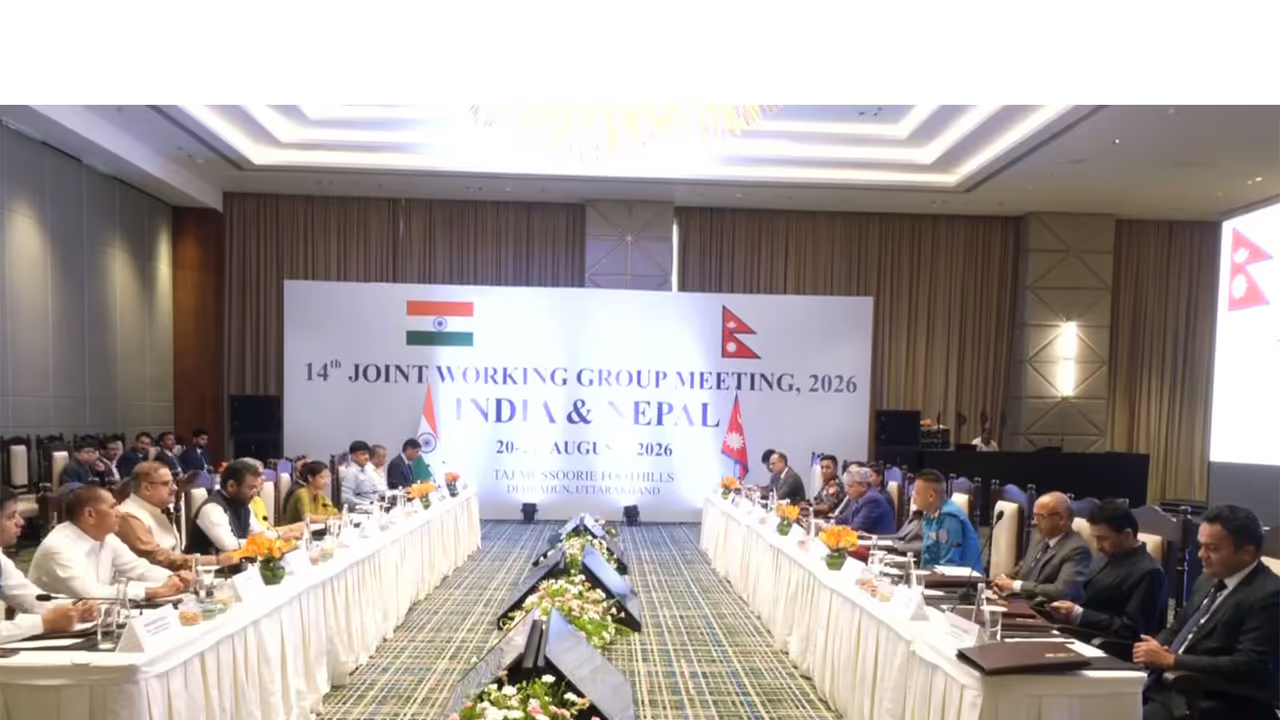
The 14th India-Nepal Joint Working Group on Border Management and Security meeting began in Dehradun, focusing on cross-border crime, infiltration, and smuggling. Discussions also include strengthening security and addressing border disputes.
The 14th meeting of the India-Nepal Joint Working Group on Border Management and Security began on Thursday, with senior officials from the Home and Foreign Ministries of both countries holding two-day talks on cross-border security and border-related issues. The meeting is being held at Hotel Taj in Dehradun and is focusing on cross-border crime, infiltration, smuggling, and other criminal activities along the open India-Nepal border.
The discussions also include measures to strengthen security along the open border and address border-related disputes, including through the examination of historical maps. The high-level talks are also taking up Nepal's concerns and position regarding India-China trade through the Lipulekh Pass.
High-Level Diplomatic Engagements
This development comes as General Dhiraj Seth, Chief of the Army Staff (COAS), Indian Army, undertook an official visit to Nepal from August 16-19. Upon his arrival in Kathmandu on August 16, General Seth was received by senior officials of the Nepali Army and representatives of the Embassy of India in Kathmandu. Subsequently, on August 18, General Seth held a courtesy call with the Prime Minister of Nepal, where the discussion focused on the longstanding partnership between the two countries, especially defence cooperation.
Earlier, on August 10, India's Ambassador to Nepal, Naveen Srivastava, paid a courtesy call on Nepal Prime Minister Balendra Shah at the Prime Minister's Office in Singha Durbar. The 45-minute interaction marked a significant milestone as PM Balendra Shah--who had previously maintained a strict policy of avoiding individual, one-on-one meetings with foreign diplomats--broke his self-imposed rule to meet directly with the Indian envoy.
Ambassador Srivastava conveyed warm greetings from Prime Minister Narendra Modi, emphasising a mutual dedication to cultivating a robust, multifaceted partnership. The discussions heavily centred on expanding cooperation in development projects, trade, energy, and infrastructure to reinforce the deep-rooted historical and cultural ties shared between the two nations.
Ambassador Srivastava extended his best wishes to Prime Minister Shah and reaffirmed India's commitment to further strengthening bilateral relations. In response, Prime Minister Shah emphasised the need to deepen historical ties between the two neighbouring nations and highlighted the value of joint collaboration across areas of mutual interest.
Releasing an official statement on the dialogue, the Nepal Prime Minister's Office in a post on X said, "Ambassador of India to Nepal H. E. Mr Naveen Srivastava (@navsri6619) paid a courtesy call on the Rt. Hon. Prime Minister Mr Balendra Shah (@ShahBalen) at Singhadurbar today. On the occasion, discussions were focused on further strengthening Nepal-India relations, promoting bilateral cooperation and enhancing development partnership for the mutual benefit of two countries."
India's 'Neighbourhood First' Doctrine
These coordinated diplomatic interactions underscore New Delhi's active commitment to robust, continuous engagement with its immediate South Asian neighbours, prioritising direct communication and mutual development under the "Neighbourhood First" doctrine.
India's "Neighbourhood First" policy serves as a cornerstone foreign policy initiative designed to give primary focus to diplomatic, economic, and security ties with countries in its immediate South Asian periphery. Conceptualised in 2008, the approach was formally institutionalised and reinvigorated under Prime Minister Narendra Modi in 2014 to foster a peaceful, seamlessly connected, and mutually supportive regional environment.
The framework aims to foster regional stability, deepen economic integration, and expand infrastructural connectivity across immediate neighbours such as Nepal through collaborative transit corridors, shared energy networks, and joint infrastructure, while actively managing shifting domestic political dynamics and broader strategic competition across South Asia. (ANI)
(Except for the headline, this story has not been edited by Asianet Newsable English staff and is published from a syndicated feed.)