
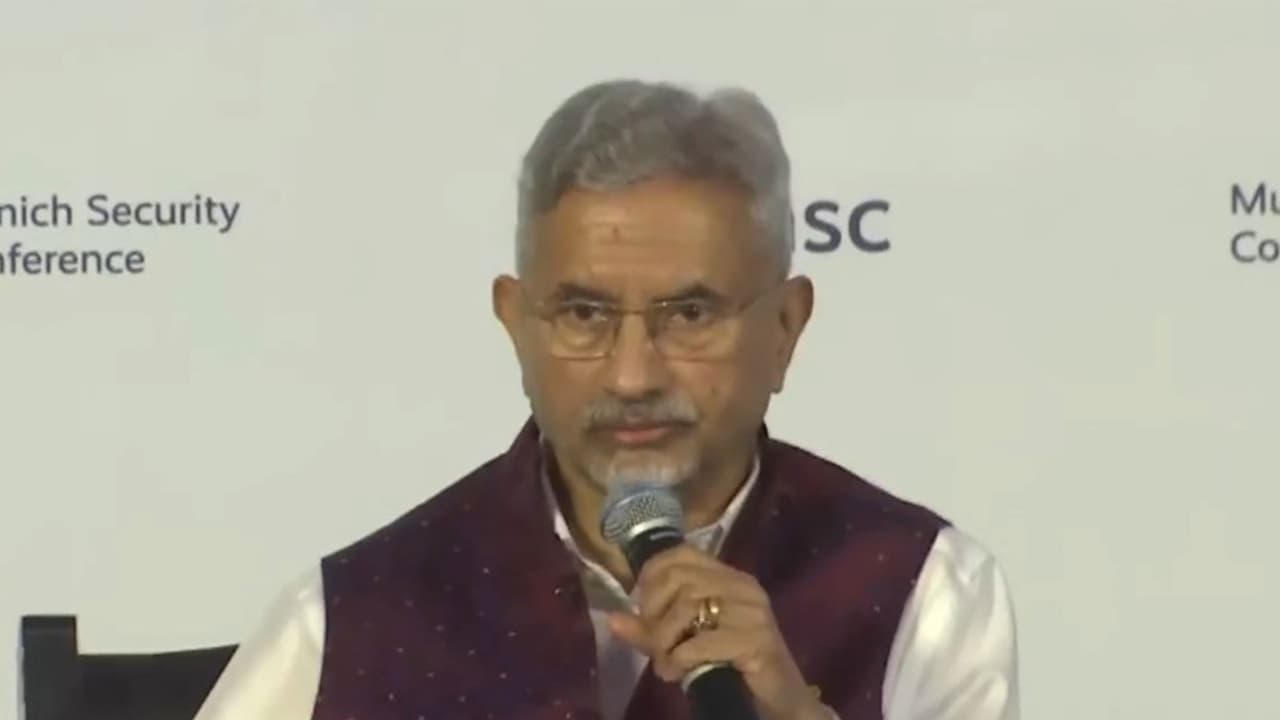
EAM S Jaishankar hailed a prospective India-EU FTA as a "real game changer." He outlined a broad agenda for partnership in technology, defence, space, and climate action, noting the need for collaboration in a shifting global order.
Welcoming a major expansion of India-EU ties, External Affairs Minister S Jaishankar affirmed that a prospective Free Trade Agreement (FTA) with the European Union will act as a "real game changer," as he outlined a vast bilateral agenda spanning technology, defence, space, and climate action to address the global void left by a shifting international order.
Responding to former German Ambassador Wolfgang Ischinger on whether scope exists for a wider partnership with the EU, Jaishankar responded affirmatively, pinpointing strategic sectors driving deeper integration at the Munich Leaders Meeting.
Strategic Sectors for Deeper Integration
"Yes, absolutely. If one looks, for example, at technology, innovation, emerging domains, not just emerging players, something like advanced manufacturing, semiconductors. These are areas where a partnership can increase," Jaishankar stated. "If you look at the AI debate, there is a considerable degree of convergence between the European thinking on AI and the Indian thinking on AI. I would argue that even in areas like life sciences, that is the case... The Global Capability Centres are also becoming a bridge today between our economies and our corporates without actually the physical mobility which is involved in this kind of knowledge-driven activity," he added.
He pointed to strategic autonomy in space and defence as key focal points for mutual collaboration between India and European partners. He commended the growth of Indian startups as they partner with foreign industries. "Another area is space. Europe today realises that it must have its own space capabilities. That ambition has always been there in India. When I look at many of the loads in our space launchers, we are today really expanding our capability to do space launches on a much more globally competitive and significant basis, and creating infrastructure for that," he noted.
"Even in an area like defence, Europe has a determination today to rebuild its defence industry. But defence is not static... We are finding it very interesting that many of our startups today have found partners abroad, but then so have many of our orthodox industries. Our defence exports are growing very rapidly," he added.
Shaping the World and UN Reform
Jaishankar emphasised that while bilateral cooperation must serve immediate strategic ends, it must also address global governance, including necessary reforms to international bodies. "Yes, absolutely, there is a wider agenda in terms of India-Europe, but there is a wider agenda also about how we shape the world because we limit it to a narrow benefit or make it too transactional. Then we are missing out on what is actually going to affect all of us, which is the nature of the world... What we need is a better UN. The idea is not to throw away the UN, but to fix the UN," he observed.
FTA: A 'Game Changer' for Bilateral Ties
Highlighting the transformative potential of a trade deal, Jaishankar argued that an FTA with the EU would catalyse broader economic and regulatory alignment across the board. "With the European Union, having an FTA makes you a serious partner. It is a real game changer in how you perceive each other," he said. "Many other things which are not directly trade-related will happen because there will be comfort created by the FTA, the ability of businesses, regulatory bodies, and bureaucracy to know each other. I expect the FTA to actually have almost like a cascading impact through the entirety of our relationship with Europe."
Climate Action and Clean Energy Goals
Turning to environmental sustainability, he identified European expertise as pivotal to achieving India's clean energy goals. "When it comes to, when it comes to climate, we certainly seek international cooperation and collaboration, not only as a G2G, frankly, often as a B2B... A big part of it will also be to attract this huge European renewable energy capacity to get them to come into India... We have very ambitious renewable targets because we feel the pressure of climate change. Europe will be a crucial factor because Europe has the technology and the business expertise... When I laid out what could be an emerging middle power agenda, frankly, in my mind a lot of it was really an India-Europe agenda," he explained.
A Multipolar World and Shared Responsibility
Concluding his remarks, Jaishankar observed that as the legacy architecture underwritten by the United States recedes, rising powers must step up to take responsibility in an increasingly multipolar order. "The current system was significantly underwritten by the United States. That underwriting is diluting. There are gaps which have emerged... As our economy grows, our standing grows, our responsibility and contributions also have to grow," he said. "Where global goods are concerned, we can't speak of a multi-polar world for everything else and say we remain unipolar for certain things. If it changes, it changes as a whole, and it is changing as a whole. There will have to be more India-EU conversations."
Background on India-EU FTA Negotiations
The India-EU FTA negotiations have been a key component of efforts to deepen economic ties between the two sides, with the agreement expected to provide greater market access and strengthen trade and investment flows. The India-EU FTA was jointly announced by Prime Minister Narendra Modi and European Commission President Ursula von der Leyen on January 27 this year during the 16th India-EU Summit in New Delhi. The announcement followed the resumption of negotiations in 2022 after years of discussions aimed at establishing a comprehensive and balanced trade partnership between India and the European Union.
The proposed agreement assumes significance amid growing economic ties between the two regions. In 2024-25, bilateral trade in goods between India and the EU stood at USD 136.54 billion, with India's exports to the bloc valued at USD 75.85 billion and imports at USD 60.68 billion. Trade in services between India and the European Union reached USD 83.10 billion in 2024. (ANI)
(Except for the headline, this story has not been edited by Asianetnews Editorial staff and is published from a syndicated feed.)
