
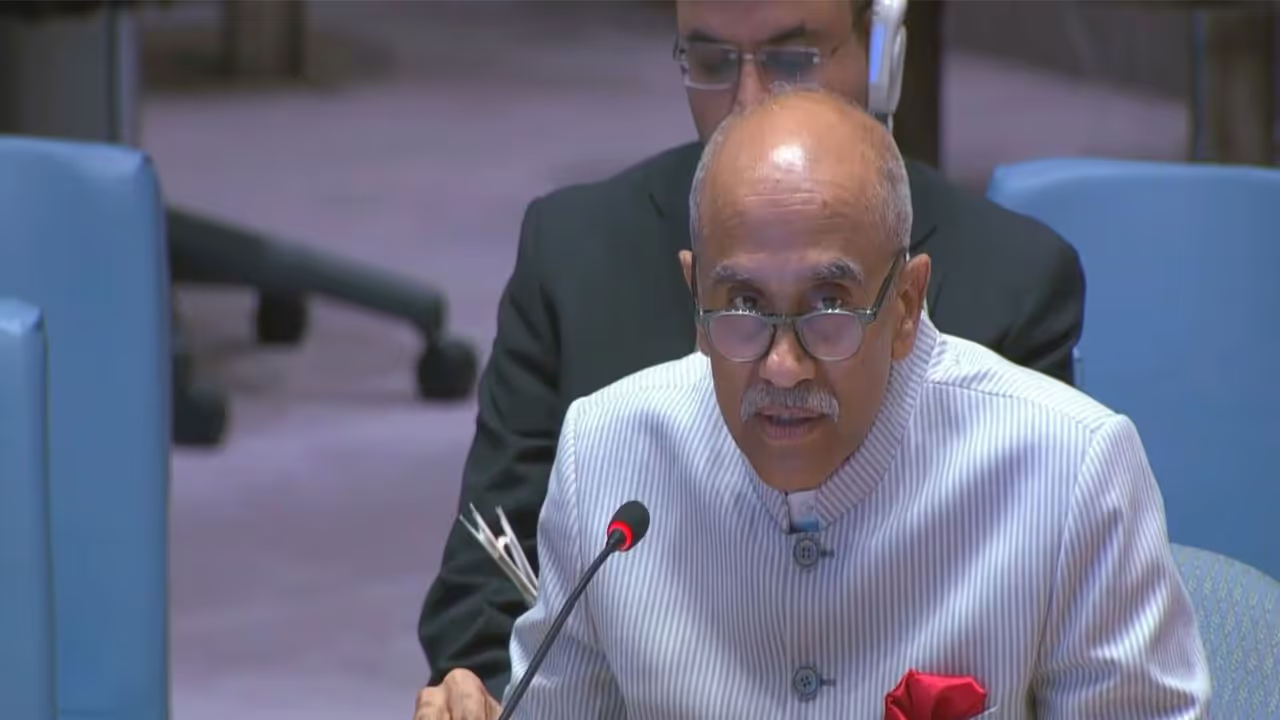
India has strongly censured the involuntary repatriation of millions of Afghans at the UN, highlighting their humanitarian plight. New Delhi also urged the world to dismantle terror networks, citing how 9/11 architects were found in safe havens.
India has strongly censured the involuntary repatriation of millions of Afghans while urging the international community to dismantle permissive environments that shelter transnational terrorist networks during a United Nations Security Council meeting on the situation in Afghanistan. India's Permanent Representative to the UN, Ambassador Parvathaneni Harish, expressed profound concern over the humanitarian plight of returning populations, stating, "We also reiterate our deep concern at the humanitarian plight of the Afghan returnees. The Secretary General’s Report mentions that, in 2025, 2.9 million Afghans were returned, and until 22 August 2026, another 1.15 million Afghans were returned, most of which were involuntary."
India Condemns Involuntary Afghan Repatriation
Highlighting the disparity in global responses, the envoy added, "A forcible return of this nature that is neither safe nor dignified, of over 3 million individuals, in any other part of the world would have elicited a political outcry in this Council, urgent provision of large-scale humanitarian support and efforts to ensure better re-integration and assimilation. That there is no such reaction is a sad reflection on the times."
Reaffirming that returns must be conducted voluntarily, safely, and with dignity, India noted its active cooperation with UN agencies and Afghan authorities to provide housing, food, and essential provisions, including the recent gifting of family tents to the Afghan Ministry of Refugees and Repatriation.
Counter-Terrorism and the Lessons of 9/11
Shifting focus to regional security and counter-terrorism measures, India underscored the lessons of the 9/11 attacks, noting that al-Qaeda's leadership did not evade justice in remote frontiers, "The international community supported the global campaign to counter terrorism in the wake of 9/11. Let us, not forget, however, that Al Qaeda’s terror eco-system established its strategic depth beyond Afghanistan through its affiliates. The leaders of Al Qaeda who conceived and directed these 9/11 attacks did not escape justice in the wilderness of some ungoverned frontier."
Terror Leaders Found in Settled Communities
Detailing the locations of key operatives, the statement noted, "Osama bin Laden, who ordered and financed the plot, was tracked down and killed in a fortified compound within a settled, guarded community under Operation Neptune Spear."
It added that "Khalid Sheikh Mohammed, the principal architect of the operation, was found sheltering in an ordinary residential house," while "Ramzi Binalshibh, who coordinated the hijacker cell after being denied a visa to join them, was sheltering in an urban centre."
Furthermore, "Senior al-Qaeda operative Walid bin Attash, who helped select and prepare several hijackers, was likewise captured separately," and "Mustafa Ahmed al-Hawsawi, a key financial and logistical facilitator of the 9/11 operation, was captured under similar circumstances."
Emphasising the broader implications, India stressed, "In each case, these were not fugitives hiding in caves or badlands; they were men who had for long evaded detection. Draining this swamp that provided an enabling environment for such monsters of humankind to prosper is important."
'Permissive Environments' Fuel Ongoing Terror Threats
Warning against ongoing security threats, the Ambassador cautioned, "The same permissive environment that sheltered the architects of 9/11 has, in the years since, continued to provide space, support, and impunity to affiliates of Al Qaeda such as Lashkar-e-Taiba and Jaish-e-Mohammed and their like, acquiring different identities to escape this Council’s sanctions framework and whose leadership and terror training infrastructure have been shielded from consequence."
Concluding the security assessment, India urged, "The international community must join hands to address the continuity of such sanctuary in order to ensure that more such individuals are not thrust upon any country or its citizens and no one loses family and loved ones."
Reflecting on the Anniversary of the 9/11 Attacks
The reflections on the 9/11 attacks resonate deeply with the anniversary having recently passed on September 11, marking a quarter century since the coordinated terrorist attacks that profoundly reshaped the United States and its approach to national security.
On September 11, 2001, 19 al-Qaeda terrorists hijacked four commercial passenger aircraft in a coordinated attack against the United States, flying two planes into the World Trade Centre's Twin Towers in New York, a third into the Pentagon in Arlington, Virginia, and crashing the fourth into a field near Shanksville, Pennsylvania, after passengers and crew attempted to regain control.
The attacks killed 2,977 people, according to official US figures, marking one of the deadliest terrorist incidents in history. The destruction of the Twin Towers and the attack on the Pentagon triggered an immediate national crisis and ushered in a new era of US counter-terrorism operations, military engagements, and heightened domestic security measures. At Ground Zero in New York, where the World Trade Centre towers once stood, annual remembrance ceremonies continue to honour the victims as family members read aloud the names of those killed, preserving a solemn tradition central to the country's commemorations.
Orchestrated by al-Qaeda leader Osama bin Laden following years of confrontation with the United States, the assault prompted Washington to launch a global campaign against al-Qaeda and its affiliates, beginning with the US-led invasion of Afghanistan in October 2001. As communities across the United States observed Patriot Day and the National Day of Service and Remembrance with moments of silence, reading the names of victims, displaying flags at half-staff, and engaging in volunteer projects, these reflections serve as a poignant reminder of resilience in the face of tragedy. (ANI)
(Except for the headline, this story has not been edited by Asianet Newsable English staff and is published from a syndicated feed.)