
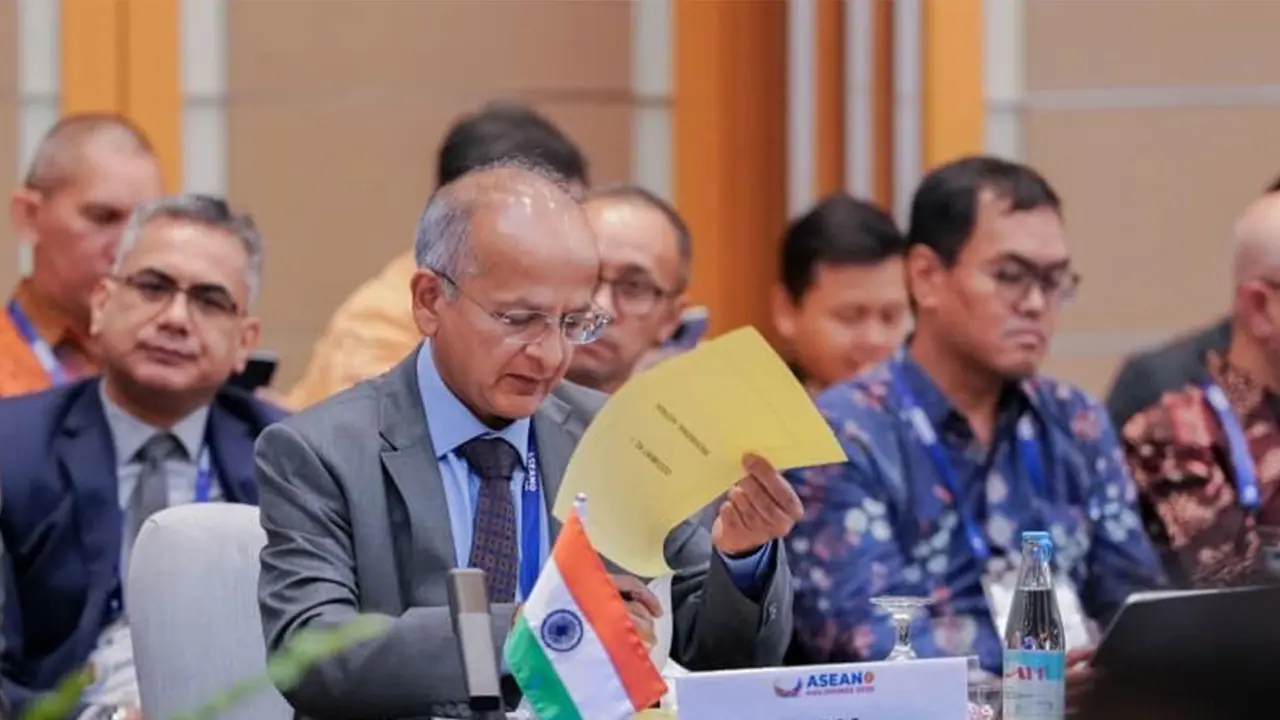
India participated in the ASEAN Regional Forum (ARF) meeting in Manila, underscoring the critical value of the framework and its commitment to dialogue and diplomacy to navigate modern geopolitical hurdles, the MEA announced.
India has underscored the critical value of the ASEAN Regional Forum (ARF) framework alongside its commitment to dialogue and diplomatic engagement to navigate modern geopolitical hurdles during a high-level security meeting in the Philippines, the Ministry of External Affairs (MEA) announced on Wednesday.
The diplomatic position was outlined by MEA spokesperson Randhir Jaiswal in an official social media update, noting that "Secretary (East) Shri Rudrendra Tandon led the Indian delegation at the Asean Regional Forum (ARF) Senior Officials' Meeting in Manila on 09 June 26." Secretary (East) Shri Rudrendra Tandon led the Indian delegation at the Asean Regional Forum (ARF) Senior Officials’ Meeting in Manila on 09 June 26. He highlighted the critical relevance of ARF mechanism and support for dialogue and diplomacy in addressing the contemporary… pic.twitter.com/HoVITisy2L — Randhir Jaiswal (@MEAIndia) June 10, 2026 Elaborating on New Delhi's intervention during the summit, Jaiswal stated that the Indian delegation "highlighted the critical relevance of the ARF mechanism and support for dialogue and diplomacy in addressing contemporary geopolitical challenges."
Discussions on Regional and International Security
The senior diplomats gathered in the Philippine capital engaged in extensive discussions regarding fluid global dynamics. According to the official spokesperson, "deliberations were held on the regional and international security scenario with a call for combined efforts in maintaining a rules-based order for the global commons in the Indo-Pacific."
ARF's Origins and Evolving Strategy
Tracing the institutional background of the platform, the MEA noted that the security body was originally established in 1993 to serve as a specialised vehicle for regional security cooperation and dialogue. Its foundation grew out of targeted discussions during the ASEAN Post Ministerial Conference, which brought together Southeast Asian Foreign Ministers and their comprehensive dialogue partners.
To systematically address complex security variables, the forum transitioned to an evolutionary strategy in 1995. This framework laid out a distinct three-stage progression: the initial phase focusing on "Confidence Building Measures (CBMs); second stage - development of preventive diplomacy; and third stage - elaboration of approaches to conflicts."
Since the inception of this multilateral framework, the core institutional tenets of ASEAN--specifically its emphasis on consensus-driven outcomes, mutual confidence-building, and advancing at a pace comfortable to all participating nations--have consistently steered the broader ARF agenda.
ARF Membership
The influential security collective currently maintains a diverse membership of 27 nations. This includes the 11 core ASEAN member states, comprising Brunei, Cambodia, Indonesia, Laos, Malaysia, Myanmar, the Philippines, Singapore, Thailand, Timor-Leste, and Vietnam. The forum's footprint is further expanded by 10 traditional dialogue partners, namely Australia, Canada, China, the European Union (EU), India, Japan, New Zealand, South Korea, Russia, and the United States. The security architecture is completed by additional regional participants, including Bangladesh, North Korea, Mongolia, Pakistan, Sri Lanka, and Papua New Guinea. (ANI)
(Except for the headline, this story has not been edited by Asianet Newsable English staff and is published from a syndicated feed.)