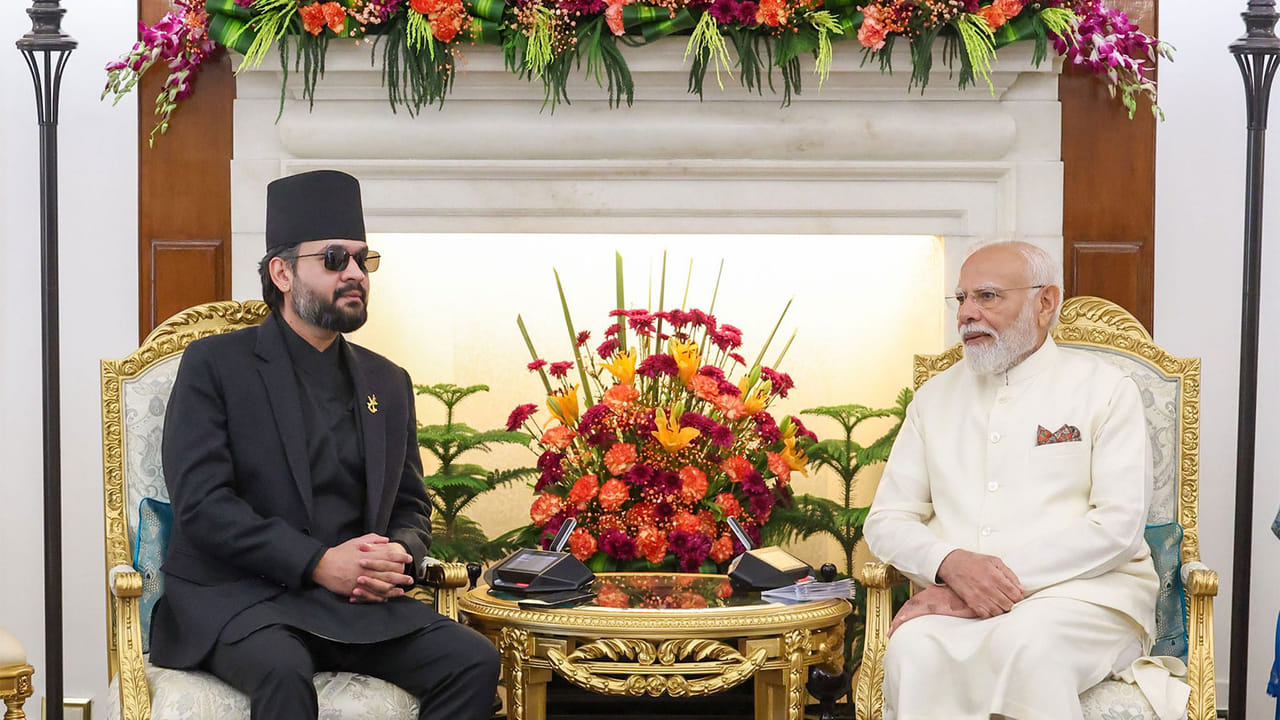
India announced a Rs 15,000 crore development package for Nepal during PM Balendra Shah’s visit. The nations finalized 19 key outcomes, including infrastructure projects, energy initiatives, and eight MoUs to strengthen bilateral ties.
India Announces 15000 Crore Aid to Nepal During PM Visit Outcomes
New Delhi [India], November 23 (ANI): India and Nepal on Monday announced 19 key outcomes spanning connectivity, infrastructure, energy, trade, education, healthcare and security during Nepal Prime Minister Balendra Shah's two-day state visit to India, with New Delhi unveiling a development cooperation package worth Rs 15,000 crore to support Nepal's reconstruction and long-term development.
The outcomes, announced during Shah's November 22-23 visit at the invitation of Prime Minister Narendra Modi, include the launch of the Sarayu-Kamala Express connecting Ayodhya and Janakpur, the inauguration of a new cross-border motorable bridge between Dharchula in India and Darchula in Nepal, and the advancement of several energy and infrastructure projects. The two countries also exchanged eight Memorandums of Understanding (MoUs) covering space technology, policing, forensic sciences, civil service capacity building, healthcare, traditional medicine, sustainable urban development, and livestock and fisheries development.
Addressing a special briefing on the visit, Foreign Secretary Vikram Misri said the two Prime Ministers held productive discussions, with the initiatives expected to deliver tangible benefits to people on both sides of the border. "Today, the two Prime Ministers held a very productive set of discussions and the initiatives that have been announced during this visit, we feel, represent very tangible gains for the people of India and Nepal and will, we feel, directly benefit large sections of the population on both sides of the border," Misri said.
He described the financial assistance as the largest-ever package extended by India to Nepal, comprising Rs 11,500 crore in concessional lines of credit and Rs 3,500 crore in grants. "I referred to the largest-ever financial assistance package for Nepal. This is a package worth 15,000 crore Indian rupees, which translates into roughly 24,000 crore Nepali rupees. It comprises 11,500 crore Indian rupees in concessional lines of credit and 3,500 crore Indian rupees as grants," the Foreign Secretary said. He added that the assistance would largely focus on energy and reconstruction following the disasters that struck Nepal earlier this year, with the specific projects to be identified through discussions between the two sides.
On connectivity, the two leaders jointly flagged off the Sarayu-Kamala Express, a new weekly passenger train service connecting Ayodhya Cantt in Uttar Pradesh with Janakpur Dham in Nepal. The service is expected to facilitate religious travel, tourism and people-to-people exchanges between the two countries, whose cultural and civilisational ties are deeply rooted in the shared reverence for Lord Ram and Mata Janaki. The train will connect several destinations across Uttar Pradesh and Bihar, including Gorakhpur, Basti, Raxaul, Sitamarhi, Madhubani and Jaynagar.
The visit also saw the inauguration of a new cross-border motorable bridge linking Dharchula in Uttarakhand with Darchula in Nepal, alongside the laying of the foundation stone for a new Integrated Check Post (ICP) at Banbasa. Progress in the construction of ICPs at Bhairahawa, Sunauli and Dodhara Chandani was also noted. In another significant announcement on regional connectivity, India agreed to facilitate Nepal's access to two additional Indian ports for transit cargo, Deendayal Port at Kandla in Gujarat and Paradip Port in Odisha. Explaining the decision, Misri said the move was aimed at addressing Nepal's requirements for additional transit trade facilitation.
"One area which was of considerable significance to Nepal was additional facilitation for transit trade and to respond to that, PM Modi announced that India would facilitate access to Deendayal Port at Kandla in Gujarat for Nepal's transit cargo. Following the completion of some infrastructure work that is required, access would also be provided on the east coast through the Paradip Port in Odisha," he said. The two sides also announced the finalisation of the Final Location Survey for the proposed Raxaul-Kathmandu electrified broad-gauge railway line, which is expected to further strengthen cross-border connectivity. In the education sector, India will work towards establishing an offshore campus of the Indian Institute of Technology (IIT) in Nepal. "India will also work on establishing an offshore campus of the Indian Institute of Technology (IIT) in Nepal," Misri said.
The two countries also agreed to establish an Agro-Industrial Park in Chitwan, Nepal, as part of efforts to expand cooperation in agriculture and related sectors. Energy cooperation featured prominently in the outcomes, with the laying of the foundation stone for the 669 MW Lower Arun Hydroelectric Project. The two sides also marked the dedication of Phase II of the Motihari-Amlekhgunj Oil Pipeline and laid the foundation stone for the Jhapa petroleum terminal, part of the planned Siliguri-Jhapa petroleum pipeline. On institutional cooperation, the eight MoUs exchanged during the visit included an agreement between the Indian Space Research Organisation (ISRO) and Nepal's Ministry of Information and Communication for establishing a Satellite Communication (SATCOM) Network for the utilisation of the South Asia Satellite. Other agreements covered academic and research collaboration between India's National Forensic Sciences University and Nepal Police's Crime Investigation Department, and cooperation between India's Rashtriya Raksha University and Nepal's National Police Academy. An MoU between India's National Centre for Good Governance and Nepal Administrative Staff College will facilitate capacity-building training programmes for Nepali civil servants. The remaining agreements cover cooperation in Ayurveda and traditional systems of medicine, health and medicine, sustainable urban development, and livestock and fisheries development.
Misri also highlighted the broader significance of Shah's visit, describing it as an important milestone in the bilateral relationship. "Prime Minister of Nepal, Balen Shah, has just completed a State visit to India at the invitation of Prime Minister Narendra Modi. Today's meeting between the two Prime Ministers was the first in-person meeting between the two of them. This is Prime Minister Shah's first bilateral visit abroad after having assumed office as Prime Minister of Nepal," he said. The Foreign Secretary also noted that the two leaders had previously held two telephone conversations, including one following the floods that struck Nepal in August this year. The visit, which concluded on Monday, saw Shah depart for Kathmandu after a series of engagements in New Delhi. He was seen off at Indira Gandhi International Airport by Union Minister of State for Commerce and Industry Jitin Prasada, Nepal's Ambassador to India Nishchal Nath Pandey, India's Ambassador to Nepal Sudhakar Dalela and other senior officials from both countries. The outcomes also include a first-of-its-kind Vision Document between India and Nepal, which Misri said would serve as a blueprint for the coming years, alongside the expanded development cooperation package and a series of connectivity and institutional initiatives. The two-day visit underscored the focus on strengthening the longstanding partnership between the neighbouring countries through infrastructure development, economic cooperation, cultural exchanges and deeper people-to-people ties. (ANI)