
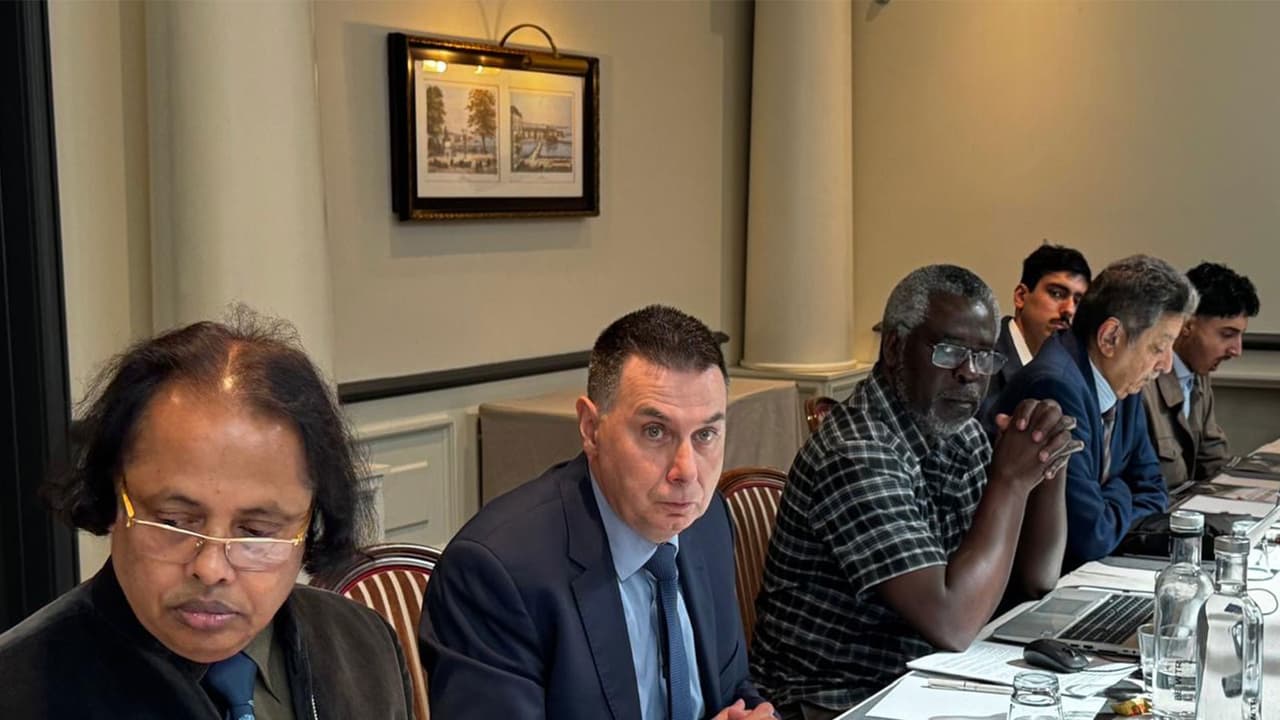
At a conference in Geneva, international experts supported India's decision to keep the Indus Waters Treaty in abeyance. They argued for a re-evaluation of the treaty, considering security, human rights, and the water rights of local communities.
International experts and human rights advocates at a conference held on the sidelines of the 63rd session of the United Nations Human Rights Council (UNHRC) backed India’s decision to keep the Indus Waters Treaty (IWT) in abeyance, arguing that the issue needs to be examined in the context of security, human rights and the water rights of communities dependent on the Indus River system.
The conference, organised by Indian civil society organisation Shivi Development Society (SDS), was titled “Community Water Rights & the Imperative to Keep the Indus Waters Treaty in Abeyance.” It brought together speakers to discuss transboundary water governance, community rights, regional security and the implications of the 1960 treaty.
Experts Argue for Treaty Re-evaluation
Dr Siegfried O. Wolf, Director of Research at the South Asia Democratic Forum, Brussels, said India was within its sovereign rights to seek a review of the treaty. He argued that, in his assessment, Pakistan’s conduct had affected what he described as the “object, purpose and spirit” of the agreement.
Wolf also pointed to what he termed structural asymmetries in the treaty, including water distribution, India’s financial contribution to the Indus Development Fund, restrictions related to storage and infrastructure, and legal disputes over Indian hydropower projects such as Baglihar, Kishenganga and Ratle. On Pakistan’s concerns over Indian projects on the western rivers, Wolf rejected the assertion that India was “blocking” river flows, describing it as an “engineering myth.” He said hydropower projects were largely non-consumptive, with water subsequently released downstream. He also attributed Pakistan’s water challenges, in part, to domestic factors such as agricultural practices, landholding patterns, urban pressures and ageing canal infrastructure.
Focus on Human Rights and Regional Water Distribution
London-based human rights activist Arif Aajakia said access to water was a fundamental human right and raised concerns over the distribution of water resources within Pakistan, particularly in Sindh. He also linked the debate over the treaty to wider India-Pakistan security concerns.
Geneva-based human rights expert Mamun Rahman of the International Forum for Secular Bangladesh called for greater attention to the distribution of natural resources within Pakistan, particularly the concerns of communities in Sindh and Balochistan. He said transboundary water governance should take into account the impact of water-related decisions on communities on both sides of international borders.
In a video statement, Lakhu Luvana, Chairperson of the World Sindhi Congress, said Sindh and Balochistan had longstanding concerns over the use and distribution of natural resources, including water, arguing that these issues extended beyond the operation of any particular bilateral treaty.
Community Rights Must Be Central, Says Organiser
The conference was chaired by Narender Kumar, Executive Director of Shivi Development Society. Kumar said the debate over the IWT should not remain confined to India-Pakistan relations and called for greater focus on the rights and water needs of communities dependent on the Indus River system.
“The question of keeping the Indus Waters Treaty in abeyance is not only about a bilateral agreement between two countries. It is also about recognising the rights and legitimate water needs of local communities that depend on the Indus River system, including communities in India,” Kumar said. He called for human rights, equitable access to water, community participation and sustainable water governance to remain central to discussions on transboundary river systems. (ANI)
(Except for the headline, this story has not been edited by Asianetnews Editorial staff and is published from a syndicated feed.)