
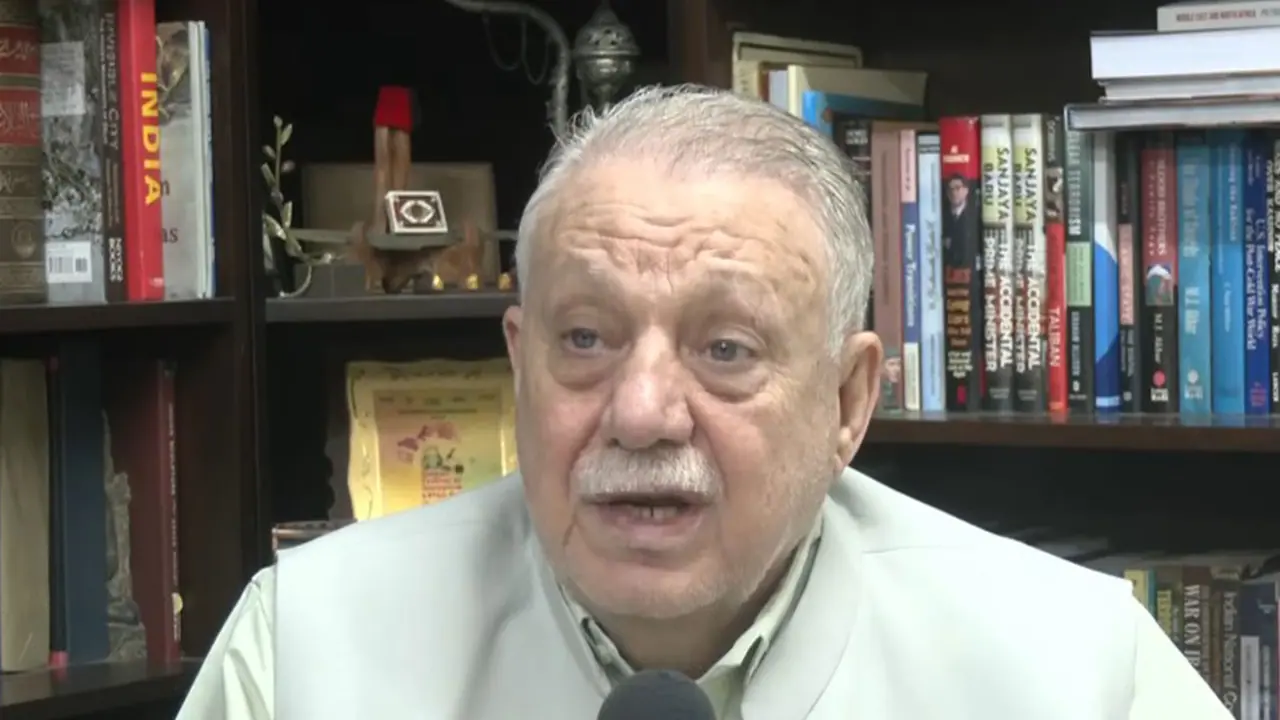
Expert Waiel Awwad warns that the US is pursuing regime change in Iran as crude oil hits USD 117 per barrel. Tensions escalate in the Middle East with Tehran labeling the situation an existential war and threatening regional stability.
US Strategic Objectives in Iran
As crude oil prices surge to USD 117 per barrel and military tensions escalate across West Asia, Foreign Affairs Expert Waiel Awwad has warned that Washington’s ultimate objective regarding Iran extends far beyond nuclear negotiations, aiming instead at complete regime change and regional dominance. Speaking with ANI, Awwad asserted that conflicting rhetoric from the White House, ranging from threats to annihilate Iran to proposals for dialogue, reflects a deeper strategic shift aimed at reshaping the Middle East in tandem with Israel.
"The United States objective is no more the oil, is no more the nuclear issues... It's a regime change, is the total destruction of Iran, disintegration of Iran, which makes Israel as a dominant force in the region," Awwad told ANI. He added that the posture is also driven by domestic political pressure, stating, "This has also created some sort of a reassessment of the situation to improve his scoring in the American midterm election."
The Existential Conflict and Energy Security
Addressing Tehran’s retaliatory posture and reports of potential threats to cut Gulf undersea internet cables, the foreign affairs expert emphasised that for Tehran, the conflict has escalated into an "existential war." "For Iran, it has been now an existential war, and for them, threatening that they will cause a global crisis is nothing but to make sure that if the United States goes this time for a war, Iran is prepared fully to defend itself and also to create more hurt to the United States," he noted. He expressed scepticism regarding Washington's diplomatic willingness, pointing out that while Tehran had submitted proposals following the UN General Assembly, the US response remained non-committal. "I don't believe that the United States is serious about the diplomatic outcome of this crisis," he remarked.
With crude oil hitting USD 117 per barrel, the highest level since April, Awwad highlighted the growing economic pressures on India’s energy security, domestic inflation, and price stability. Commenting on US Secretary of State Marco Rubio’s visit to India and the visit to the strategic Reliance refinery in Jamnagar, Awwad pointed out that Washington is seeking to manoeuvre Venezuelan oil supplies into the global market to offset potential supply shocks. "Jamnagar refinery is not merely a giant factory; in fact, it is one of India's strategic assets, where India can produce more diesel to serve the world and make some kind of balance in the international market," he stated. He cautioned, however, that escalating conflict across maritime choke points like the Strait of Hormuz and Bab-el-Mandeb signals a broader geopolitical clash. "It's a war of corridors and the war of dominance in the oil market," he said.
Recent Diplomatic and Industrial Developments
US Secretary of State Marco Rubio visited Reliance Industries' Jamnagar facilities in Gujarat on Wednesday, home to the world's largest single-site refinery. US Ambassador to India Sergio Gor expressed his privilege at accompanying Rubio to Reliance's Jamnagar facilities. In a post on X, Gor highlighted that India's imports of American liquefied petroleum gas had increased from below 10 per cent to 67 per cent over the preceding year, establishing the United States as India's primary LPG supplier. Furthermore, he drew attention to Reliance’s planned investment in constructing a new US oil refinery, characterising the initiative as a significant opportunity to expand American energy production and create jobs.
Military Tensions and Strait of Hormuz
Earlier in the day, the Islamic Revolutionary Guard Corps (IRGC) claimed that Iran maintained full control over the Strait of Hormuz, asserting that security was being maintained for vessels operating in the region in accordance with Iranian regulations. The claim came as the IRGC Navy alleged that two supertankers carrying a combined cargo of more than 4.5 million barrels of crude oil had struck naval mines while attempting to navigate what Tehran described as an unauthorised southern route through the strategic waterway.
Amid the escalating tensions, Iran warned that it would not allow US military vessels to enter the Persian Gulf, challenging Washington's assertions that Iranian military capabilities had been significantly weakened. As per Iranian state broadcaster Press TV, Chief of the General Staff of Iran's Armed Forces, Major General Ali Abdollahi, said Iranian forces had rendered the US Navy ineffective in the region. "The US president must only dream of their military and army entering the Persian Gulf again. They will take this wish to their graves," Abdollahi said. "We will under no circumstances and at no time allow US military vessels to enter the Persian Gulf," he added.
Abdollahi also questioned US President Donald Trump's repeated claims that Iran's nuclear facilities had been destroyed, asking why Washington continued to raise concerns about Tehran's nuclear programme if its facilities had already been eliminated. "If you have destroyed everything, then what is the meaning of repeating this delusion?" Abdollahi said, alleging that such statements were intended to mislead public opinion. The latest developments underscore the competing claims by Tehran and Washington over military capabilities, maritime security and the future of energy shipments through the Strait of Hormuz, amid continued uncertainty over the prospects for a diplomatic agreement. (ANI)
(Except for the headline, this story has not been edited by Asianetnews Editorial staff and is published from a syndicated feed.)