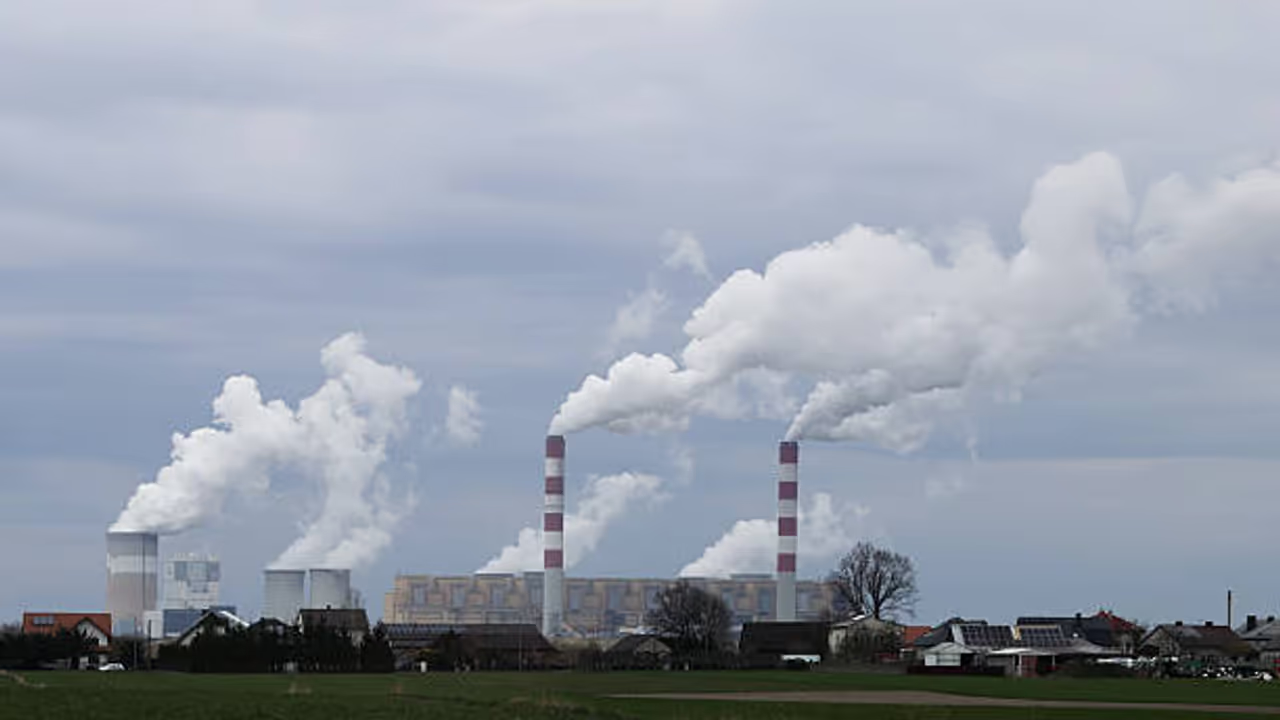
The EU's carbon border tax was designed to do more than clean up its own economy: it hoped to encourage trading partners to put a price on pollution as well.
The EU's carbon border tax was designed to do more than clean up its own economy: it hoped to encourage trading partners to put a price on pollution as well. As the levy system becomes fully operational on January 1, countries exporting emissions-intensive goods to the European Union face a choice: pay at the border, or adopt their own carbon rules at home.
The policy is already helping reshape climate policies far beyond the European Union, experts told AFP, even as critics accuse Brussels of protectionism.
What is the CBAM?
The Carbon Border Adjustment Mechanism (CBAM) aims to ensure foreign producers pay a carbon cost similar to what European companies already pay under the bloc's internal emissions trading system.
Related Articles

Importers of carbon-heavy goods produced abroad like steel, aluminium and fertiliser must declare the CO2 emissions embedded in their products, and pay a levy if they exceed EU standards.
Some competitors say the policy restricts trade and favours European manufacturers. But the EU says it encourages greener practices because countries can avoid paying the levy by imposing an equivalent carbon price on domestic production.
"Pricing carbon is something that we need to pursue with as many as possible, as quickly as possible," the EU's climate commissioner, Wopke Hoekstra, said at the top-level UN climate negotiations in Brazil in November.
Has it nudged others along?
Aurora D'Aprile, who studied the global response to CBAM for the Swiss-based International Emissions Trading Association, told AFP there had been "a clear step change in the reaction" over the past 12 months.
"Several key trade partners of the European Union actively expanded their carbon-pricing schemes, for instance China, or launched ETS (emissions trading schemes) after being in the making for many years", such as Turkey, she said.
Others, such as Japan, specifically cited CBAM in their reasoning for advancing their own policies, said Nicolas Berghmans, a climate and energy researcher at the Institute for Sustainable Development and International Relations (IDDRI) in Paris.
Some countries, including the United Kingdom and Canada, are also considering setting up their own mechanisms along the European model.
The CBAM was not the only influencing factor but given the size of the European market it "sharpened" the urgency of the global policy response, said Marios Tokas, a trade lawyer at the Brussels-based law firm Cassidy Levy Kent.
What about opponents?
Russia has argued the CBAM breaches the rules of global trade and has referred its opposition to the World Trade Organization (WTO).
China and other emerging economies have also been highly critical of what they consider a "unilateral trade measure" and successfully pushed to get the matter on the agenda at the COP30 climate talks in November.
But criticism at a global level "doesn't mean that the action on the compliance or adaptation side" isn't also being undertaken, said D'Aprile, pointing in particular to China.
Beijing was keeping up diplomatic pressure over CBAM while also ensuring it was ready to adapt and comply to the changes, she said.
Can the EU claim victory?
Georg Zachmann, a specialist in European energy and climate policies at Bruegel, a Brussels-based think tank, said the CBAM could be called "a political success for the EU".
But he told AFP that a long-term gauge would be to see how many countries imposed their own carbon pricing schemes in response, and how effective those policies might be.
D'Aprile said she would be cautious about declaring victory before the EU has finalised and implemented the "complex" last steps of the levy scheme.
Berghmans said there remained "a big challenge" in terms of how differing carbon pricing schemes may interact in the years ahead.
"We will have to support progress with a significant diplomatic effort," he said.
(Except for the headline, this story has not been edited by Asianet Newsable English staff and is published from a syndicated feed)