
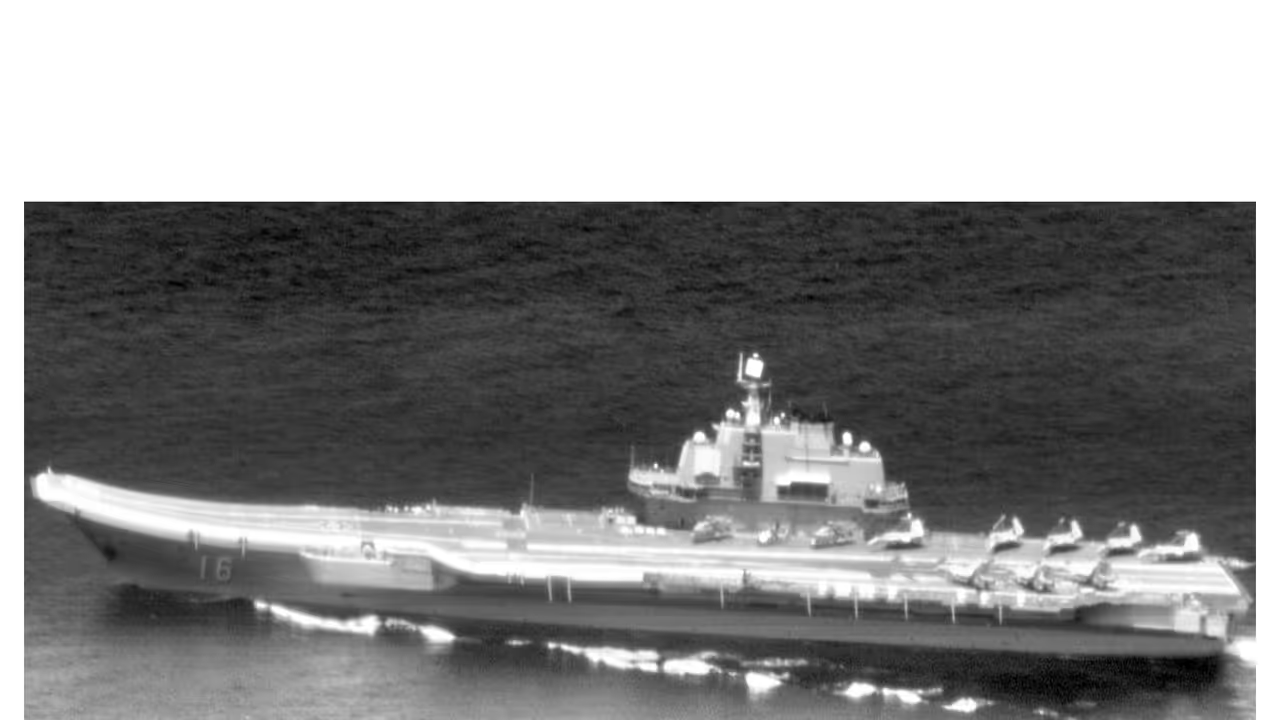
China is deploying large fleets of fishing vessels, coast guard ships, and maritime militia as part of a 'gray-zone' strategy to strengthen its control over contested waters in Asia without triggering open warfare, according to various reports.
China is intensifying its presence across contested waters in Asia by deploying large fleets of fishing vessels, coast guard ships and maritime militia units as part of a broader strategy to strengthen control without provoking direct military confrontation, as reported by The Wall Street Journal and cited by Taiwan News.
Activity in the Yellow Sea
According to Taiwan News, nearly 200 Chinese fishing boats recently advanced deeper into the Yellow Sea, moving closer to waters jointly claimed by China and South Korea. Data collected by geospatial intelligence company Ingenispace revealed unusually dense vessel activity along critical shipping routes and disputed maritime zones.
Analysts stated that Beijing is increasingly relying on civilian fishing fleets equipped for dual-use operations as part of its "gray-zone" tactics, a method aimed at gradually expanding influence while remaining below the threshold of open warfare. Ingenispace Chief Operating Officer Jason Wang said the deployment of these vessels reflects an effort to exert control over regional waters through irregular maritime operations. He added that the growing buildup also demonstrates China's potential capability to disrupt international commercial shipping routes during periods of heightened tensions.
Escalation in East and South China Seas
Chinese maritime activity has also intensified in the East China Sea. More than 600 Chinese fishing boats were observed forming a long line formation for nearly 18 hours on April 3, while Beijing simultaneously increased coast guard patrols around the disputed Diaoyutai Islands.
In the South China Sea, China reportedly doubled its coast guard operations near Scarborough Shoal over the past year and introduced stricter administrative measures after designating the area as a national nature reserve. Fresh construction activity near Vietnam in the Paracel Islands. Researchers from the Center for Strategic and International Studies and Stanford University's SeaLight project said China began expanding Antelope Reef last year under the protection of maritime militia and coast guard vessels, as highlighted by Taiwan News.
A 'Calibrated' Strategy for Regional Control
Experts stated that China's long-term objective is to steadily normalise its dominance in disputed waters while avoiding outright conflict. Victor Cha, president of the Geopolitics and Foreign Policy Department at CSIS, said China's actions are carefully calibrated to strengthen regional control without triggering war, as reported by Taiwan News.
(Except for the headline, this story has not been edited by Asianet Newsable English staff and is published from a syndicated feed.)