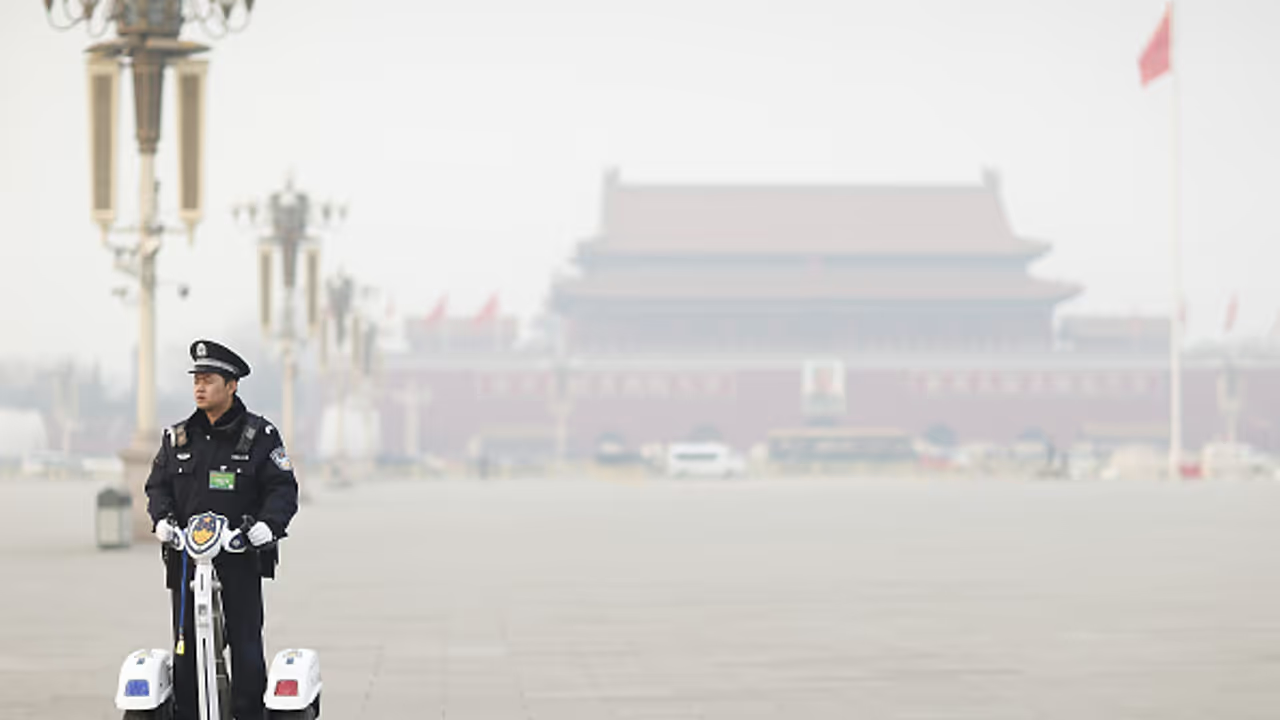
China’s People’s Police Day projects patriotism, but behind the celebrations, UN reports and survivor accounts describe the force as a tool of repression.
Every January 10, Beijing stages a familiar display of patriotic zeal for Chinese People’s Police Day, a holiday introduced in 2020 to salute what state media calls the exceptional work of the country’s public security “guardians.”
The imagery is always the same: crisp uniforms, scripted hero stories, and solemn vows of loyalty to the Chinese Communist Party. But the celebration is built to distract.
Behind the polished theatre lies a far harsher reality that does not stop at China’s borders. While propaganda praises police for protecting “social stability,” academic research, UN findings and survivor testimony point to a security apparatus tied to issues such as systematic repression, mass detention and transnational surveillance. These facts puncture the CCP's claim of unity.
Related Articles

What the hero story leaves out
Each year, the Ministry of Public Security publishes honour rolls and citations for officers in border regions and major cities, crediting them with safeguarding order. What those tributes don’t explain is what that “order” requires.
In Xinjiang, the People’s Police have been central to a campaign the UN has said may amount to crimes against humanity.
Former officers now in exile describe midnight raids where Uyghur families were pulled from their homes — hooded, handcuffed, and transported to meet detention quotas. One detective said torture was not a rare excess but routine procedure: new detainees were beaten regardless of age or gender, including children as young as fourteen.
Accounts describe suspension from ceilings, sexual violence, electric shocks, and waterboarding. Prisoners were pushed to sign forced confessions to “terrorism” and to provide names of relatives — effectively feeding the next round of detentions.
In Tibetan areas, policing has often doubled as cultural enforcement. When monks at Kirti monastery resisted “patriotic re-education,” paramilitary forces reportedly stormed the site, detaining more than 300 monks and killing two elderly Tibetans who tried to stop the arrests. More recent reports suggest the pattern persists: over 1,000 Tibetans, including monks from multiple monasteries, have been detained during peaceful protests against infrastructure projects that could submerge historic religious sites. Detainees are reportedly told to bring their own bedding and food, an ominous signal that they may be held for long periods without meaningful due process.
The point is hard to miss: the system is less about public safety than about breaking religious and ethnic identities that the Party treats as threats to its monopoly on authority.
Digital authoritarianism, exported
The coercion inside camps is reinforced by a data-driven system that is both vast and highly adaptable.
China’s Integrated Joint Operations Platform aggregates information from phone use, internet activity, travel records, and other streams, then uses predictive analytics to flag people as “suspicious.” That architecture enables detention at scale — sometimes triggered by behaviour as ordinary as using certain apps or contacting family abroad.
What makes this especially alarming is that Beijing has not kept these tools at home.
Research by the Australian Strategic Policy Institute and other scholars has found Chinese firms, often supported by state financing have supplied AI-enabled surveillance systems to at least 150 countries.
In parts of Central Asia, facial recognition tools sold to authoritarian governments have been used to identify dissidents and protest participants, while Chinese intelligence services are reported to benefit from access to data that can help track Uyghur diaspora communities. Adding to the reach, US-origin chips, servers, and other components have been integrated into Chinese surveillance platforms despite export-control efforts.
The result is a widening ecosystem in which China’s methods of algorithmic control increasingly shape security practice far beyond its borders, giving other governments a ready-made template for repression.
Voices that won’t disappear
And yet, even under such kind of pressure, people continue to resist in ways the Chinese Communist Party cannot fully script or suppress.
Tibetan monks who have spent years in incommunicado detention for expressing cultural pride on social media often emerge without the obedience the state demands.
Uyghur teachers who witnessed rape and forced sterilisation in detention centres continue to testify, even while knowing their families at home may pay the price. The UN has documented that roughly two-thirds of former detainees reported torture or ill-treatment, yet many still pursue accountability through international channels rather than accept silence.
That persistence exposes the hollowness of the “one China” narrative — the suggestion that citizens naturally and willingly embrace Party rule.
Loyalty cannot be manufactured by force. When monks kneel before police with raised thumbs, pleading for dialogue as their 700-year-old monasteries face demolition, they reveal where the real legitimacy crisis lies. When a 15-year-old nomad carries a portrait of the Dalai Lama, knowing arrest is likely, she shows how faith and identity can outlast intimidation. These are not isolated gestures. Documented by human rights groups and researchers, they reflect a broader refusal to surrender culture and conscience simply because the state demands it.
Chinese People’s Police Day is designed as state theatre, meant to cast coercion as patriotism. But the record — Xinjiang police files, survivor testimony, and UN reporting— points to another story, one in which law enforcement operates as an instrument of repression and cultural destruction.
As Beijing’s surveillance toolkit spreads worldwide, the choice facing the international community becomes sharper: treat digital authoritarianism as normal, or take seriously the voices of those living under it.
The hope in Tibetan monasteries and Uyghur communities is not for performative sympathy or distant slogans. It is for recognition that their suffering is real, documented, and worth confronting. That recognition, sustained by careful evidence and sustained attention, may still help build the pressure needed to challenge a system built on the myth of unity through force.