
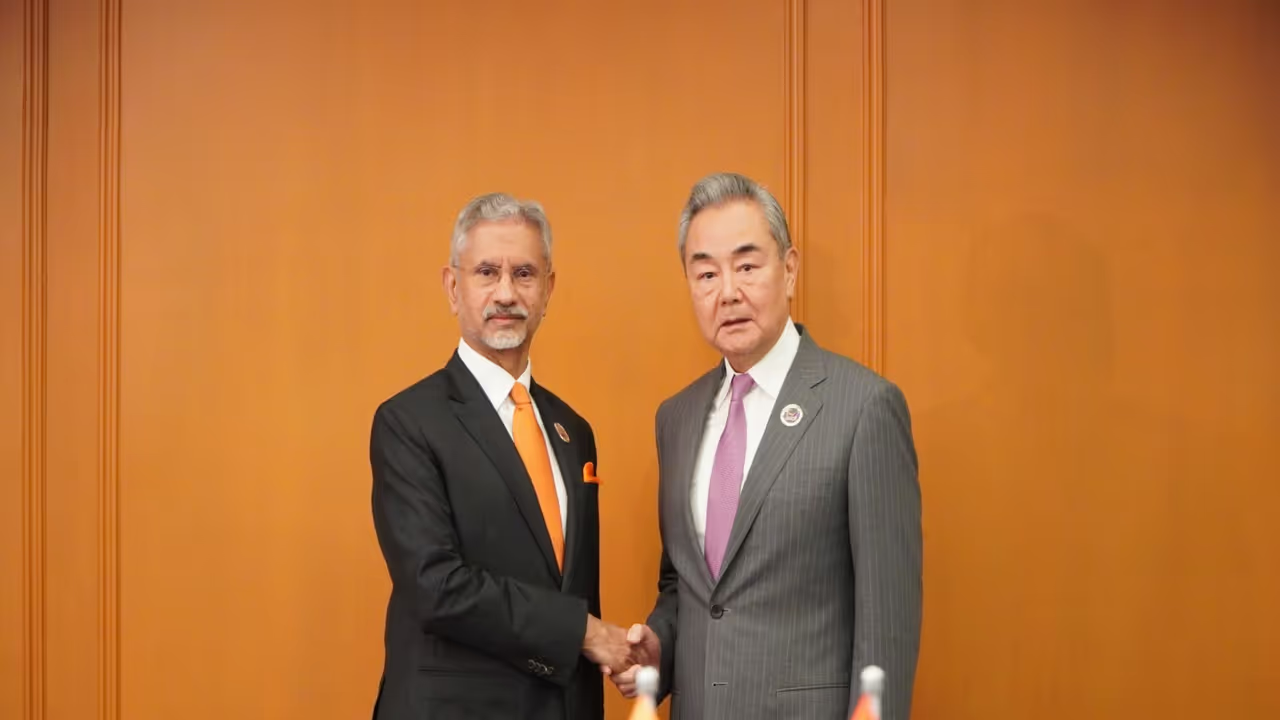
Chinese FM Wang Yi told S Jaishankar that the two nations are partners, not competitors. Jaishankar stressed that peace and tranquillity along the Line of Actual Control is a prerequisite for normalising ties between the two Asian giants.
Chinese Foreign Minister Wang Yi has said that China and India should view each other as "partners, not competitors, and opportunities, not threats," as he met External Affairs Minister S Jaishankar in Manila, calling for stronger bilateral ties, closer coordination in multilateral forums and enhanced cooperation between the two countries.
According to the Chinese foreign ministry readout, Wang on Wednesday said the meetings between Chinese President Xi Jinping and Prime Minister Narendra Modi in Kazan and Tianjin had "guided China-India relations onto the right track of improvement and development." Chinese FM Wang Yi met with Indian External Affairs Minister Subrahmanyam Jaishankar in Manila.#China stands ready to work with #India to implement the important common understandings reached by the leaders of the two countries, maintain close high-level exchanges, strengthen… pic.twitter.com/Q6R4zQ9PdS — Lin Jian 林剑 (@SpoxCHN_LinJian) July 23, 2026
Wang Yi on Partnership and Cooperation
"China and India are partners, not competitors, and opportunities, not threats, for each other," Wang said, adding that institutional exchanges between the two countries had gradually resumed, border areas had maintained peace and tranquillity, and bilateral trade had reached a new high.
"These achievements have not come easily and should be cherished," he said.
Calling China and India representatives of emerging economies and key members of the Global South, Wang said the two countries should "prioritise human well-being, demonstrate their responsibility as major powers, consolidate the positive momentum of bilateral relations, strengthen coordination and cooperation in international and regional affairs, and make positive contributions to promoting multipolarity and the democratisation of international relations."
He said China was willing to work with India to implement the consensus reached by the two leaders, maintain close high-level exchanges, expand cooperation in trade, media and people-to-people exchanges, properly handle sensitive issues, and "explore a correct way for neighbouring major powers to coexist peacefully, based on mutual respect, mutual trust, common development, and common prosperity."
BRICS Cooperation and Regional Issues
Referring to the BRICS grouping, Wang noted that India and China would assume the bloc's chairmanship successively over the next two years and called for greater coordination to advance the "Greater BRICS Cooperation" mechanism. "China will continue to support India in successfully hosting this year's BRICS summit," he said.
The two foreign ministers also exchanged views on international and regional issues of mutual concern, including Iran and Myanmar, according to the Chinese foreign ministry.
Jaishankar Stresses Border Stability as 'Pre-requisite'
Meanwhile, according to Jaishankar, he conveyed to Chinese Foreign Minister Wang Yi that ensuring stability along frontier regions remains a "pre-requisite" for restoring standard diplomatic engagements, emphasising that bilateral relations ought to be anchored in mutual respect, interest and sensitivity.
During the talks, Jaishankar raised crucial economic concerns with his counterpart, drawing attention to market entry barriers, expanding trade deficits and unpredictable global supply networks.
Both diplomatic representatives gathered in the capital of the Philippines to participate in key ministerial discussions hosted under the Association of Southeast Asian Nations (ASEAN) umbrella.
Ties between the two Asian giants have witnessed progressive normalisation measures recently, following years of acute tension triggered by the long-drawn military standoff in eastern Ladakh that began four years ago.
Addressing the delegation, Jaishankar stressed that a stable and cooperative partnership requires a foundational framework governed by shared principles. "We believe that a stable and cooperative relationship can best be developed on the basis of mutual respect, mutual interest, and mutual sensitivity," he remarked during his opening statement.
He further added, "Such a relationship can make a valuable contribution to a multi-polar Asia and a multi-polar world."
'Peace and Tranquillity' Non-Negotiable
Reiterating the absolute necessity of maintaining calm along the Line of Actual Control (LAC), the minister noted that border stability is non-negotiable. "Peace and tranquillity in the border areas is obviously the pre-requisite for normal ties. Since October 2024, both sides have engaged to ensure that this important objective is met," Jaishankar asserted.
"This will continue to need our constant attention. Relevant mechanisms in this domain must be given full support and strong encouragement," he highlighted. (ANI)
(Except for the headline, this story has not been edited by Asianet Newsable English staff and is published from a syndicated feed.)