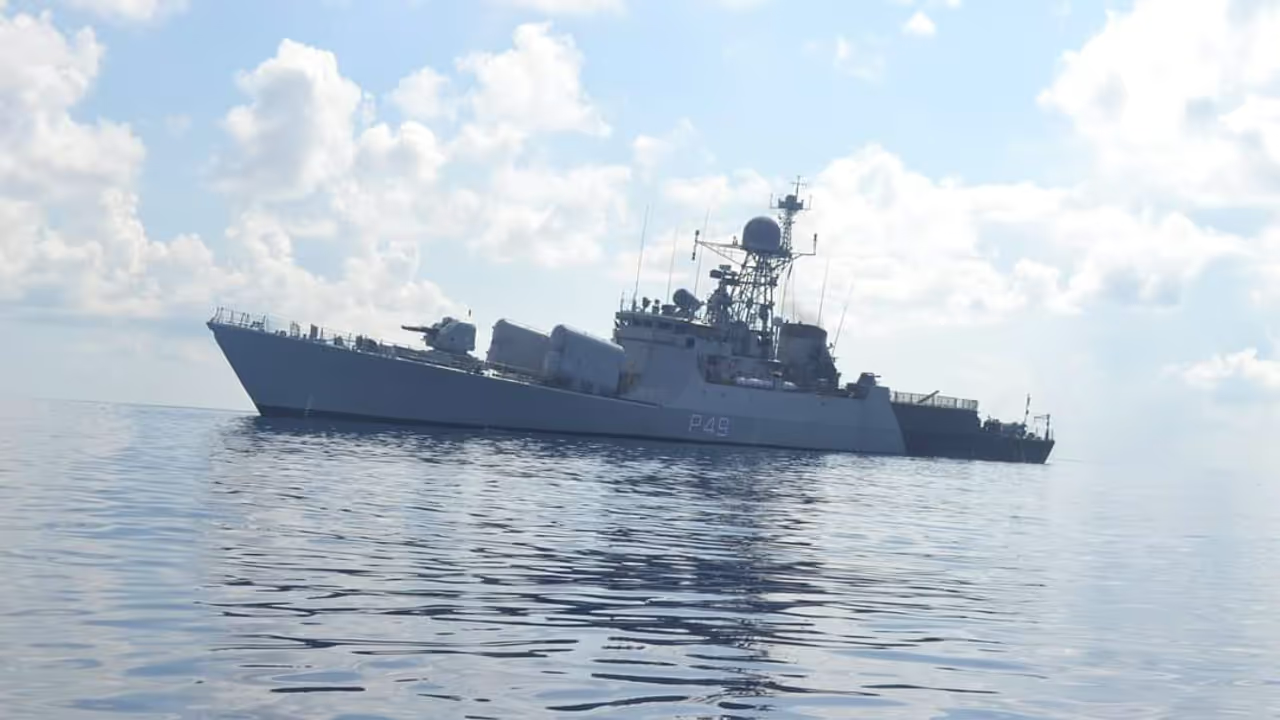
The naval courses under The Indian Technical and Economic Cooperation (ITEC) span hydrography, navigation, engineering, communication systems and the legal underpinnings of maritime security.
New Delhi: The newly elected BNP government has tried to soften the sharper anti-India positions associated with the Yunus period. Yet over the past year and a half, both Dhaka and New Delhi have shifted to more measured public messaging, with officials on both sides carefully navigating political sensitivities.
One space that has not reflected this caution is naval cooperation. Even during the tense 2024–2025 phase, naval cooperation continued on schedule.
Bangladeshi officers continued to attend courses in India during this period.
Related Articles

The naval courses under The Indian Technical and Economic Cooperation (ITEC) span hydrography, navigation, engineering, communication systems and the legal underpinnings of maritime security.
Over the years, these programmes have steadily raised the professional capabilities of officers from neighbouring countries, including Bangladesh.
The ITEC programme, often viewed as a low-visibility capacity-building tool, has quietly become one of the key factors keeping naval engagement steady at a time when the broader political relationship has gone through a cycle of strain and adjustment.
Official Indian Navy figures show that 39 ITEC naval training slots were allotted to Bangladesh in 2023–24, of which 37 were utilised, while the number increased to 42 in 2024–25, with 34 officers attending courses in India despite diplomatic caution in Dhaka.
Between Training Years 2016–17 and 2024–25, a total of 491 Bangladeshi personnel were trained in India under ITEC.
This continuity was also visible at sea. The two navies conducted Exercise Bongosagar 2025 and an India–Bangladesh Navy Coordinated Patrol (CORPAT) without scaling back their operational scope. Ships from both sides carried out coordinated manoeuvres, communication checks and Visit, Board, Search and Seizure drills, mirroring earlier iterations of the exercises.
The decision to go ahead with these engagements — even as other exchanges were being handled with unusual caution — highlights the depth of familiarity built through training links.
Officers who have studied together in Indian institutions find it easier to coordinate at sea, reducing friction at a time when the political climate is less predictable.
While India’s emphasis on capacity building is not new, its importance has grown as strategic competition in the Bay of Bengal has intensified.
Several Indian Ocean littorals rely on Indian training institutions, creating a gradual convergence in operational habits across the region.
For India, this fits neatly within its SAGAR framework, which prioritises cooperative maritime security. Unlike equipment sales or credit lines, training rarely triggers political sensitivities. It builds habits of cooperation rather than short-term dependency.
India–Bangladesh ties have long moved through cycles of trust and hesitation, but naval cooperation has begun to break that pattern.
The continuity of ITEC training, combined with regular joint activities at sea, has created a channel of engagement that remains stable irrespective of diplomatic ups and downs.
In effect, the training network has become a quiet pillar of India’s naval diplomacy in the Bay of Bengal by keeping coordination intact when other avenues face headwinds.