
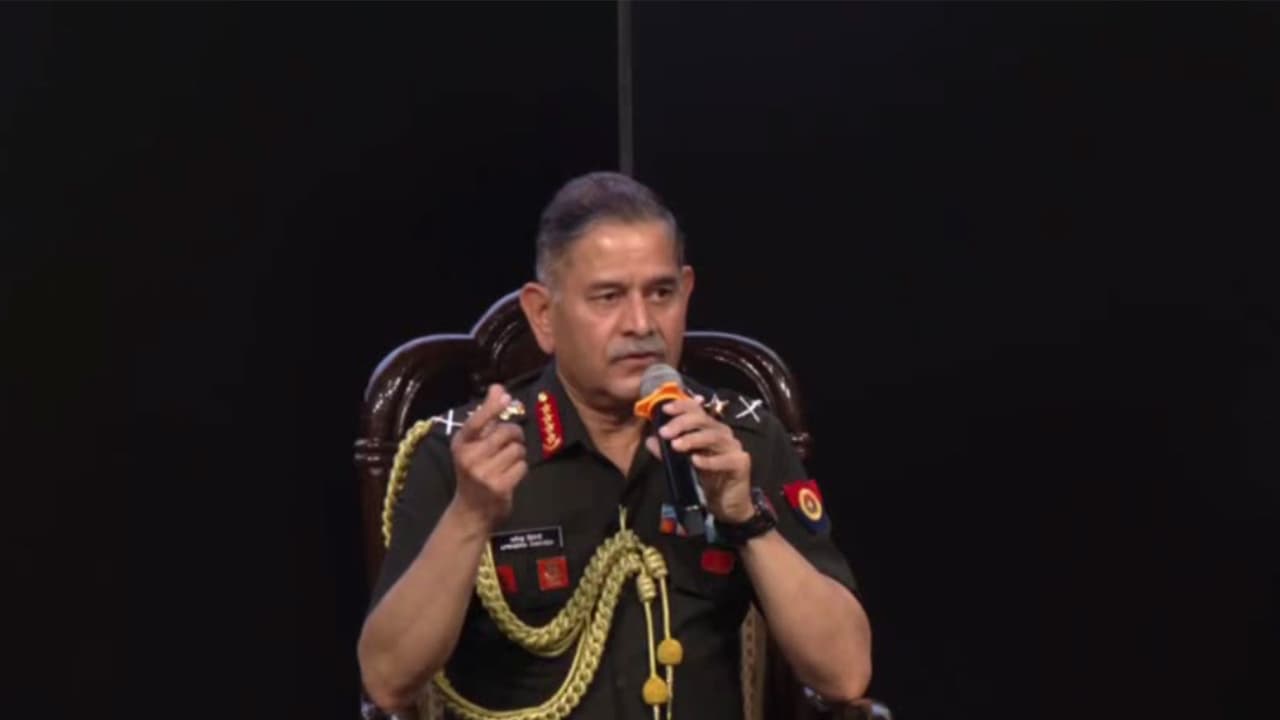
Army Chief Gen Upendra Dwivedi issued a stark warning to Pakistan over its support for cross-border terrorism, stating that if terror activities continue, Islamabad must decide if it wants to remain 'part of geography or history'.
Army Chief's Stern Message to Pakistan
In a stern message to Pakistan over its support to cross-border terrorism, Army Chief Gen Upendra Dwivedi referred to Operation Sindoor launched in response to the Pahalgam terror attack and said if Islamabad continues with its terror-related activities, "they have to decide whether they want to be part of the geography or history or not".
"If you have heard me earlier, what I have said is that Pakistan, if it continues to harbour terrorists and operate against India, then they have to decide whether they want to be part of the geography or history or not," Gen Dwivedi said at the Sena Samvad event here, responding to a question on Operation Sindoor.
Harnessing Youth and Technology
He lauded the capabilities of the tech-savvy generation and the Army's intention to utilise their potential. He said the Army has started the internship and received one lakh applications for 100 vacancies "Let me firstly concede and accept that the generation is at least 10 times better than our generation. They are much more adaptable. They're socially aware, globally connected, and digitally fluent...The Indian Army is talking about 2026-27 as the year of networking and data centricity. We have started the internship, and we received one lakh applications for 100 vacancies," he said.
"Today, we have opened up all the army-based workshops, all our category A establishments, and so many headquarters for the internship of the children. Because half of the time, they come out with a simplistic solution. On the battlefield, we require a battlefield equaliser. We don't require tank versus tank. If you give me a simple solution to a difficult problem, I think you are the ones who are going to win the battle for us," he added.
Adapting to Modern Warfare
Gen Dwivedi talked of the rapid changes in technology and its impact on military modernisation. He also talked about self-actualisation, transcendence and the whole of the nation approach.
"Self-actualisation is when you realise what your actual potential is and then you desire to reach out to that level, and that is what is something important because when you have to reach out to that level, it is not individual. You are heading a team, you are a leader...Today, the military is changing so fast, the modernisation is taking place so fast, and technology becomes stale within 18 months. If you have to adapt to that kind of technology, how are you going about it? Therefore, the ripples of change have to be felt at every level, starting from a soldier to a major to a major general, till a general like me," he said.
"When you look at the big picture, a whole-of-nation approach. How are you going to converge this complete India as a nation to fight a war? How are you going to establish the interlinkages? How are you going to provide the strategic guidance to the decision makers? Those are the big things that we are looking at while making sure that your halo effect and the reputation which you have made over a period of time comes down to a soldier or to a common citizen who is part of the whole of the nation approach whenever you go for the next operations or war," he added.
About Operation Sindoor
India targeted terror infrastructure in Pakistan and PoJK in Operation Sindoor, which was launched in May last year in response to the Pahalgam terror attack. Following escalation by Pakistan, India pounded its airbases. (ANI)
(Except for the headline, this story has not been edited by Asianet Newsable English staff and is published from a syndicated feed.)