
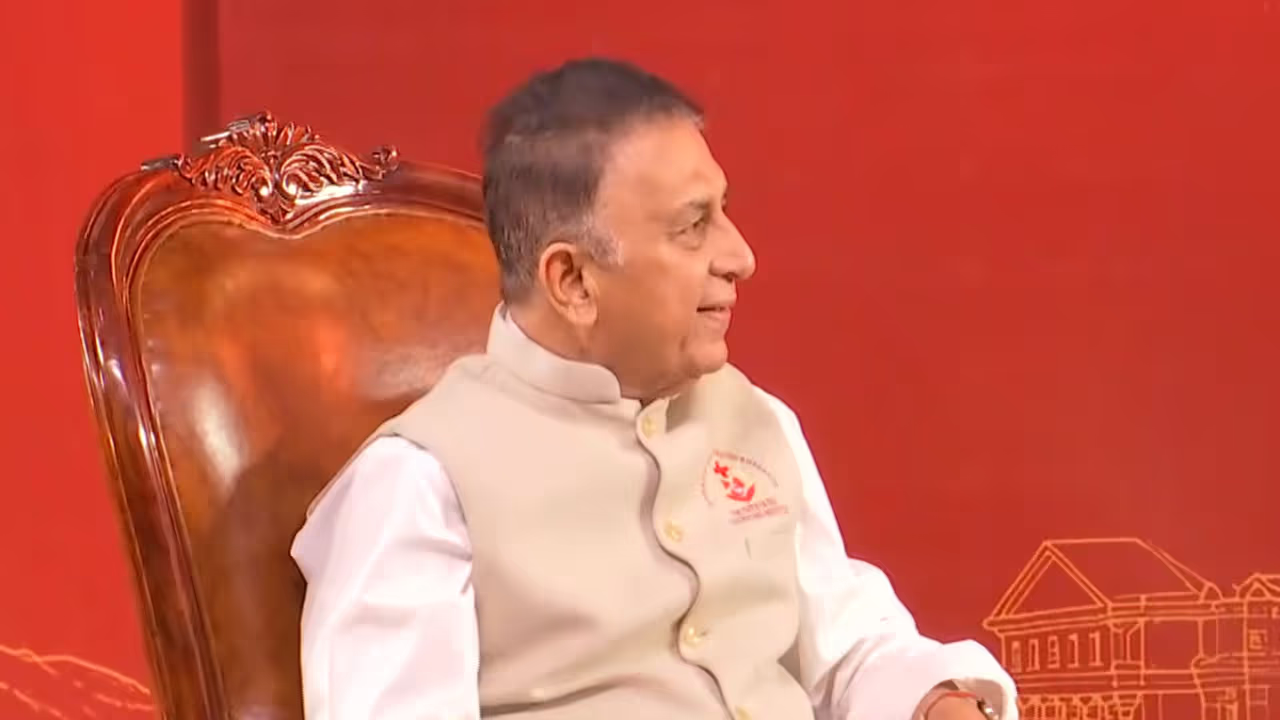
Sunil Gavaskar reflected on how dropped catches by Sir Garfield Sobers gave his career a second chance, drawing a parallel to the free heart surgeries for children by Sri Sathya Sai Sanjeevani Hospital, which he calls his 'third innings'.
Indian cricket legend Sunil Gavaskar reflected on how two dropped catches by former West Indies great Sir Garfield Sobers gave his international career a second chance, drawing a connection between those moments and the work of Sri Sathya Sai Sanjeevani Hospital supporting free heart surgeries for children born with congenital heart defects. Speaking at the event ‘An Evening with Legends: Compassion in Action’ in Bengaluru on Saturday, Gavaskar said Sobers’ generosity and the opportunities he received early in his career had shaped his perspective on giving others a second chance.
“So that generosity of Sir Garfield Sobers gave my cricketing career an almost vertical take-off. So when I got this opportunity to be involved with the Sai Sanjeevani Hospitals, where children born with congenital heart defects are given totally free-of-cost surgeries and they get a second life. They get a second life where they can be contributing citizens of our country,” Gavaskar said.
A Cricketing Second Chance
Recalling his debut Test against the West Indies, Gavaskar said he was batting on 12 when he edged a delivery to slip, where Sobers dropped what appeared to be a straightforward catch. The reprieve let him keep batting and score his first Test half-century, helping him retain his place for the next match. Gavaskar said he received another reprieve in the following Test, when Sobers dropped a more difficult chance at slip.
“In those days you barely got one or two opportunities, and if you didn't grab them, you were out,” he said, recalling the significance of those moments in the early stages of his career.
Connecting Cricket to Compassion
The former India captain said the experience resonated with the work of Sai Sanjeevani Hospitals, where children from financially challenged backgrounds receive heart surgeries without being charged.
“That second chance is connected to what we do here – where children born with congenital heart defects are given totally free-of-cost surgeries, and they get a second life. A second life where they can become contributing citizens of our country. And therefore the connection was there,” he said.
Gavaskar also praised the medical teams for their work, saying the hospitals had a success rate of more than 99 per cent. “When you consider that we are operating on children's hearts, you really have to appreciate the extraordinary skill of our doctors and our support staff,” he said.
He added that many children receiving treatment came from villages and families dependent on daily wages, for whom missing even a day's work could have serious consequences. “Not a single rupee is charged. Most of these children come from financially challenged backgrounds, from villages. Unlike in the private sector, where surgeries are performed for a fee, most of these children come from families of daily wage earners – who, if they miss a day's work, the whole family goes hungry,” Gavaskar said.
Gavaskar's 'Most Fulfilling Innings'
Describing his involvement with the initiative as the most fulfilling phase of his life, Gavaskar said his association with cricket had continued beyond his playing career through media work and sports-related businesses.
“Yes, it is my third innings. It is the most fulfilling of my innings so far. I've been blessed to be able to represent my country, India, over 17 years in various forms of the game, in Test matches, in one-day matches, and subsequently I've also been fortunate and blessed to be able to carry on my association with Indian cricket and cricket in general by being part of the media and also having a company which is into sports events, marketing, branding, and connecting brands through cricket and sport,” he said.
Gavaskar, one of India’s most celebrated opening batters, was the first player to score 10,000 runs in Test cricket. He also held the record for most Test centuries, with 34, before Sachin Tendulkar surpassed it in 2005. He scored 774 runs in his debut Test series against the West Indies in 1971 and was part of India’s 1983 Cricket World Cup-winning team. (ANI)
(Except for the headline, this story has not been edited by Asianet Newsable English staff and is published from a syndicated feed.)