
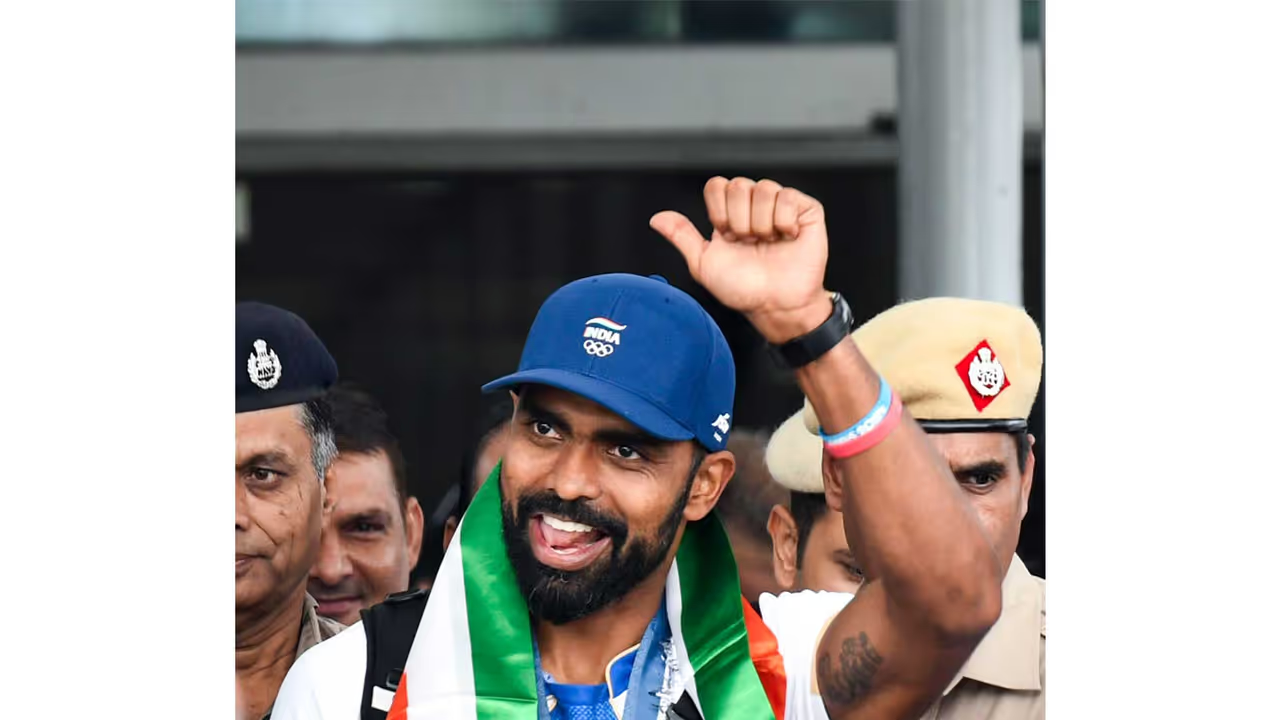
Former captain PR Sreejesh says India's improved fitness and decision-making have ended late-game struggles. Ahead of the crucial FIH Hockey World Cup 2026 clash, India needs a draw against Pakistan to advance, while Pakistan faces a must-win game.
Sreejesh on India's Evolution and Rivalry with Pakistan
Former India hockey captain and legendary goalkeeper PR Sreejesh said the national side has significantly improved its fitness, game awareness and decision-making, helping it overcome the late-game struggles that once affected matches against Pakistan. Speaking to JioStar, Sreejesh reflected on the evolution of the Indian hockey team and the India-Pakistan rivalry, saying India has now become more capable of scoring in the final stages of matches. "Conceding goals in the last quarter or final minutes used to be a problem for us, but that is no longer the case. Now, we are the ones scoring late to win matches," Sreejesh said.
He recalled that India often struggled during the earlier 35-minute-half format, with lapses in fitness and decision-making allowing opponents to score late. "Earlier, during the 35-minute halves, we used to make mistakes due to fitness or poor decision-making and let in goals. But since the four-quarter system came in, and even before that, we made big improvements in our fitness, strength, game awareness, and decision-making," he said.
Sreejesh said these improvements have also changed the nature of India's matches against Pakistan, which he believes are no longer as difficult as they were in the past. "Because of that, matches against Pakistan are not as tough as they used to be. In the past, India vs Pakistan games were tight, often ending 1-0 or 2-1," he said.
While acknowledging Pakistan's potential, Sreejesh said the current team does not have the same level as previous Pakistan sides. "Pakistan still has potential, but their current team's level is not the same as before," he added.
High-Stakes World Cup Clash
The India-Pakistan clash at the FIH Hockey World Cup 2026 on Wednesday will be one of the most significant matches of the tournament, with the Pool D encounter at Wagener Hockey Stadium carrying both the weight of a historic rivalry and major implications for the semi-final race.
Qualification Scenario
The match is crucial because India and Pakistan are fighting for the second qualification spot from Pool D. England have already secured a top-two finish after winning both of their matches. India are currently second with three points, having defeated Wales 3-1 before losing 2-4 to England. Pakistan have one point, earned from a draw against Wales, and also suffered a 1-4 defeat to England.
Under the tournament format, the top two teams from each of the four pools advance in the competition for the semi-finals, while the bottom two teams move into classification matches. With England already assured of a top-two finish, the remaining qualification battle involves India, Pakistan and Wales. The equation is straightforward: India needs at least a draw against Pakistan to secure second place in the pool, while Pakistan must win to keep their semi-final hopes alive. Wales are also in contention and need a victory against England to remain in the race. This makes the India-Pakistan encounter much more than a traditional rivalry match, as the result could directly determine the tournament prospects of both teams.
India's Recent Dominance
India will enter the contest with a strong recent record against Pakistan. The two sides have faced each other 19 times in the last 10 years, dating back to the 2016 South Asian Games final. India have won 17 of those matches, while the other two ended in draws. Pakistan has therefore gone without a victory over India for a decade, highlighting India's dominance in the rivalry during this period.
Key Players and Team Strategy
India's attacking threat will once again be led by captain and drag-flick specialist Harmanpreet Singh. The defender has already scored three goals in two matches at the tournament, with all three coming from penalty corners. His ability to convert set-piece opportunities could prove particularly important in a high-pressure match where scoring chances are likely to be limited.
India's forwards have shown encouraging movement and an ability to create opportunities but will need to improve their finishing. With qualification at stake, converting chances efficiently could be decisive against Pakistan.
Pressure and Expectations
Pakistan, meanwhile, will come into the match under greater pressure. With only one point from two games, nothing short of a victory will keep their semi-final hopes alive. The urgency could make Pakistan particularly dangerous, especially given the emotional significance of an India-Pakistan encounter.
For India, the key challenge will be to manage the intensity and emotion surrounding the rivalry while maintaining discipline and executing their plans effectively. Pakistan will look to use the occasion to challenge India's recent dominance and revive their World Cup campaign.
Overall, the match combines historic rivalry, qualification pressure and contrasting recent form. India has the advantage of a strong head-to-head record and only requires a draw, while Pakistan faces a must-win situation. With a place in the semi-final race at stake for both sides, the encounter is expected to be one of the most intense and closely watched matches of the FIH Hockey World Cup 2026. (ANI)
(Except for the headline, this story has not been edited by Asianet Newsable English staff and is published from a syndicated feed.)