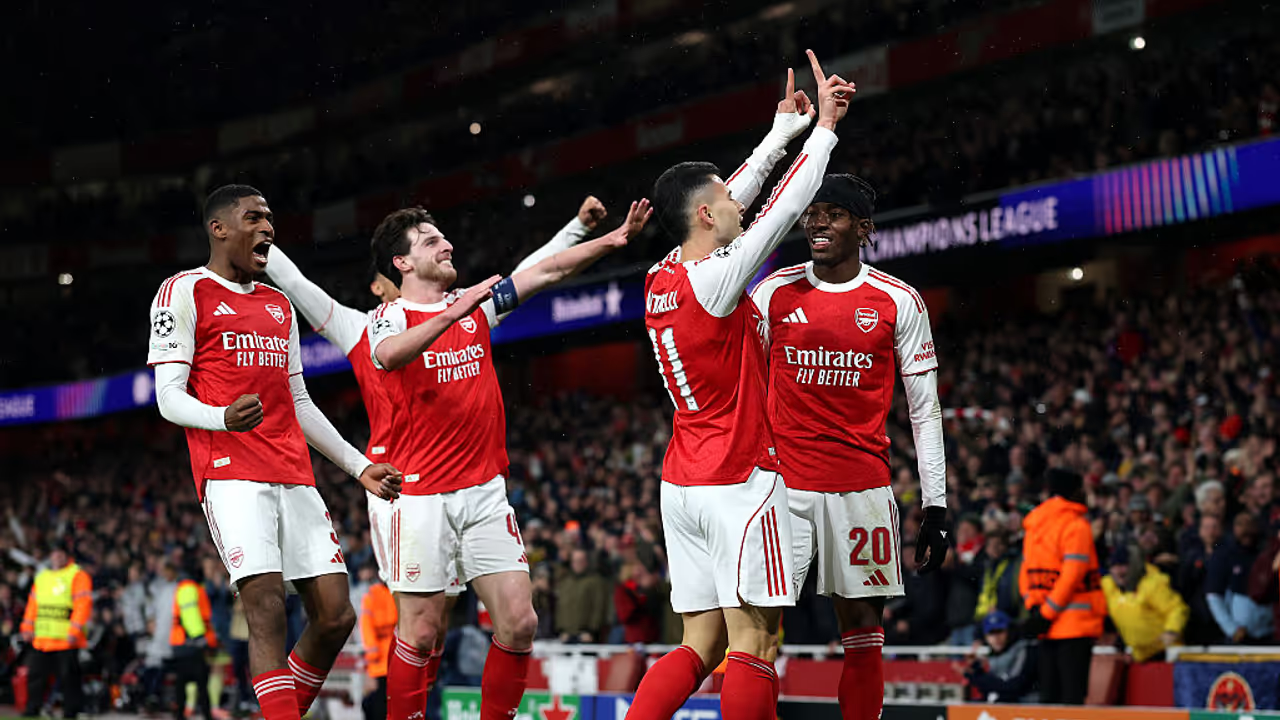
Arsenal's comprehensive 3-1 victory over Bayern Munich represents a significant statement of intent in the Champions League. The win showcased a tactical evolution, with the team excelling in both planned set-pieces and dynamic open-play football.
Arsenal's comprehensive 3-1 victory over Bayern Munich transcends a mere group-stage result. It represents a statement of intent that could fundamentally reshape this season's Champions League narrative, signaling the emergence of a side capable of reclaiming European football's ultimate prize.
The tactical architecture of Arsenal's performance revealed a fundamental shift in elite football's competitive landscape. While Bayern Munich epitomizes continental football's traditional commitment to open positional play, Arsenal has evolved into something more multifaceted-a team that excels simultaneously across set-piece exploitation and dynamic open-play football.
The Set-Piece Revolution
Arsenal's opening goal through Jurrien Timber exemplified their mastery of dead-ball situations. The corner execution was essentially indefensible, yet it merely underscored a troubling trend for Bayern: their last five conceded goals have originated from set-pieces. This reflects a broader tactical reality-Premier League sophistication now encompasses weaponizing every marginal advantage through meticulous preparation and execution.
Related Articles

Bayern's response demonstrated the precision that separates elite continental sides from the rest. Joshua Kimmich's cross-field pass found Michael Olise in space, who immediately supplied Lennart Karl's finishing touch. The 17-year-old's composure hinted at Bayern's generational talent, yet even such moments of brilliance proved insufficient against Arsenal's relentless machine.
Dominance Beyond Set-Plays
The narrative that Arsenal merely excels from dead-ball situations fundamentally misrepresents their superiority. Mikel Arteta's squad executed open-play football with comparable-if not superior-fluidity to Bayern, with the clinching goals exemplifying this advantage. Noni Madueke's strike resulted from Dayot Upamecano's misplaced pass to Declan Rice, while Gabriel Martinelli capitalized on Manuel Neuer's wandering positioning.
By the second half, Arsenal had achieved complete tactical dominance. They could realistically have extended their margin to five or six goals, mirroring their performance against Tottenham Hotspur-a result that now appears reflective of Arsenal's genuine quality rather than Spurs' inadequacy.
The English Advantage
The emerging pattern suggests English elite clubs possess an inherent competitive advantage rooted in their synthesis of tactical approaches. They maintain traditional continental excellence in positional football while simultaneously dominating the technical and organizational aspects of set-piece execution. Bayern, like PSG before them, represents the old European paradigm-proficient but increasingly incomplete.
Arteta's squad possesses versatility across all operational dimensions. They attack from multiple angles, defend with discipline, and exploit every marginal advantage with methodical precision. This comprehensive superiority extends beyond individual moments to encompass entire matches.
Cautious Optimism with Historical Precedent
Arsenal's perfect Champions League record coincides with their domestic dominance, yet recent history demands caution. Last season's comprehensive victory over Paris Saint-Germain in the group stage preceded elimination, illustrating how early-season impressions can deceive. However, the fundamental difference this season lies in consistency-Arsenal haven't merely won; they've overwhelmed opponents while maintaining structural discipline.
Looking Forward
The immediate challenge against Chelsea this weekend will test whether Arsenal can sustain this trajectory, yet their current trajectory appears unsustainable for opponents. Only generational talent, represented by Karl's emergence or similar exceptional performances, appears capable of disrupting their momentum.
Arsenal have positioned themselves with everything required to succeed at Europe's highest level. Their challenge now involves translating dominance into silverware-a task that increasingly appears inevitable given their current trajectory and comprehensive superiority across all tactical dimensions.