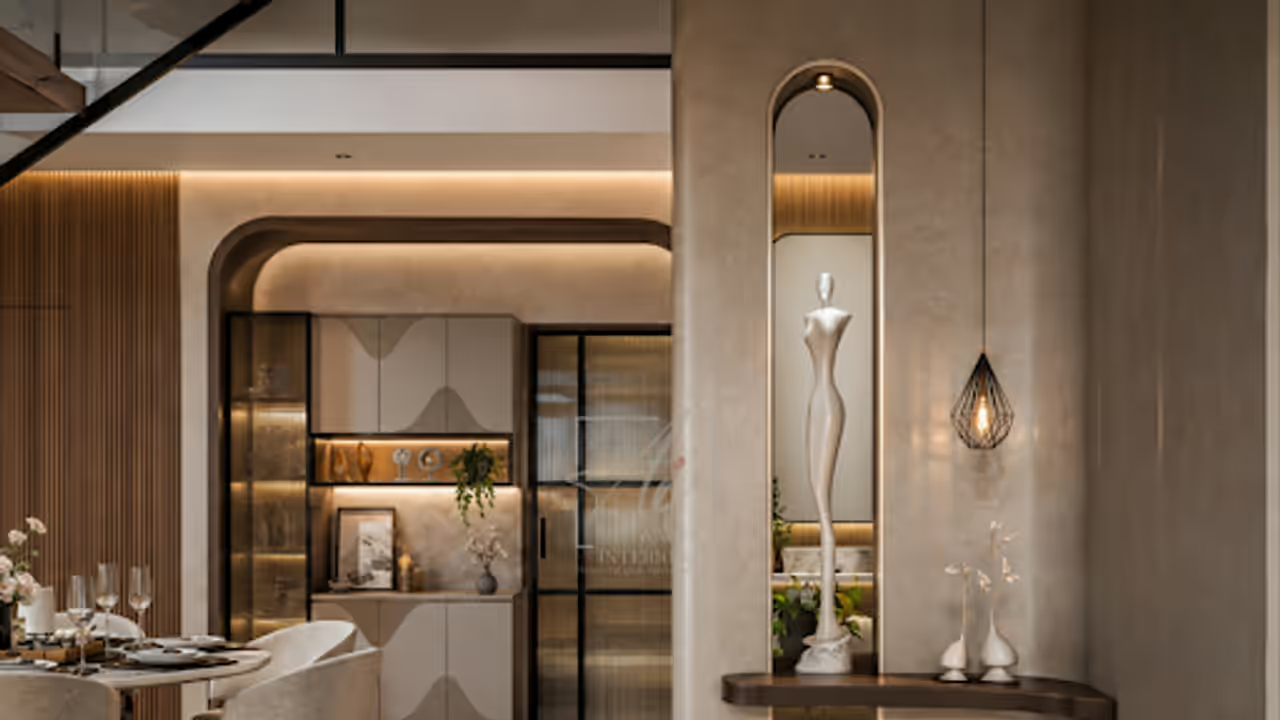
Bespoke interior design is gaining popularity among premium homeowners in Bangalore as buyers seek spaces that reflect their lifestyle and personality. Discover why customised layouts, materials and detailing are redefining luxury interiors.
Walk into two newly finished homes in the same premium Bangalore enclave, built off the same architectural template, sold by the same developer — and increasingly, they will look nothing alike inside. One owner has a reading nook carved into a wasted stair landing; the other has replaced a standard wardrobe run with a dressing room sized around exactly how many sarees, suits, and shoes the family owns. Neither feature came from a catalogue. Both came from a designer who measured the life first and the room second.
This is the quiet but decisive shift underway in the city's premium housing market: bespoke home interiors in Bangalore are no longer a rarefied indulgence reserved for a handful of landmark villas. They are fast becoming the baseline expectation for anyone building or buying a high-value home.
The Limits of Off-the-Shelf Design
For much of the last decade, premium interiors in Bangalore followed a fairly standard playbook: a modular kitchen from a catalogue, a wardrobe system in one of three finishes, a living room arranged around a sofa set chosen from a showroom floor. It looked polished, it photographed well, and it was fast to execute. But it also meant that homes with very different owners, family sizes, and daily routines ended up looking, and functioning, almost identically.
Related Articles

That formula is losing ground. As buyers spend more time researching before they commission a designer, and as more of them have lived in — and grown frustrated with — a standardised interior before, the appetite for custom interior design built specifically around one household has grown sharply. Off-the-shelf furniture and fixed layouts are increasingly seen not as convenient, but as a compromise premium buyers no longer feel they need to make.
What 'Bespoke' Actually Means in Practice
The word bespoke is used loosely across the design industry, but in serious residential practice it describes something specific: furniture, storage, and layouts built to the precise dimensions, habits, and preferences of one family, rather than adapted from a standard product line. A made-to-measure wardrobe built around a couple's actual wardrobe inventory. A kitchen island sized for a family that cooks together rather than a generic three-person household. A study desk angled to the one window in the room that gets usable afternoon light.
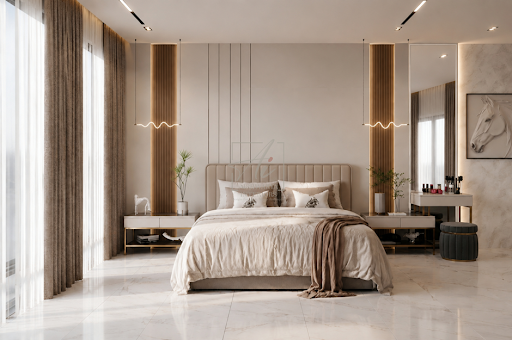
None of this is visible in a brochure render. It only emerges through a design process that starts with detailed conversations about how a family actually lives — what time they eat, who works from home, which heirloom pieces need to be built around rather than replaced — before a single material or finish is chosen.
Materials and Craftsmanship Over Catalogue Finishes
The other marker of genuinely bespoke work is where the craftsmanship happens. Rather than selecting from a limited set of factory finishes, premium home interiors increasingly involve in-house or closely supervised carpentry, veneer and stone selected in person rather than from a swatch card, and hardware chosen for how it will perform after years of daily use rather than how it looks on day one.
This shift has also elevated the role of personalised design details that were once considered unnecessary flourishes: a jaali pattern reworked for one family's balcony rather than repeated from a stock design, a colour palette developed around a specific piece of art or a client's favourite fabric rather than a seasonal showroom range. These details rarely add significant cost, but they are precisely what separates a home that looks expensive from one that has been genuinely designed.
Why Premium Buyers Are Driving This Shift
The push towards bespoke work is coming disproportionately from Bangalore's higher-value housing segment — villas, penthouses, and large-format apartments — where owners are both more willing to invest in a considered design process and less willing to accept a home that feels interchangeable with a neighbour's. Many have also lived through at least one generic, contractor-led interior fit-out and are actively designing against that experience the second time.
Aishwarya Interiors, the Bangalore-based residential design studio founded in 2004 by Yogesh and Laxmi Deshmukh, notes that the shift shows up earliest in the questions clients ask. "A few years ago, people would show us a photograph and ask if we could recreate it," the studio observes. "Now they start by telling us how they actually use a room, and ask us to design around that. The brief has become the person, not the picture."
That change in mindset is reshaping how designers structure their process. Measured drawings, detailed lifestyle questionnaires, and iterative material sampling — once reserved for flagship villa projects — are becoming standard practice even for mid-sized apartment briefs, because clients now expect the same level of personalisation regardless of the footprint they are working with.
Bespoke as the New Baseline, Not the Ceiling
Perhaps the clearest sign that bespoke design has moved from niche to standard is that it is no longer marketed as an exclusive add-on. Where studios once positioned customised interior solutions as a premium tier above standard packages, many are now folding measured, made-to-order elements into their default process — because clients simply expect a wardrobe to fit their actual belongings, not an average household's.
For Bangalore's premium housing market, this represents a genuine recalibration of what "finished" means. A well-executed catalogue interior can still look complete. But a bespoke one is built to disappear into daily life so precisely that the design itself becomes invisible — which, for the city's most considered homeowners, is increasingly the entire point.