
According to a CNBC report, analyst Julian Emanuel believes the benchmark index could run to 9,000 in the next 12 months.
- Emanuel’s base case for the index is 7,750.
- Meanwhile, Ray Dalio, the billionaire investor and founder of Bridgewater Associates who anticipated the 2008 financial crisis, warned of “classic signs” of an AI bubble on The Diary of a CEO podcast last month.
- BTIG is warning that U.S. equities may be entering a historically weak stretch, particularly ahead of the midterm election years.
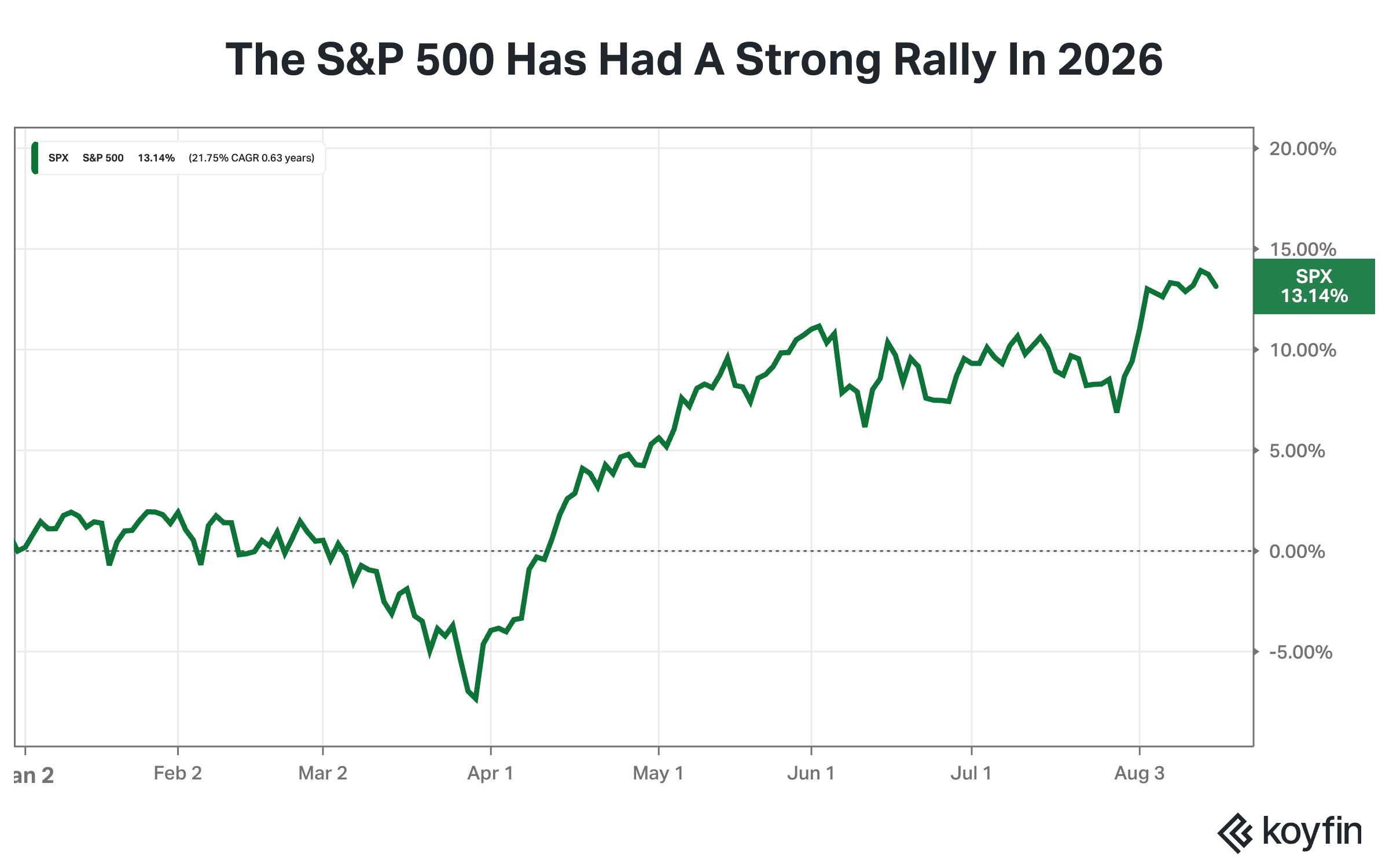
The S&P 500 is already up about 13% so far this year, sitting near record highs, but Wall Street’s latest calls suggest investors could be heading toward either another leg higher or a sharp bout of volatility. Evercore ISI believes the rally is far from over. But this call comes as other market watchers are highlighting increasingly uncomfortable risks.
Billionaire investor Ray Dalio compared the current AI-fueled market momentum to bubbles preceding the 1929 crash and the 2000 dot-com bust. Meanwhile, BTIG analysts warned that August through October has historically been a weak period for U.S. stocks in midterm election years.
So where is Wall Street headed from here? Is the S&P 500 still in the early stages of an AI-driven bull market or is the rally becoming vulnerable to a pullback?
S&P 500’s 9,000 Bull Case
According to a report from CNBC, analyst Julian Emanuel believes the benchmark index has potential to run to 9,000 in the next 12 months. On Monday, the index closed at 7,745.06, which implies an upside of nearly 17%. Emanuel’s base case for the index is 7,750.
Wall Street’s broader 2026 forecasts have also moved higher following stronger earnings expectations. Citi currently has a year-end target of 8,100, while Yardeni Research sees 8,400 for the S&P 500.
| Analyst | S&P 500 Target For 2026 | Upside/ Downside From Current Level |
| Bank of America | 7,100 | -8.33% |
| Citi | 8,100 | 4.58% |
| U.S. Bank Asset Management Group | 8,040 | 3.81% |
| JPMorgan | 8,000 | 3.29% |
| Yardeni Research | 8,400 | 8.46% |
What Could Drive The S&P 500 Higher?
Emanuel believes the long-term trend for the stock market remains higher amid potential Fear of Missing Out (FOMO) sentiment. “SPX 9,000 attainable in next 12 months,” the Evercore ISI strategist reportedly wrote in a note to clients Sunday.
“The traditional elements that end a Bull Market are not evident – recession, spiking long end yields, profound investor and/or capital markets FOMO,” he added.
The analyst also said that in contrast to the run-up ahead of the dotcom bubble bursting, investors are now far more diversified.
“Having learned the lessons of Y2K, investors have sought diversification even as the Indices hit new highs,” he reportedly said. “The 2020′s AI Bull has yet to reach the heights and length of the innovation-driven Bulls of the 1990s and 1920s, while overall corporate leverage remains subdued, underscoring potential for further upside – and FOMO fueled by investors' preference for equities and appetite for Call options, Until It Isn’t.”
Billionaire Investor Warns Of 1929, 2000 Bubble Similarities
Meanwhile, Ray Dalio, the billionaire investor and founder of Bridgewater Associates who anticipated the 2008 financial crisis, warned of “classic signs” of an AI bubble on The Diary of a CEO podcast last month.
Dalio said today’s artificial intelligence boom has parallels with the bubbles of 1929 and 2000, when transformative technologies generated enormous excitement, but investors became so convinced of their potential that they lost sight of valuations.
“They don’t pay attention to the price,” he said, arguing that borrowing and leverage can amplify gains on the way up and forced selling on the way down. Dalio stressed that he remains highly bullish on AI’s technological potential, but said the technology’s promise does not justify any price.
He argued that paper wealth is growing much faster than the actual flow of money in the financial system, creating a fragile market structure. If investors suddenly need liquidity, they may be forced to sell assets, potentially triggering a broader selloff.
The concern, he says, is not that AI will fail to deliver meaningful productivity gains, but that AI stocks priced for extremely high growth could face sharp corrections if earnings fall short of expectations or financial conditions tighten.
“The bubble I should emphasize, it’s not a ‘you’re in a bubble or you’re not in a bubble.’ It’s a degree thing,” he said.
AI Stocks Are Already Outperforming
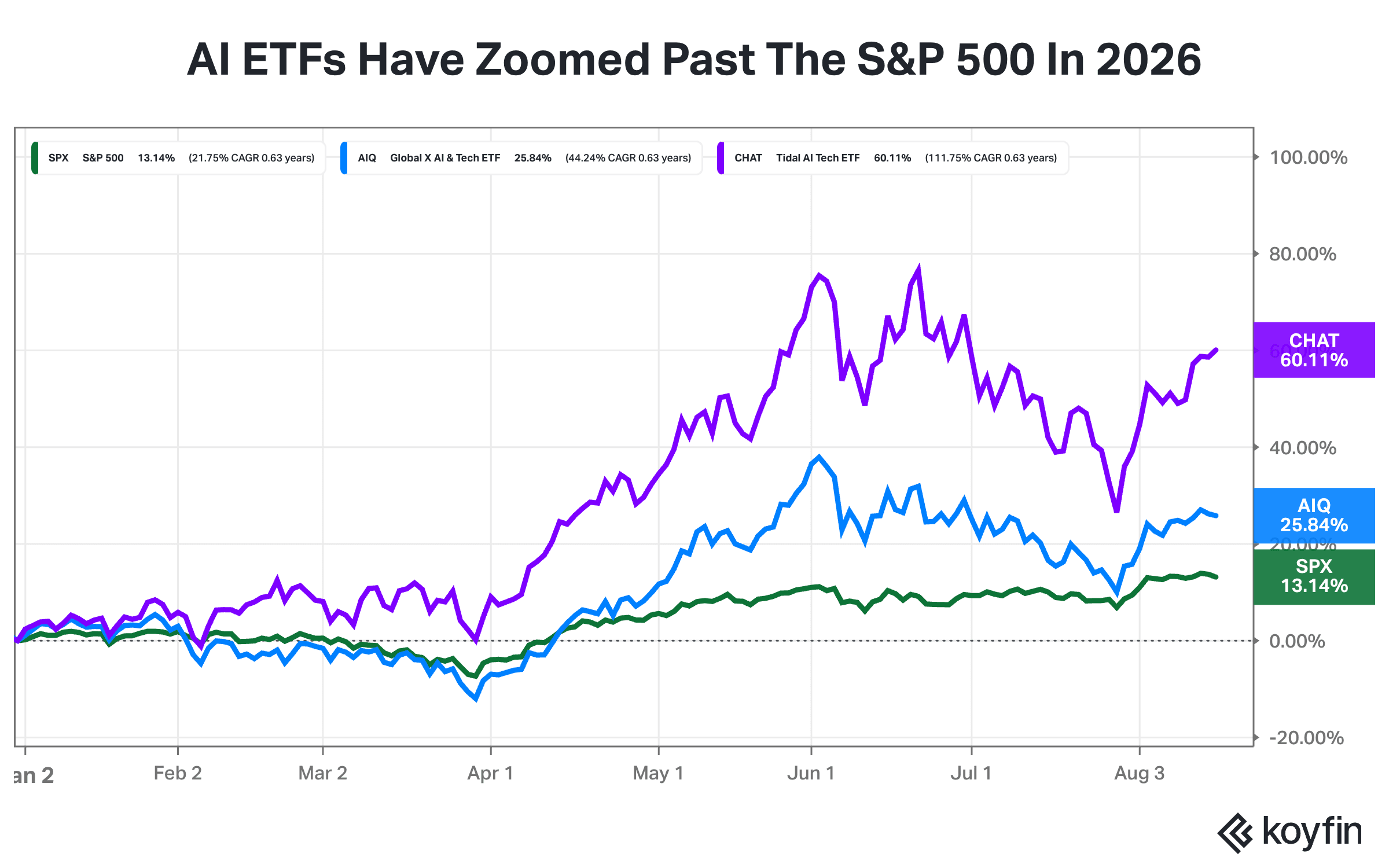
The Global X Artificial Intelligence and Technology ETF (AIQ) and the Roundhill Generative AI & Technology ETF (CHAT) have outperformed the S&P 500 this year by a wide margin. AIQ has risen nearly 26%, while CHAT has jumped over 60%.
BTIG Sees Seasonal Weakness Ahead For US Markets
According to a report from Investing.com, BTIG is warning that U.S. equities may be entering a historically weak stretch, particularly ahead of the midterm election years.
Despite its rally, the firm noted that the S&P 500 index has historically suffered at least a 7% pullback between August and October in most midterm years since 1990.
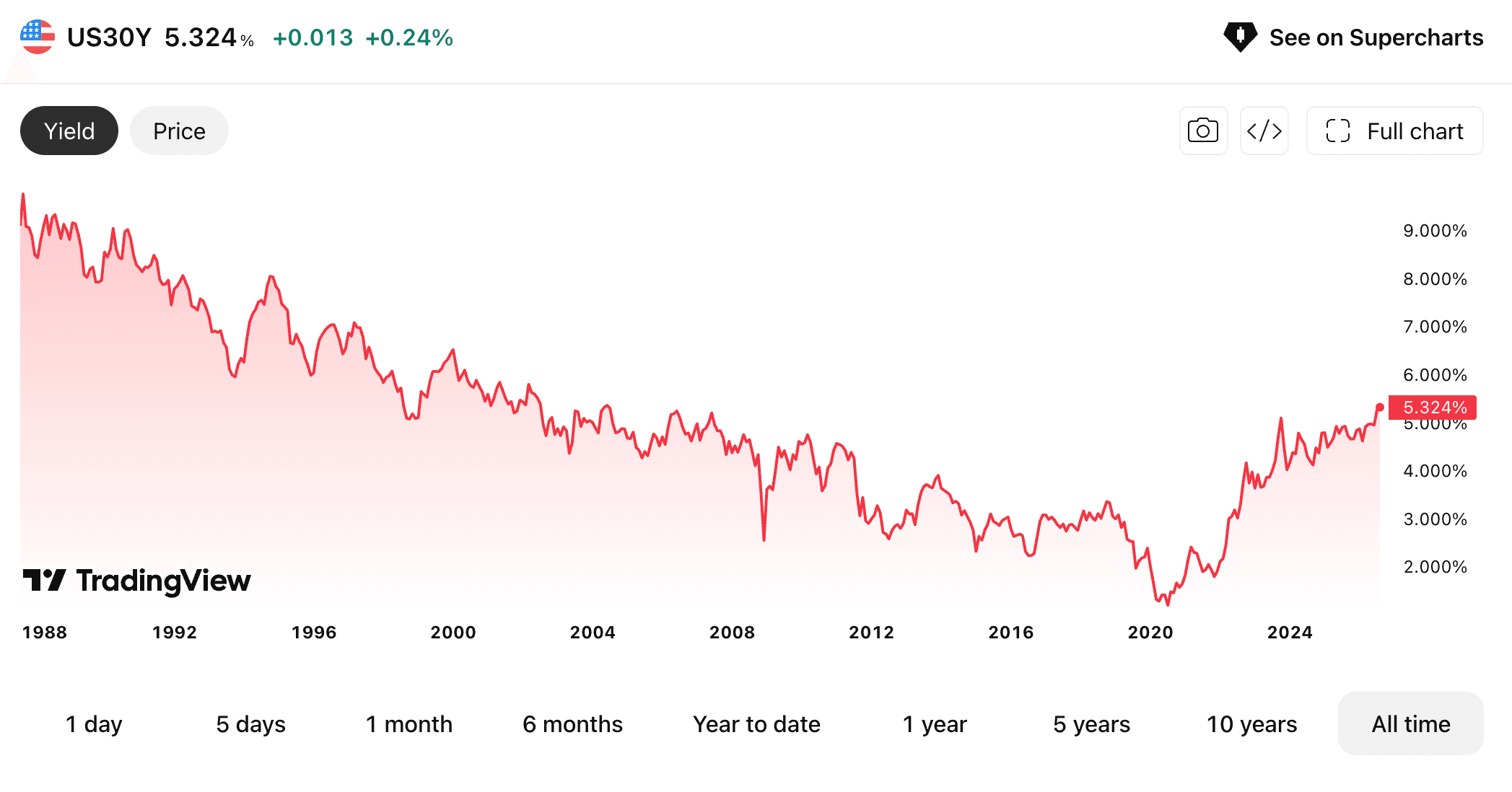
BTIG also highlighted elevated long-term Treasury yields and the lack of a meaningful pullback since March as signs of stretched conditions.
Rising oil prices have pressured the U.S. 30-year Treasury yield to 5.32%, its highest level in nearly two decades, while the 10-year Treasury was at 4.74% at the time of writing, hovering near June 2025 levels.
BTIG said that it recommends reducing risk or hedging broad equity exposure, adding that the healthcare sector has historically been among the stronger-performing sectors during this period, while semiconductors have shown technical weakness.
What Wall Street Expects For S&P 500 In 2026
Wall Street is split on the S&P 500’s 2026 outlook as the index trades near record highs.
Bank of America has the most bearish view among the forecasts, targeting 7,100 and warning that seven of its 10 bear-market indicators have been triggered, alongside extreme tech concentration.
On the bullish side, Citi raised its year-end target to 8,100 from 7,700, expecting S&P 500 earnings per share of $350 this year and $400 in 2027 as AI spending supports earnings. U.S. Bank Asset Management Group also raised its target to 8,040, citing resilient consumers, reasonable valuations and AI-led economic activity.
JPMorgan has assigned a target of 8,000, while Yardeni Research sees 8,400.
Retail View On S&P 500
On Stocktwits, retail sentiment around the SPDR S&P 500 ETF Trust (SPY), which tracks the S&P 500 index, was ‘neutral’ at the time of writing, having slipped from the ‘bullish’ zone.
One user said, “$SPY $QQQ 30% correction at a minimum in the near future. The bond market knows the truth. The Fed has zero good options. They played this stupid game for far too long.”
Another user said, “$SPY $QQQ US 10 year yield is right now 4.74%. And keeps climbing. US 30 year yield is spiking. There's no stopping the yields rallying.”
Meanwhile, retail sentiment on iShares Core S&P 500 ETF (IVV) was ‘bullish’ at the time of writing.
For updates and corrections, email newsroom[at]stocktwits[dot]com.<
