
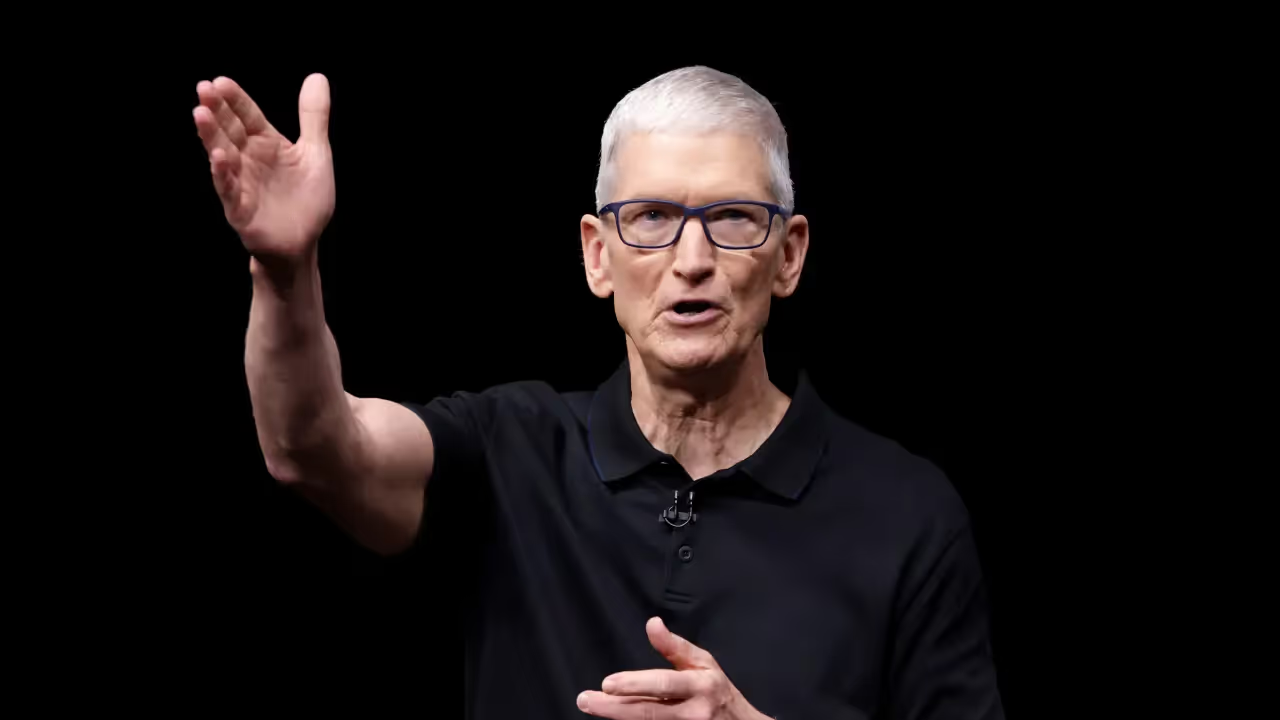
Nike has been trying to right its playbook, and for that, it has had consistent support from Cook, someone who has been around to see the company fall and pick itself up again.
- On Tuesday, Cook made an open-market purchase of about $3 million worth of the company’s stock.
- Cook’s move comes during the turnaround under new CEO Elliott Hill, who has reverted the focus to wholesale partnerships.
- Nike said that wholesale has returned to growth globally, with a growing order book globally in both spring and summer.
Nike’s past few years have been anything but smooth. Leadership changes, a broad management reset, bloated inventories, and an overdue push back toward product innovation have forced the sportswear giant into a prolonged reset. The turnaround has been slow, uneven, and often under the market’s unforgiving spotlight.
Yet through the turbulence, some constants have stood out. Apart from founder Phil Knight, Nike has had a steadfast supporter in an unlikely place: Apple CEO Tim Cook. Time and again, through strategic shifts, market skepticism, and operational missteps, Cook has publicly and privately reinforced his confidence in Nike, lending credibility at moments when the brand needed it most.
Cook has been on Nike’s board since 2005, long before inheriting the role of Apple CEO from Steve Jobs. He is known to have worn Nike’s shoes at Apple’s events and was also one of the directors who backed Elliott Hill's taking the role of CEO.
And on Tuesday, his long-standing relationship with Nike was amplified when Cook made an open-market purchase of about $3 million worth of the company’s stock. Nike said Cook bought 50,000 shares of Class B common stock on Monday at a weighted-average price of $58.97, for a total of about $2.95 million. The company added that he currently owned 105,480 shares directly.
In the last few years, Cook has been around while Nike’s shares have lost significant value, but the company is seeing a turnaround take shape slowly. He has witnessed Nike, now in the “middle innings,” as Hill said recently, achieve its goals of bringing the company out of its struggling era.
Reduction In Inventory
The company has undertaken an initiative to reduce its inventory, mainly by cutting excess production of Air Jordans and Air Force 1s, which has led Nike to bleed. This December, Nike said that inventory is in a healthy, clean position in North America and Europe, the Middle East, and Africa. “Inventory decreased 3% versus the prior year, with units down high single digits. In North America and EMEA, which represent almost three-quarters of our business, we have returned to a healthy marketplace,” CFO Matthew Friend said on a post-earnings call.
In December 2023, Nike noted the need to cut the supply of some of its iconic products while boosting newer models and building on demand in the running and performance category, where Hoka and On Holding were nibbling at its market share.
Apple And Nike Under Cook’s Influence
Cook’s presence on Nike’s board has quietly deepened one of Silicon Valley’s most sporty brand alliances. Over the years, Nike and Apple have woven their collaboration into the Apple Watch ecosystem.
Nike has developed exclusive Apple Watch bands that carry design cues and patterns distinct to the partnership, reinforcing the device’s positioning as both a fitness tool and a lifestyle accessory. On the software side, the Nike Run Club app has turned the Apple Watch into a coach, training partner, and running journal all in one.
The relationship has also extended beyond hardware and fitness. In 2022, reports emerged that Apple and Nike were teaming up to produce sports-focused films for Apple TV+, signaling a broader ambition to tell athlete-led stories across screens.
Cook Witnesses 3 CEO Changes At Nike
When Cook became a member of Nike’s board, the company was under the leadership of William D. Perez, the first outsider CEO after founder Phil Knight decided to step back and remain Chairman Emeritus.
But within a year as a board member, Cook saw Nike name Mark Parker as the head, who led the sportswear giant for nearly 14 years and scaled the company to greater heights, mainly the Air franchise.
Sometime in 2018, Parker came under the radar, reportedly following the departure of brand president Trevor Edwards and claims of a toxic work culture at the company.
Following Parker, John Donahoe was named CEO in 2020 and led the company through the pandemic, pushing for more direct-to-consumer sales. This strategy started to put Nike on the red and led to its eventual departure in 2024.
With backing from founder Phil Knight and board recommendations, including Cook's, Nike veteran Hill was named CEO. He has since then reverted to building wholesale relationships and boosting innovation.
Nike’s Top Shareholders
According to data from Koyfin, Vanguard Group is Nike’s top shareholder with a 7.8% stake in the sportswear company. BlackRock closely follows it, with 6.23% as of Sept. 30. Knight & family still own 21% of Nike, according to Forbes. A filing from fiscal 2024 showed that the Class A Stock is currently primarily held by Swoosh, LLC, an entity formed by Phil Knight in 2015 to retain the majority of his shares.
How Are Stocktwits Users Reacting?
Retail sentiment on Nike jumped to ‘extremely bullish’ from ‘bearish’ a month ago, with message volumes at ‘extremely high’ levels, according to data from Stocktwits.
The retail user message count on Nike has jumped over 120% in the last year, and the stock has seen about 9% of Stocktwits users add it to their watchlist.
Shares of Nike have lost a quarter of their value so far this year.
For updates and corrections, email newsroom[at]stocktwits[dot]com.<
