

Valens is extending its MIPI A-PHY technology toward mainstream automotive cameras through an onsemi collaboration aimed at lowering component count and simplifying vehicle camera designs.
- Valens and onsemi plan a cost-optimized integrated sensor for high-volume 3MP automotive cameras.
- The 3MP offering targets a broad market, with Valens saying most automotive image sensors sit in the 1MP–3MP range.
- The collaboration supports Valens' broader effort to drive commercial adoption of MIPI A-PHY.
Valens Semiconductor (VLN) shares jumped about 8% in premarket trading Monday after the company announced a collaboration with onsemi (ON) to develop a cost-optimized integrated sensor based on the MIPI A-PHY standard for high-volume 3-megapixel automotive camera applications.
Under the agreement, Valens will work with onsemi on an A-PHY-based solution, a technology used to carry high-speed data from vehicle cameras and sensors, that can be built directly into onsemi’s image sensors.
This could reduce the number of separate components needed and make it easier for automakers and their major component suppliers, known as Tier-1 suppliers, to adopt the technology.
At the time of this writing, VLN stock was up around 8% in premarket trade and ON stock was trading marginally in the green.
Valens Targets Mainstream Auto Cameras
The collaboration aims to simplify automotive camera designs. Onsemi said integrating the technology could create a more streamlined camera architecture by reducing component count while supporting an industry-standard connectivity interface.
That matters because Valens is not targeting only high-end camera systems with the new offering. The company said a majority of automotive image sensors currently target the 1MP–3MP range. A 3MP solution therefore addresses both an established high-volume market and automakers upgrading toward higher-resolution cameras.
Valens CEO Yoram Salinger called the agreement a “major milestone” for the company and the MIPI A-PHY ecosystem, saying the cost-optimized product could extend A-PHY into a wider range of applications. He also highlighted the addition of onsemi, itself an A-PHY silicon supplier, as a way of giving automakers greater supplier choice around the industry standard.
Valens’ Automotive Business Heads Toward 2027 Ramp
The latest collaboration adds to Valens' broader effort to build commercial adoption around MIPI A-PHY, the automotive industry's first standardized solution for high-speed sensor connectivity. Valens says it was the first company to bring compliant chipsets to market and has already secured design wins with multiple automakers.
In its fiscal second-quarter (Q2) results, Valens said all four of its automotive design-win programs were progressing toward production, with revenue expected to begin ramping in 2027. Automotive revenue reached $5.0 million in the quarter, up from $4.3 million a year earlier, though below $5.9 million in the prior quarter.
Overall Q2 revenue rose to $18.1 million from $17.1 million a year earlier, exceeding the company's guidance. Valens subsequently raised its full-year 2026 revenue forecast to between $78 million and $81 million.
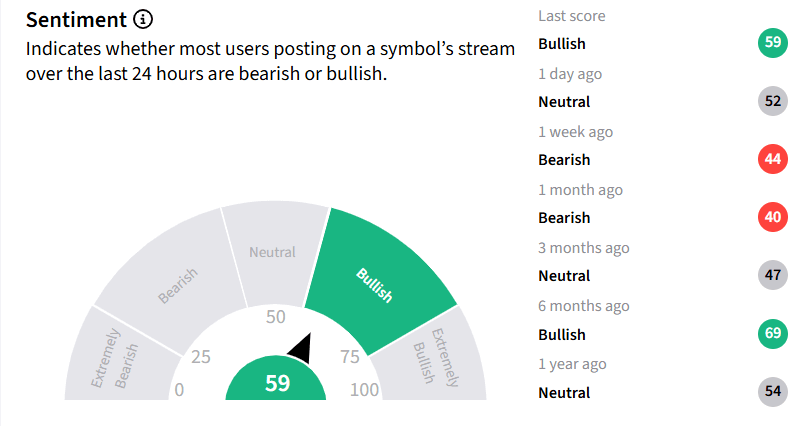
Retail Sentiment Around VLN Stock
Retail sentiment around Valens turned ‘bullish’ on Stocktwits.
So far this year, VLN stock has risen more than 13%. In comparison, Cathie Wood’s Ark Israel Innovative Technology ETF (IZRL), which holds the stock, has fallen more than 3% over the same period.
See Also: Beyond Meta, Cathie Wood’s ARKG Loads Up On These 4 Biotech Names
For updates and corrections, email newsroom[at]stocktwits[dot]com.<
